by Gordon Taylor | 10/01/2009 01:34:00 AM

The following article was written by Mizgin Yilmaz, proprietor of Rasti. Mizgin virtually always writes in a state of high dudgeon, and she is virtually always justified in doing so. Such is the case this time. Note: be sure to check out the links she has posted. They are highly instructive. Again, this is a state which expects to be part of the European Union.

[TSK is the Turkish Armed Forces. OHAL refers to the emergency martial-law regime in the Kurdish southeast of Turkey.]

Cross-posted at The Pasha and The Gypsy and Progressive Historians.

THE STATE OF INJUSTICE

"A kingdom founded on injustice never lasts."
~ Lucius Annaeus Seneca.


Picture this: A seventeen-year-old guy picks up his seventeen-year-old girlfriend after school and takes her to his family's large home. The guy kills the girl, decapitates her with a saw and chops up her body, stuffs the body parts into a suitcase and guitar case, gets a driver to take him to a dumpster on the other side of town and disposes of the body.

The guy's father is picked up by the police on charges of abetting the crime and the mother flees the country.

Six months after the murder, the guy turns himself in to the police.

What do you think should happen to a guy like this? Would it make any difference if you knew that the murderer was a member of one of the richest families in the country?

If this story plays out in Turkey, which it did, the murderer will be charged in juvenile court--because he's only seventeen--instead of being tried as an adult.

More on the murder at Zaman and another at Bianet. Note that the first of those articles claims the father of the murdered girl is quoted as thanking the police and government for helping to capture the murderer. However, that's not at all the same guy who was on NTV on the day of the surrender, yelling to know what kind of deal had been made between the government and the very rich kid's family.

On the other hand, if you're a ten-year-old kid growing up in another part of the country, in a family that was probably forcibly displaced from their home back in the 1990s, and you're a Kurd, you're going to get very different treatment from the state:


In Adana alone, some 155 children are facing trial, 67 have been convicted and five have begun to serve their sentences, says Ethem Acikalin, head of the local branch of Turkey’s Human Rights Association. All were charged under article 220/6 of the penal code, which criminalises “acting on behalf of a terrorist organisation”. The cases are tried in adult courts.


Or then there was Cizre:


If Turkish prosecutors have their way, Yilmaz, a soft-spoken 16-year-old with a teenager’s pimply face, could spend up to seven years in jail for having joined a demonstration early last year in the town of Cizre, in Turkey’s predominantly Kurdish southeast.

Yilmaz (the name has been changed to protect his identity) has already spent 13 months in jail awaiting trial, although he was recently let out on bail. Although he joined a demonstration that took place after the funeral of a young boy who had been run over by a police armored vehicle during an earlier protest, prosecutors say the event was organized by the outlawed Kurdistan Workers’ Party (PKK) and are charging the boy with supporting a terrorist organization.

"In each appearance in court, we were telling the prosecutors that we are children, that they should let us go back to our lives," says Yilmaz.

Yilmaz is one of hundreds of minors, some as young as 13, who have been arrested and jailed in Turkey over the last few years under strict new anti-terrorism laws that allow for juveniles to be tried as adults. Some have even been accused of "committing crimes in the name of a terrorist organization" for participating in demonstrations that prosecutors charge have been organized the PKK.


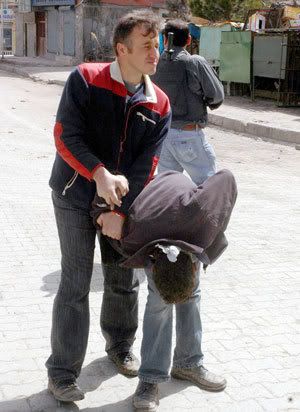
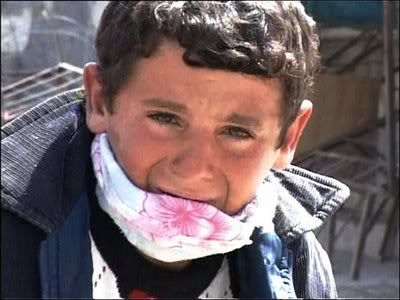
If you're the police and you torture a Kurdish kid in broad daylight, in front of media cameras, then have no fear! Your case will be dropped.

Then there are the activities of the ironically-named "Children's Day" in Hakkari.

Or, as happened several days ago, if you're a fourteen-year-old Kurdish girl gathering feed for her sheep, you can just be blown to bits by TSK mortar fire. At least Ceylan's mother was able to pick
up the pieces of her daughter that were left so that they could be buried. The cover-up is already ongoing because no prosecutor arrived at the scene of the crime and he cites "security zone" (i.e. OHAL) as the reason for helping TSK to cover up its murder of this Kurdish child.

Labels: , , ,

 
by Gordon Taylor | 4/09/2009 03:34:00 AM


One treads carefully in the Turkish presence. Turkey is no joke.
--Jan Morris

It's a tough crowd, the Turkish parliament. Say the wrong thing and you'll quickly discover the disadvantages of growing a mustache. The above photograph was taken 21 December 2008 after a Kurdish deputy of the Democratic Society Party (DTP) got up and told his fellow MPs that it was high time for Turkey to face up to the Armenian Genocide of 1915. As a Kurd, of course, he had his motives for this deliberate provocation: he knew that until the Turks confronted the truth about 1915, they would never recognize reality about the Kurds. It was a gutsy move. He, his DTP party colleagues, and millions of other people are still waiting for something other than a fist in the face.

On April 6, in Ankara, Barack Obama faced the same uncertainties. You could see it on the videos: the tiniest dent in that iron assurance we have come to expect of him. Perhaps it was because Michelle, his partner in world conquest, had left him to be with their daughters back home. In any case, he seemed slightly hesitant as he spoke to the Turkish parliament. "Who are these people?" one can almost hear him thinking; or, perhaps he was mesmerized by the sight of all those mustaches. This was not an easy crowd, nothing like those cheerful Europeans in Prague and London, delirious at having found a U.S. President who actually seemed to have a brain in his head. Most of Obama's Ankara speech, said reports, was greeted with silence.


But, to begin with a generalization, it was as good a speech as one could expect, given the occasion. In it nuance, nonsense, diplomacy, and willful disregard of reality found equal expression. Someone from the military-industrial-diplomatic complex worked hard on this text, and it showed.

First, the nonsense. Those who take a jaundiced view of Turkish nationalism can find plenty of it in Obama's words. He began his speech with the usual--a homage to Ataturk, the Republic's founder--by referring to the morning's signal event, the requisite wreath-laying at Fred's tomb. Here his restraint was admirable. At no point did Obama point out the absurdity of a free and quasi-democratic people, a NATO member and EU-aspirant, bowing and scraping before a personality cult that rivals that of Kim il-Sung.

Obama then moved on to the main event: friendly persuasion and flattery. There were references to Turkey's democracy, a dubious concept, as well as to the friendship between our two peoples--which really is a lie, since I doubt that more than five Americans out of a hundred could find Turkey on a map. (Hell, they can't even find their own country!) Here the message was, Let's Cooperate. The two nations, he said, were working together for peace and prosperity, as was appropriate. Obama affirmed U.S. support for Turkey's EU candidacy. (Which he can do because he knows that France and Germany will have the guts to tell them No.) Cliches like Resolute Ally, Responsible Partner, and Bridges Over the Bosphorus were given the requisite airing. Two Turkish basketball players were duly noted. Obama praised the Turks for their progress (non-existent) on penal code reform, as well as for their establishment (scorned by most Kurds) of a TV station broadcasting in Kurdish. This is where it began to get interesting:
These achievements have created new laws that must be implemented, and a momentum that should be sustained. For democracies cannot be static: they must move forward.
In other words, We know that you've passed a few laws. But you have to make them work; otherwise it's just an empty form. (Which is the game, Turkey-watchers know, that the Turks have always played.)
Freedom of religion and expression lead to a strong and vibrant civil society that only strengthens the state, which is why steps like reopening the Halki Seminary will send such an important signal inside Turkey and beyond. An enduring commitment to the rule of law is the only way to achieve the security that comes from justice for all people. Robust minority rights let societies benefit from the full measure of contributions from all citizens.
Note: "a strong and vibrant civil society that only strengthens the state." This is the toughest sell of all, the idea that the freedoms Turkish officials fear so greatly could actually strengthen their beloved, all-important Turkish State. This is the heart of the matter. And the Halki Seminary? It's an interesting gambit, a reference to a long-closed seminary near Istanbul which the Greek Orthodox Patriarchate desperately needs to have reopened if it is going to sustain itself in its ancient home. If you really become a democracy, Obama is arguing, you become stronger. And upholding minority rights is the key.
I say this as the President of a country that not too long ago made it hard for someone who looks like me to vote. But it is precisely that capacity to change that enriches our countries. Every challenge that we face is more easily met if we tend to our own democratic foundation.
Note: "that enriches our countries"; using the language of inclusion to cajole the listeners into going along. Obama then moved on to admission of past American sins, like slavery, in order to slide into that most treacherous of quicksands, the Turkish treatment of Armenians.
Human endeavor is by its nature imperfect. History, unresolved, can be a heavy weight. Each country must work through its past. And reckoning with the past can help us seize a better future. I know there are strong views in this chamber about the terrible events of 1915. While there has been a good deal of commentary about my views, this is really about how the Turkish and Armenian people deal with the past. And the best way forward for the Turkish and Armenian people is a process that works through the past in a way that is honest, open and constructive.
No one, I submit, is ever going to make a more diplomatic, nuanced statement about this subject. With this Obama and his speechwriters have slipped through a narrow opening indeed. If the "full and frank exchange of views" of diplomatic doublespeak were taken literally, a visitor might have said, "Grow up, people, and stop being afraid. Yes, the murderers of a million Armenians were your ancestors, but the ordinary Turks who worked to save their Armenian neighbors were also your ancestors, as were the army units which refused to participate, and the Ottoman generals and officials who refused to go along. Ataturk himself called it a 'shameful act.' So what is your problem?" Obama would never have said such a thing, but for what he did say he deserves credit.

So for the Greek patriarchate and the Armenian Genocide, two touchy subjects, we can give Obama decent marks. He went on to make a statement which was, for America's tone-deaf news media, a big deal: "[T]he United States is not at war with Islam." And he made a pitch for Turkey's cooperation in Iraq and Afghanistan. But for Turkey's biggest problem, the Kurds, Obama was as silent as a Turk at Easter. True, he had declared himself in favor of "robust minority rights." But in a Turkey defined by the Lausanne Treaty of 1923, "minority" does not apply to the Kurds. Unlike Jews, Greeks, and Armenians, 15 million Kurds do not have official "minority" status in Turkey. They are full-fledged citizens, indigenous residents of Anatolia for thousands of years, who have a culture and language that has never been recognized by the Turkish Republic.

In a short meeting with Ahmet Turk, vice-chairman of the DTP and the "grand old man" of Kurdish politics in Turkey, Obama expressed "sympathy" for the Kurds but said what he had to say, that violence was not a solution for the Kurdish problem. As he said this, Turkey's Kurdish provinces were still reeling from the latest outbreaks of police violence, which left two Kurds dead and a Kurdish female deputy of the DTP injured after being beaten by the state's "security forces." Despite these almost daily reports, it is still official U.S. policy that the PKK, which has made repeated offers of negotiation, is a "terrorist group"; and the Turkish government, which rarely sees a head that doesn't deserve beating or an F-16 that isn't worth buying, is a beacon for democracy in the Middle East.

So nothing really has changed. Obama's speech made some intriguing gambits, and the symbolism of meeting with Kurdish MPs, a group that has been shunned up to now, will no doubt resonate; but without straight talk and an abandonment of the lavish armaments contracts that are the true core of Turkish-American relations, nothing ever will change. Like a baby in an iron womb, Turkish democracy has gestated for decades without hope of accouchement. Turkey's governance has always had one goal: to maintain the state and its power. And the pattern continues. For the sake of the all-important State, political parties have been closed, papers shut down, reporters imprisoned, YouTube prohibited, websites darkened, letters of the alphabet proscribed, and thought crimes punished. While murderers of liberals and ethnic minorities, caught red-handed, go unpunished, people who speak the simplest truths are arraigned and convicted within weeks. Inquiries into the most blatant thuggery drag on, without resolution, for years. Judges render verdicts that defy common sense, then retire to drink tea out of tulip-shaped glasses.

And so it goes.

Cross-posted at The Pasha and the Gypsy.

Labels: , , , ,

 
by Gordon Taylor | 4/17/2008 07:30:00 PM

I didn't want to publish it at first. I was, frankly, being too sensitive. But by now the image has been all over the world: and who am I to hide from reality? Demonstrators in virtually every European nation have put this photo on banners or in websites by the score, and the nondescript name "Cuneyt Ertus" (joo-nate air-toosh) now gets Google hits in the thousands. The boy has been discharged from prison, and the pro-Kurdish/pro-PKK news services have all published interviews with him. His experience is exactly as one would have expected -- fear,confusion, brutality, and pain -- but it bears repeating. And still there is no one in the mainstream Turkish or American media that has paid the least attention.


The most extensive interview is here, with a photo of "C.E." (his face obscured) and his father Hussein. Cuneyt, who still cannot use his right arm, showed great emotion as he recounted the events. "On March 22," said Cuneyt, "I went down to the market. I didn't know that Newroz events were going on, and I found myself in all this confusion. The police came right to me and collared me. Three policemen. Then they started manhandling me. First they twisted my arm. My arm went out of place [dislocated]. Then they took me to the Emniyet headquarters in a police vehicle. In the van they continued beating me; 3 or 4 of us were riding together. Inside the vehicle they called us "kufur" [infidels: an insult] and continued to hit us." At the station, Cuneyt recounts, the beating continued with kicks and truncheons aimed at the genitals.

And so it continued. At the station, for hours, the detainees were all kicked, beaten, and insulted. "Apo's [Abdullah Ocalan's] bastards" was one of the more choice insults, along with the opinion that they were no better than "filthy infidels." After the first day's interrogation Cuneyt was let go. "I couldn't sleep," he said, "from the pain in my arm." The very next day, however, while in the center of town again [For God's sake, Cuneyt, why did you go there?--g.t.], Cuneyt was again arrested, taken to the Emniyet and beaten. "They showed us their guns. Then before our eyes, they took the bullets out of their magazines, put them between the fingers of our hands, and then crushed our hands around them. That was extremely painful." From the Hakkari Emniyet, Cuneyt was transported to a prison in Bitlis, a city many miles away. Still he could not escape the beatings. His dislocated arm kept him in excruciating pain. No one was allowed to see him, neither aid workers nor his family nor lawyers. His fellow prisoners, he says, could see what pain he was in and tried to help him, but they could do nothing to stop it. Meanwhile, the casual beatings continued. "In prison from time to time they would let us out into the fresh air. Both going out and coming in they would hit us," Cuneyt says. "They treated us like animals."

While very happy to be reunited with his son, Huseyin Ertus is, as one might expect, outraged at the treatment he received. "My son is very young," Huseyin noted, "and he committed no crime at all. And yet, in plain view of everyone, they turned him around and broke his arm. This is a disgrace to humanity...There is no excuse for it at all." Cuneyt's father, meanwhile, is quite worried about the injuries he has received. He will be searching for treatment. In the published photographs Cuneyt is shown with no cast, sling, or bandages of any kind on his arm. "My humanity," said Huseyin Ertus, "tells me that no one should have to go through this kind of pain."

The facts are plain for all to see, yet of course the Turkish government will deny them, if they even deign to acknowledge the case. As for the U.S. government, we know them well enough. Turkey, after all, is "a vital partner in the War Against Terror."


Labels: , , , , ,

 
by Gordon Taylor | 4/13/2008 10:53:00 PM
There's always news from Turkey, where repression bears down, emotions run hot, and something is always boiling over. (Rather like the rest of Planet Earth, but at a greater concentration.)


First, there is information about Cuneyt Ertus, the 15-year-old boy whose arm was mangled on-camera by a security agent during recent Newroz demonstrations. After his arrest in Hakkari, the boy was taken to prison in Bitlis, many miles away and a long day's drive for his parents and lawyers, at the west end of Lake Van. His case has only recently been adopted by Amnesty International, who urged members to write Turkish officials about him. Today Cuneyt was released, and after inspection at the State Hospital in Van he was allowed to go home to Hakkari. It remains to be seen what long-term injuries, if any, he sustained. We'll come back to this story if new information is posted.

Next there is pleasant news: not exciting, not troubling, just--nice. In the southeast, on the Iraqi border, the town of Silopi sits amid a triangle of land bounded by the Tigris on the west, the Khabur and Hezil rivers on the south and east, and to the north the mass of Cudi Dağı (pron. Judi Daah), a mountain about which I have written before. The Khabur River provides the town's biggest source of income, for on the north side of that stream sits the only border gate between Turkey and the Kurdish region of northern Iraq. Here the Turkish Army is massed in a threatening (and useless) array, and here the Iraq-bound trucks sit baking in the sun for days and weeks, in a line ten miles long. Between the trucks on one hand and Turkish tanks on the other, Silopi's people eke out a living.

This weekend Silopi is celebrating neither trucks nor rivers but their mountain. These people know the "genuine" landing-place of Noah's Ark, after all; it has been part of local tradition for thousands of years, long before a European traveler tagged the other, Armenian, mountain as the Biblical Ararat. And since they know the story, they are using this springtime of rising water in the Tigris to celebrate the second annual "Silopi Cudi Noah Culture and Arts Festival." Sporting the slogan, "Art Comes Alive with Cudi," the festival features visiting musicians, folk dancers, and art exhibits (including one at the local prison entitled "Freedom Behind Walls"), as well as plenty of mayors from nearby towns to shake hands, make speeches, and give it an official air. (Most of these politicians and artists, by the way, had to pass through military check-points in order to get there.) Give these people credit, folks. In the least likely of places, they are celebrating the life they have.

For other news, I'll first put in a link to Mizgin, who has her own post about America's "model democracy" for the Middle East. Of war and repression there is always news aplenty, and Cuneyt was not the only victim of Newroz violence. Yuksekova, another mountain town near the Iranian border, was rocked by the Newroz events. Two people were shot to death by police during the week of demonstrations, and now a third, Fahrettin Sedar, 37, has died of bullet wounds in the hospital at Van. According to reports, over 600 vehicles accompanied his body on its return journey to Yuksekova, and 10,000 people walked with his family to the cemetery. The crowd shouted pro-PKK slogans and made repeated calls for revenge. One of the slogans, "Youth to Botan, Freedom to the Country" made reference to the mountain district where the PKK makes camp and fights a lot of its battles. (Bohtan [or Botan], a geographical area shared by Turkey and Iraq, was the emirate ruled by the Bedr Khan family, prominent figures in Kurdish nationalist history.)

Given this kind of anger, we can perhaps believe a PKK spokesman named Bozan Tekin, who, during a recent interview with Agence France-Presse, claimed that guerrilla ranks have now swollen to between eight and ten thousand fighters. [Same thing posted at Rasti.] Obviously there is no way to confirm this figure; however, I think it's significant that he made the boast at all. Previously the guerrillas have claimed about 5,000 soldiers. Even if we cut his estimate considerably we have to say that it jibes with recent PKK announcements which told of new graduating classes at their "military academy" in the mountains. This shows that the war is likely to get worse, not better. When PKK leader Abdullah Ocalan was captured in the late 1990s, an anonymous American diplomat was quoted as saying that, with his capture, "ninety percent of Turkey's excuses for not solving the Kurdish problem are now gone." That was almost ten years ago, and the PKK was on the ropes. Now the Turks have managed to build up the PKK's strength from nearly nothing to a reputed 10,000. Tebrik ederim, beyler. Many congratulations indeed.

The Turks' big offensive of late February to March had scarcely ended before new clashes were reported by both the Turkish Army and the PKK's website, and they have continued into April. I have no intention of rehashing press releases by either side, but what is remarkable is the geographical scope of the clashes: not only their number, but the widely separated places in which they have occurred. The PKK has claimed attacks in a swath of territory stretching from Hatay (formerly the Sanjak of Alexandretta), on the Mediterranean, to Mt. Ararat, on the Armenian and Iranian borders. The Besta Mts. clash (in Sirnak, just north of the Iraq border) seems to have been the biggest, with (says the PKK) twenty Turkish soldiers killed, one Cobra helicopter downed, and four PKK guerrillas (including photographer/filmmaker Halil Uysal) dead. Further north, in Tunceli (Dersim) province, the PKK reported an attack by one of their YJA-STAR units: in other words, girls in pony tails carrying Kalashnikovs and looking to blow your head off. (They will do it, too; but they will also die, as several have done already in 2008.) All this, as I've said, will get worse. One pro-PKK newspaper, Ozgur Gundem, is already reporting that a joint operation is being planned by the Turkish Army and Iran's Revolutionary Guards. Their aim: probably PKK and PAJK (anti-Iranian Kurds) installations in the region of Qandil Mountain. Such an operation, of course, will not succeed; it will, if anything, only succeed in killing more sheep and goats.

I'll close with links to three stories.

First, the horrific. The nude body of a young Italian artist, Pippa Bacca, was found this weekend in bushes near the town of Gebze, on the Sea of Marmara south of Istanbul. The details are too painful to recount. The mass-market daily Hurriyet proclaimed in a headline, We Are Ashamed! This BBC link tells her story. I will only say this: DO NOT HITCH-HIKE IN TURKEY. Do not do it. Turkish peasants are the kindest of people. Any village will take in a traveler and treat him as an honored guest. The Turkish transportation system has been designed to accomodate every class of passenger. It is easy to find cheap transport. Ordinary Turkish workers and peasants simply do not understand it when middle-class kids from rich western nations come to Turkey and beg for rides. Especially this would be true if they were girls dressed up in bridal gowns as a stunt. DO NOT HITCH-HIKE IN TURKEY. PAY THE FARE AND RIDE A BUS.

Next, from the Times of London, the story of Yakup Satar, a Crimean Tatar, aged 110, who was Turkey's last living soldier from the Great War. Now they are virtually all gone. Highly recommended.

And last, in a week which saw the death of that phoniest of heroes, Charlton Heston, we get the story of Ragip Zarakolu [also at Rasti], a Turkish publisher who has spent a lifetime making books and going to jail for having made them. I've said in past posts that if the Nobel Committee wanted to find qualified recipients for the Peace Prize, they could come to Turkey and find a dozen more qualified than Al Gore in less than a day. Ragip Bey is one of those people.

Labels: , , , ,

 
by Gordon Taylor | 3/30/2008 02:15:00 AM
About suffering they were never wrong,
The Old Masters: how well they understood
Its human position; how it takes place
While someone else is eating or opening a window or
just walking dully along;

~W.H.A., "Musee des Beaux Arts"

Once again, my apologies. You probably didn't enjoy your first "Day at the Office," and now here I am putting you through another. Never fear. I will be as gentle as possible. No self-righteous rhetoric. And no photos--links only. This isn't because I want to shield anyone else from unpleasantness. It's because I want to shield myself. I simply do not enjoy the sight of naked human suffering, especially that of a child, and I couldn't stand having the photographs in front of me as I wrote the piece.

And in spite of my revulsion, this will be a composed--though short--piece. For there is a lot for an historian to glean from this incident, concerning both the past and a very instructive present.


First, the incident itself. It evidently happened on March 22, the day after the equinox, when Newroz (New Year) would have been in full swing in all Kurdish cities. In Hakkari, a mountain town near the Iraqi and Iranian borders, the Turkish governor had banned celebrations. They happened anyway, and when the police attacked, violence ensued. As expected, there were plenty of Kurds on hand to voice their support for the PKK, which has been fighting against the Turkish government for about 25 years.

The first photograph tells you the facts. Note especially the satisfied look on the face of the Meatman [my own coinage, based on the Turkish MIT, or National Intelligence Organization, for whom he probably works]. This follows his previous expression, in the third of the series of photos I published yesterday, in which he looked like a man straining at the reluctant lid of a pickle jar. The second photo is the boy himself. His name is Cuneyt Ertuş (joo-nate air-toosh), and he is 15 years old. By God I hope he survives this and regains the use of his right arm. But as far as I can tell he is still in jail, and there's no telling what--if any--medical care he is getting. The incident took place right in front of representatives of the press (whether pro or amateur we can't tell), and both still photos and video have been published from several angles. Cuneyt may have been throwing rocks, or he may have just been in the wrong place at the wrong time. Nothing justifies what you see. He was taken in on a charge of "resisting an officer of the State," and no word was given about his medical treatment or the charges to either his family or to attorneys.

Cuneyt's father related his own story to DIHA, the Dicle Haber Ajansi (Tigris News Agency), a pro-Kurdish outlet which publishes in Turkish from Europe. Zubeyir Ertuş told DIHA that his son went on a shopping trip to the center of Hakkari (formerly Julamerk, or Colemerg), the capital city of Hakkari province, on March 22. After the events of that day he didn't hear from his son, and he thought that Cuneyt had been detained. "At last," he said, after two days of searching, "I found him on Roj-TV." If only he hadn't. Zubeyir: "The police were breaking my son's arm right in front of the representatives of the press. I looked away in horror. I didn't want to believe my eyes."

It's a wonder that he saw anything. For Roj-TV is not a Turkish channel. It is not an Iraqi channel. And it certainly is not Syrian or Iranian, two other dictatorships with sizable Kurdish minorities. Roj-TV is a Kurdish-owned satellite channel that broadcasts out of Denmark, and the Kurds of Turkey use satellite dishes in order to get it. During this year's Newroz festivities in Diyarbakir (permitted by the State), Roj-TV managed to broadcast the whole thing live--a first. This under the noses of the Turkish government, which is trying to shut them down. So far the Danish government has resisted. The Turks claim that Roj-TV is a terrorist organization. (But of course they do. If the Turks got a sunburn, they'd claim that ultraviolet rays were part of a terrorist plot.) The Danes have asked the Turkish government for more information, and in the meantime several Kurdish websites are gathering signatures to urge the Danish government to do the right thing. But if they don't, the Kurds will simply go elsewhere.

In the meantime, we have Zubeyir Ertuş and his son Cuneyt, who because of a satellite channel and the sharing of photos on the Internet, are suddenly not alone. In a past posting about the Turks' recent invasion of northern Iraq, I talked about another pro-PKK news outlet, Firat News, and the dozens of reports that they constantly get in detailing the movements of Turkish government forces. Here we see the same thing, as the Kurds have constructed their own "virtual Kurdistan" from the reports, videos, and digital photos of their own people.

Not that the father and son would really have been alone. For the family's surname, Ertuş, indicates a very strong attachment to the local population. It is a tribal name; in fact, it is the name of what was traditionally the biggest tribe in the Hakkari region and beyond. In old travel books about Kurdistan it is variously spelled: Ertoush, Hartoushi, Ertushi, etc. When Asahel Grant, M.D., of Utica and Waterville, NY, arrived in Julamerk in 1839, it was these same Ertushi Kurds and their emir, Nurullah, that he dealt with. The story remains unfinished. In the cities of Turkey's southeast, hundreds are wounded, or in jail, or both. Cuneyt's father, meanwhile, says, "My economic situation is not good. But I'm going to the bar association and I'm going to find a lawyer."


Labels: , , , , ,

 
by Gordon Taylor | 3/28/2008 11:05:00 AM
This post won't be a lot of fun. I apologize for that, and I apologize for the photograph which is visible when you click through to the rest of the story. There's no blood; rest assured that I haven't splashed gore across the pages of PH. However, it is disturbing. It's what we can call "a day at the office" for the hard-working men of MIT (pron. Meat), or Milli Istihbarat Teskilati: the National Intelligence Organization of Turkey. To see the video from which the overleaf pictures were taken, go to: http://www.youtube.com/watch?v=4ENIwySnfNM
For the ultimate heartbreak, to see the face of the boy himself, go to Mizgin's blog.


Photobucket

OK, here we are. I got this on the front page of Yeni Ozgur Politika, a left-wing Turkish- and Kurdish-language paper that is based in Europe. The headline says, "Adini Siz Koyun!" which means, by my translation, "You name him!" In other words, they want to know the name of this policeman, and his companions. On the actual front page of the paper, larger images of the three policemen's faces were posted.

These frames are from video taken on the streets of Hakkari, capital of the province of the same name, in southeast Turkey, during the recent Newroz (New Year) demonstrations. Obviously they turned ugly. If you look in the background, especially of picture #4, you can see in the distance the rocky, snowclad slopes of Sumbul (Hyacinth) Mountain, whose 12,000-foot summit towers over the town. But of course, you're not looking at the mountain, you're looking at a plainclothesman from the Turkish secret police giving us a demonstration of how to break a 15-year-old boy's arm. Let's not dwell on it. Every once in a while historians must confront everyday reality, and this is it. I am not one to use red-flag words idly; in fact, I despise the debasement of language that results when pejorative labels are endlessly purveyed in contexts that do not warrant them. This, however, is a case where the "F" word is fully justified. This is fascist thuggery, pure and simple.

For a more complete rundown on recent events, see the following article from the Eurasia Daily Monitor, a feature of the Jamestown Foundation's website:


KURDISH DEMONSTRATORS CLASH WITH TURKISH SECURITY FORCES DURING NEWROZ

By Gareth Jenkins

Tuesday, March 25, 2008


Over a period of four days from March 21-24, two people were killed and several hundred injured in clashes with Turkish security forces, as hundreds of thousands of Kurds took the streets to celebrate the Kurdish New Year of Newroz. No reliable figures are available for the number of demonstrators detained by the security forces, although Turkish media reports suggest that several hundred were taken into custody (Hurriyet, Radikal, Cumhuriyet, Milliyet, Yeni Safak, NTV, CNNTurk, March 22-24).

Newroz is not an exclusively Kurdish holiday. It is celebrated on March 21 each year from the Balkans through the Caucasus and Iran and across Asia into northern China. However, during the late 1980s and early 1990s, Newroz celebrations were banned in Turkey on the grounds that they encouraged Kurdish separatism. Attempts to mark the holiday were broken up, usually violently, by the security forces. In 1992 over 60 people were believed to have died in clashes with the Turkish security forces during Newroz celebrations.

The situation changed in 1995 when the Turkish authorities decided to rediscover Newroz as “Nevruz,” an authentically Turkish spring holiday with its origins in Central Asia. Although Kurds continued to be prosecuted if they referred to it as Newroz rather than by its Turkish name, the authorities not only began to allow celebrations, but state officials joined in the traditional Newroz ritual of jumping over a fire to symbolize rebirth and renewal.

Initially, the strategy of appropriating Newroz appeared to have worked. During the late 1990s, most of the celebrations passed peacefully, and killings and arrests became relatively rare. However, the newly rediscovered festival of Nevruz failed to capture the imagination of most ethnic Turks, who still regarded it as essentially a Kurdish celebration. In recent years, violence at Newroz celebrations has begun to rise again. The main reason is that participants have increasingly begun to use the festival not just as a public demonstration of their Kurdishness but of their support for the PKK. There is also little doubt that the opportunity has been deliberately exploited by the PKK itself, for whom newspaper photographs and television footage of defenseless demonstrators being beaten and sometimes killed by the Turkish security forces are a propaganda gift.

Significantly, the worst of the recent clashes – and both of the deaths – occurred in southeast Turkey in cities such as Van, Yuksekova, and Hakkari, which have long been hotbeds of PKK support and where the authorities banned any Newroz celebrations this year for fear that they would be hijacked by the organization. But demonstrators gathered anyway, chanting pro-PKK slogans, waving PKK flags and holding posters of the organization’s imprisoned leader Abdullah Ocalan. The result was several days of rioting. In Hakkari, life virtually ground to a halt. Stores remained closed and shuttered for three days as the streets became a battleground between stone-throwing youths and members of the security forces (Radikal, Hurriyet, Milliyet, Zaman, March 22-24).

But there were also clashes at Newroz celebrations between PKK supporters and the security forces in the cities of western Turkey, which all now have their own substantial Kurdish populations as the result of migration from southeast Turkey. In Istanbul, which in terms of sheer numbers is now the largest Kurdish city in the world with perhaps up to 4 million ethnic Kurds among its total population of 14 million, more than 100,000 Kurds gathered in the Kazlicesme neighborhood, some of them chanting pro-PKK slogans and carrying banners with portraits of Ocalan (Milliyet, Hurriyet, Radikal, NTV, Dogan Haber Ajansi, March 24).

The Turkish authorities took the opportunity of the Newroz demonstrations to flex their ideological as well as their military muscle. Both in the southeast and in Istanbul, where 10,000 police were assigned to the Kazlicesme demonstration alone, members of the Turkish security forces marched through the streets chanting slogans such as: “Everything for the motherland”; “How happy is the one who says I am a Turk”; “Every Turk is born a soldier”; and, in a reference to Kurdish demands for education in their native language, “One state, one language.”

It is currently unclear whether such attempts at intimidation will do anything either to reduce support for the PKK or to defuse Kurdish demands for greater political and cultural rights. But Turkish television footage of young, male demonstrators clashing with the security forces at Newroz coincided with the publication of a study by the state-owned Turkish Statistical Institute (Turkstat) on the median age of the Turkish population by geographical region. The results suggested that the median age of the Turkish population rises steeply as one moves from the east to the west of the country. Turkstat reported that, in the predominantly Kurdish provinces of southeastern Turkey, the median age was in the range 17.4 to 21 years, rising to 31.8-35.4 years along the Turkish Aegean coast. The median age in Istanbul was in the range 28.3-31.8 (Radikal, March 23).

The southeast of Turkey has also long been the most underdeveloped region of the country. In some provinces, per capita income is less than 20% of the national average. In many of the cities of southeast Turkey the unemployment rate among young people often reaches 50-60% (see EDM, March 18). As has been once again demonstrated by the clashes during Newroz, the combination of ethnic unrest, poverty, a young population, and a high rate of unemployment is rarely a recipe for social stability.
Amen to that. I would only add: more employment won't really matter. You aren't going to quash this kind of violence with more jobs, more cars, and more cell phones. And you certainly aren't going to do it by breaking the arms of teenagers. I'll let these ladies have the final say:

Photobucket

The message is simple. They're saying, "It is enough."

Labels: , , , , ,

 
by Gordon Taylor | 3/23/2008 04:39:00 AM

The photo fairly cries out for a violent metaphor. And yet, far from being a Biblical plague, the color is good news. Rain has been falling in northern Mesopotamia and Anatolia, and the farmers are smiling. Streams and torrents have tumbled from the mountains, swelling the Tigris. Lowland wadis have sprung to life, while snow has stuck to the high peaks. All these have churned the river's sediments near Cizre (pron. jeez-ray) into a display of red.


But there's also red in the cities of Turkey's southeast: red with yellow and green, to be exact. These are Kurdish political colors, associated as they are with the Democratic Society Party (DTP), a pro-Kurdish parliamentary group, as well as the outlawed PKK (Kurdistan Workers Party), its men's and women's guerrilla forces (HPG and YJA), and its affiliated political organizations. All this has come together in the great New Year/Equinox festival known as Newroz among the Kurds, Nevruz to the Turkish government (which bans the letter w, but decided that Nevruz was of "Turkish" origin), and Nowruz to the Iranians.

The symbolic event of Newroz is the bonfire. These have been set alight all over the southeast, as well as in the rest of Turkey, and over them the young men leap to celebrate the New Year and their own bravery. With this Newroz, there have been the usual pro-PKK demonstrations and the inevitable assaults by police. No one notices it, of course, in the western media. Millions of people have gathered across the southeast, and a staunchly pro-tourist paper like the Turkish Daily News has scarcely taken notice. But the "pro-Kurdish" papers are bringing in stories from everywhere. The holiday has come close on the heels of the Turks' 21 February cross-border invasion, which many, if not most, now consider to have been a significant victory for the PKK over the Turkish Army. "Are they settling accounts?" asked one headline at the radical-left paper Ozgur Politika, referring to the police assaults. Violence has broken out in Van, with one woman run over by a police panzer, and many more there have been injured. Unrest has spread to Syria as well: in Qamichli, a town as close to Turkey as Tijuana is to the U.S., three Kurdish youths have been shot and killed by Syrian police after Newroz-related demonstrations. Everywhere the Kurds are feeling their power, and every time another demonstrator is shot or clubbed, they have more reason to riot. "Peace, Democracy, and Freedom" read one large banner in Diyarbakir. "It is enough," read many others. In the mountains of Iraq, the leaders of the PKK guerrillas have called for dialogue with the Turkish government, the third time they have done so (by my count) since the end of the latest invasion on March 1. No reply has been vouchsafed by the gods of Ankara.

In the Tigris itself, the red color indicates another kind of bleeding. The suspended sediments mean erosion, and the erosion continues because this is a wounded land, whose mountains long ago were stripped bare by centuries of sheep- and goat-breeding, human habitation, and neglect. Goats, after all, will eat anything. In the Seattle area, they are hired to get rid of the Himalaya blackberry, a vine as thorny as anything in Creation. Trucked to a site and contained by a portable electric fence, in mere hours these beady-eyed ruminants can pick a briar patch clean. Multiply them into the millions, spread them out over a country the size of France, give them a millenium to work, and you have a landscape like Turkey's, nibbled to the point of extinction. Attacked by such beasts, as well as by their ravenous accomplice, Mankind, with his hunger for construction timber, firewood, and charcoal for metallurgy, the forests of Asia Minor and Kurdistan didn't have a chance. To these plagues have now been added the Turkish Armed Forces, who have burned forests in the southeast in order to deny cover to PKK guerrillas. All this happens despite the efforts of Turkey's Forestry Ministry and private foundations, who have, in some places, created near-miracles of reforestation. But reforestation doesn't happen overnight in a country the size of Turkey. With little to hold the soil in place, and with all that red liquid draining from the land, the violent metaphor becomes too obvious to repeat, too manifest to ignore.

Such a life-symbol as this river, however, means more than temporal politics. The name Tigris comes to us via the Greeks and is unknown to the people who live along its banks. [Note: The Turks also have their own name for Greece, which they call Yunanistan. A special gold star will be awarded to the first person in class to post a comment and tell us why.] The Turks and Kurds call the Tigris Dicle (deej-lay), their form of the Arab Dijla, and the Old Testament Hidekel (Genesis 2:14), one of the rivers of Eden, and the "great river, which is Hiddekel" (Daniel 10:4) by whose banks Daniel received a prophetic vision of the Messiah. Of the two great Mesopotamian rivers, the Euphrates (Firat) is the longer, but the Tigris carries more water and was historically of greater importance as an avenue of commerce. It is along the Tigris that the cities gathered: Diyarbakir (Amida, or Amed), Mosul, Nineveh, Ctesiphon, Seleucia, Tikrit, Samarra, Baghdad. Trade goods floated downstream on rafts known as kelek, craft that were made to order and varied in size according to the weight of their cargo. Here I may as well quote myself, [with asides] from Fever and Thirst:

The Tigris, now well on its way to being choked with hydroelectric dams, was then [1839] navigable from Diyarbakir south to the Persian Gulf using keleks, rafts constructed of fresh-cut poplar logs lashed to inflated goat skins. The rafts were made and operated by the kelekjis, a caste of men who specialized in the trade. The largest, says [American missionary] Thomas Laurie, used some three hundred skins, the smallest thirty-two. Before railroads and motor trucks, these rafts delivered the goods: grain, hides, wool, gall-nuts, dried fruits and nuts. Each was made to order and used one time only. At Baghdad (or Basra) the rafts were dismantled and the timber sold, and the deflated goatskins, heaped on the backs of camels, traveled north to be used again.

Eight years after [Dr. Asahel] Grant’s visit [1839], Austen Henry Layard, the pioneer Assyrian archaeologist, used massive versions of these same rafts to transport his finds, including the giant 20-ton limestone bulls now at the British Museum, to Basra, at the head of the Persian Gulf. In Nineveh and its Remains (1849), Layard describes their construction.

The skins of full-grown sheep and goats are used. They are taken off with as few incisions as possible, and then dried and prepared. The air is forced in by the lungs through an aperture which is afterwards tied up with string. A square framework, formed of poplar beams, branches of trees, and reeds, having been constructed of the size of the intended raft, the inflated skins are tied to it by osier and other twigs, the whole being firmly bound together. Care is taken to place the skins with their mouths upwards, that, in case any should burst or require filling, they can be easily opened by the raftmen. Upon the framework of wood are piled bales of goods, and property belonging to merchants and travellers. When any person of rank, or wealth, descends the river in this fashion, small huts are constructed on the raft by covering a common wooden takht, or bedstead of the country, with a hood formed of reeds and lined with felt. In these huts the travellers live and sleep during the journey. The only real danger to be apprehended on the river is from the Arabs; who, when the country is in a disturbed state, invariably attack and pillage the rafts.


Arabs may have been one danger, but there were others as well. Surely the best description in English of a raft voyage down the Tigris is by E.B. Soane, in his 1912 To Mesopotamia and Kurdistan in Disguise. Deflated goatskins, rapids, and potshots by Kurds along the riverbank all figure into his narrative, and the people of Cizre, he claimed, had "a reputation for roguery, treachery, and lawlessness"--a reputation, I might add, which was conveyed to me personally before I visited the town in 1977. In 1676, Charles Petis de la Croix (fils), an envoy of Louis XIV to the Shah of Persia, took passage on a kelek down the Tigris. South of Cizre, he was especially discomfited by the "roaring of lions," though this did not prevent him from feeling joy at seeing so many of them along the riverbanks. Indeed, Asiatic lions were a regular feature of life along the Tigris until well into the 19th century. Then it became the old depressing story, as high-powered breech-loading Martini and Mauser rifles, with the new smokeless cordite powder and brass cartridges, became ubiquitous among the desert Arabs as well as the mountain Kurds. The corpse of a female lion, the last known in Mesopotamia, was found along the Karun river in the Khuzestan province of Iran, near Basra, in 1944.

The photograph above shows the Tigris near the Turkish town of Cizre, formerly known by its full Arabic name, Jezirah ibn Omar, the "island of the son of Omar." A few miles upstream, opposite Cizre, the Ten Thousand Greeks under Xenophon (400 B.C.) were forced by the terrain (cliffs hemming in the river) to detour east into the mountains, where they had the misfortune to meet the famous Karduchoi, predecessors of the Kurds. Strabo, the 2nd century A.D. Greek geographer, says that "Tigris" derives from a Median word meaning "the arrow" ((Geography 11.14.8). And thereby hangs another tale.

Strabo called it the "the arrow" not because of its straightness (God knows) but because of its fabled power and force, especially with regard to its imagined birthplace, the Lake of Van. Lake Van is not the source of the Tigris, but it's easy to see why Strabo could have imagined that it was. Lake Van sits high in the mountains, at an altitude of 5400 feet, rimmed by peaks that are higher still. It is (according to the Blue Guide to Turkey) the world's largest soda lake, some 70 miles across at its widest point and 1500 feet down at its deepest. Though undrinkable, the water does support a variety of carp, which is harvested by the locals. Van has no outlet. Strabo, however, thought otherwise. He identified it by the name "Arsene," or "Thopitis," and he noted correctly that "It contains soda, and it cleanses and restores clothes." South of this lake was a wild range of mountains known to the ancients as the Niphates. This range figures in Milton's Paradise Lost; it is upon their peaks that Satan alights when he returns to earth to have his vengeance on mankind. Strabo writes:

The Tigris flows through this lake after issuing from the mountainous country near the Niphates; and because of its swiftness it keeps its current unmixed with the lake; whence the name Tigris, since the Median word for arrow is "tigris." And while the river has fish of many kinds, the fish in the lake are of one kind only. Near the recess of the lake the river falls into a pit, and after flowing underground for a considerable distance rises near Chalonitis [a place now unknown--g.t.].


In fact, the waters of Lake Van can go nowhere. There they sit, blue, promising, but ultimately unusable, contained sometime during the Pleistocene Era (10,000 to 2 million years ago) by a massive outpouring of lava from a volcano at the west end of the lake. And here, at last, is a metaphor that I can flaunt with pleasure. For though it is easy to see the Kurds of Turkey's southeast in the turbid, crimson, and vital currents of the River Tigris, I myself see them more as the waters of Van: hidden, remote, penned in behind their mountains by solid rock, straining with the potential to break out and down.

In April 1975 a friend and I took the ferry from Van, on the east end of the lake, to Tatvan, on the west. From there a bus carried us over the short mountain barrier to Bitlis, a few miles southeast. It was in Bitlis, on a gray day in April, with snow lying about in patches, that I could feel the real power of Van, a power that lay as much in its invisibility as in anything else. Bitlis lies in its mountain setting astride a series of ravines, each of which pulses with water. It's a city with history behind it. A great chronicle of Kurdish history, the Sharafname, was written by a man of Bitlis. On a far sadder note, the family of William Saroyan came from Bitlis too. From there the road followed the Bitlis water downhill through a great gash in the earth, but it followed by a path scratched from the mountainsides: a rolling, front-row balcony seat above a theatre of desolation. Of course there should have been forests, but forests are too soft for this country. Instead we had massing clouds above and yawning emptiness below, and ahead the dappled badlands of what would become the Tigris valley.

The climax of this trip came not in Diyarbakir ("Black Amid"), our destination, and not in the town of Silvan, where a watch repairman took me aside and instructed me in the facts of Kurdish nationalism. It came half an hour out of Bitlis, where we could still feel the waters of that immense lake jostling at the hills behind. There at a bend of the road a truck had gone over. It had not fallen far, and no one was injured, but the results were spectacular. The load: vegetable oil, a hundred fat square tins of the stuff, scattered across the slope, glistening with a dull silver against the sky. All it required was a figure cloaked in black, carrying a scythe in his bony hand, to complete the picture of yet another minute human gesture brought to ruin. The truck no doubt was eventually righted, and the tins of vegetable oil found their way to kitchens across the province. But at the time it felt like a curse, and it still gives me a shudder today. That huge lake behind me and the long road down to the Tigris: just one more item in a long list of metaphors.

Labels: , , , , , , , , ,

 
by Gordon Taylor | 3/09/2008 03:50:00 PM


Turkey Renames "Foreign" Animals

Mar 4, 2005

ANKARA (Reuters) - Turkey has renamed some animal species, saying foreign scientists opposed to its territorial integrity had chosen their former names with ill intent, the Environment Ministry has said.

A sheep species previously known as Ovis Armeniana was renamed Ovis Orientalis Anatolicus. A species of red fox (found in the country's Kurdish area) was renamed as Vulpes Vulpes rather than Vulpes Vulpes Kurdistanica.

"Unfortunately there are many other species in Turkey which were named this way with ill intentions. This ill intent is so obvious that even species only found in our country were given names against Turkey's unity," the statement said.


This is the Turkish Nationalist reality: foreigners, enemies all, putting offensive Latin names on animals--animals!--in a subtle, insidious effort to divide and rule the fatherland. You have to be taught to believe in this kind of thing. Carefully taught. From year to year, actually. And if it has to be drummed in your dear little ear, well, so much the better. In fact, nationalist paranoia can be considered an integral part of Turkish educational policy. A Peace Corps friend, while teaching on the Black Sea coast of Turkey in the 1960s, once made the mistake of correcting students' test papers during a school assembly called to commemorate the life of Ataturk. He may as well have urinated on Fred's tomb, such was the horror and outrage that ensued. Only after the most delicate negotiations was he allowed to stay in the country. Such stories are not the exception in Turkey: they are the norm.


And yet, let us repeat again, this is a nation that thinks it should join the EU. In fact, economically speaking, it has a chance. Since Turkey opened up, under the presidency of Turgut Ozal beginning in the 1980s, the country has made enormous strides in all areas of commerce. It is now a genuine economic power. But politically? "Ossification" is here the operative word; ossification, as in the formation of bone, the calcification of soft tissue, especially in the brain. Nowhere is this more visible than in the execution of Turkey's war against the PKK.

First, some good news. In the eastern city of Van, the Oramar Eight are free, having been released, pending their eventual trial, on Saturday February 2. "Oramar Eight" is my Crusading Liberal coinage (as in, "Free the Oramar Eight!") for the unfortunate Turkish soldiers who, having surived a PKK attack on 21 October 2007 in the mountain village of Daglica (Oramar), found themselves marched off into Iraq by the guerrillas, held in caves for a month, repatriated, then imprisoned by their own army for, among other things, having "deserted to a foreign country." These young men, all but one of whom are draftees, sat for 3 1/2 months in a military prison before their case's first hearing on 2 February 2008. During this time their parents remained desolate and angry, having received no words of comfort from the Army either during their sons' captivity or their imprisonment. Meanwhile, the case was sealed under an official news blackout. Now, suddenly, the clouds have opened an inch, and the question is, Why were these boys charged in the first place? The answer seems obvious: they were deliberately frightened as an example to others. Their major offense: being alive; not getting themselves killed on October 20. This sorry episode illustrates perfectly the ethos which has always governed the Turkish Army and, thus, the State itself. It says: the Turkish State has no real friends. Everyone, at home and abroad, is either an enemy or a potential enemy, and the only possible loyalty is that which has been purchased by the relentless application of threats and punishment. These boys did not prove to be adequate enemies of the State's enemies; therefore, they themselves became enemies.

At the other end of the country, there's better news. In Istanbul the government has cracked down on a right-wing gang whose members include a retired army general as well as various lawyers, journalists, organized-crime figures, and active members of the military. There was even a representative from something called "The Turkish Orthodox Patriarchate," which is in reality an ultra-right fringe group originally founded by a family of renegade Greeks. These people called their organization Ergenekon, after a mythical land in Central Asia from which, according to legend, sprung the progenitors of the Turkish race. The gang has been implicated in murder and terrorist attacks, several of which were made to look as if they were Islamist in origin. Mustafa Akyol, writing in the Turkish Daily News, wrote, "One of their prominent members, retired colonel Fikri Karadag, is reported to have gone mad with the fact the Education Minister, Hüseyin Çelik of the AKP [Justice and Development, the ruling party] cabinet, is a man whose mother is Kurdish and whose father is Arab." If--and it's a big if--the government vigorously pursues the case against these men, it could deal a major blow to right-wing terrorism in Turkey. But if, as many believe, the state is only rounding up these men to impress the outside world, after which it will let them go on a technicality and allow other, similar gangs to proliferate, it will show once again that nothing has really changed in Turkey. Turkish commentators say "wait and see," so that's what we'll have to do. The Ergenekon gang's most famous leader, a retired General named Veli Kucuk, is a well-known figure on the extreme right. Before Hrant Dink's murder (January 2007) he threatened the victim over the telephone some half a dozen times. (Threatening phone calls are evidently legal in Turkey, because nothing was done to stop him.) The gang is also implicated in other murders. We must not forget that Hrant Dink, an Armenian journalist, was only the latest in a long, dismal string of assassinations aimed at journalists and intellectuals, virtually all of whom were of Turkish Muslim origin.

Like most racists, Kucuk looks nothing like the person of his fantasies. Real Central Asian Turks look like Mongols. Veli Kucuk looks like what he is: a central Anatolian, very much like all the other peoples of the eastern Mediterranean, including the Greeks. The General, in other words, is a pure-blood Central Asian Turk the way that Goebbels was a blonde Aryan. Like other extremist fantasies (Mussolini's Roman warriors, Hitler's Valhallan gods, the NRA's modern self-reliant frontiersmen) the image collapses under the simplest of scrutiny. In fact, he is the son of an Anatolian village farmer. As such he represents the strengths and pathologies of the Turkish Officer Corps, its equality of opportunity coupled with systemic brainwashing and fanaticism.

Just before the Ergenekon gang's arrest, Turkey witnessed another happy event: the visit of a Greek Premier, Constantine Karamanlis, for the first time in 49 years. Of the many points of disagreement between two countries, not one was addressed or resolved. On the other hand, nothing happened, which was itself a triumph. Everyone seemed happy that the visit had come off at all, with no ugly nationalist demos to mar the occasion. One of the most depressing aspects of the Turkish scene during the last fifty years has been the virtual disappearance of the Greek population (called Rum by the Turks; Romios by the Greeks) in Istanbul after the pogroms of 1955. They've now dwindled to some 2,000 people, most of whom are old. (The Armenians, by contrast, are almost flourishing, with a population of 50,000 [est.] and active schools for their children.) The Turkish Daily News, in several articles published before Karamanlis's arrival, noted a number of young Greeks who have emigrated from their homeland and made careers in Istanbul. Annual trade has risen from virtually nothing a few years ago to over $2 billion now. In short, individual human beings have moved ahead even as their governments remain stuck in place.

But it is the recent war in northern Iraq that now dominates the headlines. In considering it, we should admit the universal truth; that no one really "wins" a war. Yet it is the case that in war one side may lose less than another. In the eight days of Turkey's recent fight against the PKK guerrillas, it seems obvious that the PKK lost a lot less than did the Turkish Army (known by its Turkish initials, the TSK). I'm not referring just to the number of casualties, though that is an important indicator. The TSK claims that they lost 24 soldiers. The PKK claims they lost 9, and they have posted the pictures of those "martyrs" online. The PKK claims they killed approx. 125 TSK soldiers; the TSK claims over 200 PKK "terrorists" killed. Neither side, in reality, has any way of proving that they killed that many. However, the PKK has published an accounting of the weapons and materiel garnered in the operation, as well as photographs and video of the Cobra helicopter which they shot down, and that accounting is impressive: multiple weapons, large numbers of day and night binoculars, personal equipment, ammunition, etc. Moreover, they are in exactly the same position they were before the operation, and in fact are inducting new recruits, as this item from their website shows. Equally disturbing to the Turks must be this story, in which a guerrilla, code-named Rubar Andok, writes, "This operation showed many things, among them the Turkish soldiers' cowardice, their lack of experience, and their willingness to run away from the battle." He says that by the end of the second day of the invasion, the TSK forces were basically surrounded, and by the final day, with the Turks in retreat, it was like "a holiday." In another PR coup for the guerrillas, a Washington Post story, just published, complete with photos and video, shows them in a better light than ever before. The Jamestown Foundation, certainly no friend to terrorism, has stated, as nearly as they ever will, that the PKK got the better of the encounter. In fact, their correspondent even states the obvious; that negotiations would be a better way for the Turks to go.

America's Centcom commander, Admiral William Fallon, concluded much the same thing. The reaction from Turkish commentators: the Americans must be mad. Turkey's Ambassador to Washington, Faruk Logoglu, soothingly told the readers of Today's Zaman that all was well, huge gains had been made against the PKK, and no one should worry. Cengiz Candar, in the Turkish Daily News, concurred. Only the far right nationalists were really angry, and they were offended because the Army had ended the operation too soon, at the direction of--shame!--the Americans. Among Turkey's self-muzzled press, such deep denial ruled the day. Their attitude: the TSK has told us that they killed hundreds of terrorists. Obviously they are correct. The PKK is a terrorist organization; government policy says so. Therefore, we do not negotiate with terrorists. All of this is explained by Mizgin, who has assembled several posts so damning that even the Turkish General Staff is reading them.

Among the Kurds, however, something far different is going on. In the east, the west, and the south of Turkey, they are marching and in fact have been on the march since before the TSK started bombing Iraq late in 2007. "Edi Bes'e!" is the slogan: "It is Enough!" Scores of demonstrations in every city and town of the east, and including Istanbul, Izmir, and Ankara, have rocked the country. Demonstrators have been run over by police panzers and beaten to death. March 8, International Women's Day, saw an unprecedented outpouring of anger from women who are sick of the war and want to stop it. And is the PKK unpopular among the Kurds? Not really. Scenes from the funeral of one guerrilla who died in the fighting showed a huge turnout. This was in Adana, biggest city in the south of Turkey and the home of Incirlik Air Base, where American fighters are based. "Thousands" of people showed up on this day and made a pilgrimage to the traditional "taziye cadiri," or "condolence tent," set up for the parents of Aydin Isik, a PKK fighter who died in the recent invasion. "He died a martyr for the Kurds and Kurdistan," said his mother, Perihan Isik. And on it goes.

The solution is obvious, yet no one chooses to see it. The President of Iraq, a Kurd named Jelal Talabani, has just made his first official visit to Turkey. During the visit he drank the same Kool-Aid as everyone else. At Fred's tomb he (a secular socialist) laid a wreath and prayed that Allah would bless Ataturk (an atheist) in heaven. As for the PKK, he said, their presence in northern Iraq would no longer be tolerated. As everyone knows, Jelal Talabani, George Bush, and the commanders of the TSK have no way of making the PKK leave. As Talabani, now grown immensely fat after his days as a guerrilla fighter, waddled back onto his official plane, those Kurds who weren't laughing were calling him a toady and a traitor.

And the Americans? Hell, we invented Kool-Aid. On 2 February 2008, in Ankara, the U.S. Ambassador to Turkey, Ross Wilson, stated that the Turkish air strikes had had a "genuine effect" on the PKK. (Note that on February 21 the PKK met the invading Turks with all their forces intact.) But "dropping bombs won't deal with this problem completely," Wilson added, though he carefully avoided the term "political solution." Using such a phrase would not do for a diplomat; its frankness would involve too steep a climb into the dizzying heights of rational discourse. "Political solution" would imply that the Turks might talk with Kurdish politicians and the PKK, or otherwise treat them as ordinary persons might. The solution, Wilson said, is "something for the Turkish government to decide." This is a finely tuned way of saying, "We know they're crazy. But they buy a lot of bombs, planes, and helicopters from us, and we're not going to stop them." For the fact is, the Turkish Army is prepared to make war forever, and no one in the civilian government is in any position to tell them otherwise.

On March 1, the day after the Turkish withdrawal from northern Iraq, the PKK proposed peace talks with the Turkish government, with officials from the Kurdish Regional Government of Iraq as intermediaries. Nechirvan Barzani, one of their leaders, has accepted the role of intermediary if the Turks approve. The Turks did not deign to respond. As Dana ("What's the Cuban Missile Crisis?") Perino chirped: "I don't know. Maybe they [the Turks] talk to terrorists. I know we don't!"

Labels: , , , , , ,

 
by Gordon Taylor | 10/23/2007 01:09:00 PM


Here are the latest pictures of the eight captive soldiers of the Turkish Army, captured by PKK fighters after their battle near Oramar (Daglica) early in the morning of 21 October 2007. These pictures bear the stamp of Ozgur Gundem (Free Agenda), a pro-Kurdish newspaper in Istanbul. They evidently were posted first by Firat Haber Ajansi (Euphrates News Agency), a pro-PKK outlet. I have been unable to connect either to Firat or to the website of the HPG/PKK. Probably they are swamped by Turks looking for news. Note the rugged terrain and narrow, vegetation-choked canyons where they are hiding. These are the former haunts of the Nestorian (aka, Assyrian) Christian tribes who inhabited these mountains for many centuries until they were driven out during the First World War.

P.M. Tuesday note: The HPG website is now claiming that they downed a "Sikorsky-type" helicopter during fighting on Monday.

Labels: , , , , , ,