by Winter Rabbit | 1/05/2010 04:27:00 PM


http://www.indiancountrytoday.com/home/content/80058582.html

The 35-year-old chairman was camped on 7,100 acres of wind-swept, snowy land owned by Crow Creek Tribal Farms. The IRS recently seized the tract and on Dec. 3 auctioned it off for $2 million less than its $4.6 million value to pay a purported tax bill for the tribe, a separate legal entity.


Mr. President,

It is in a weary state I write this. I know you have a lot on your mind right now, so just continue reading, which I am grateful you do.


“It’s the Black Hills gold rush all over again,” said historian Waziyatawin, Ph.D., Wahpetowan Dakota from Upper Sioux and a University of Victoria research scholar. “Nowadays, the press is reporting on a green energy land rush and Department of the Interior efforts to free up millions of acres for wind and solar development. Open prairie land, such as that on Indian reservations in the Plains, is suitable for such enterprises. So the U.S. government is going after the poorest of the poor to find the resources it needs.”


Mr. President, please do something.


http://www.indiancountrytoday.com/archive/80412587.html

On Dec. 4 an action was taken against Crow Creek tribal land near my district that shook the absolute foundations of Indian law all the way back to the 1800s. Yet, few people were in the small room in Highmore, S.D. to see this monumental action and few other tribes even know it has taken place. Any tribe with land should shutter with the magnitude of what this precedent could mean for themselves or their individual tribal members.

The Internal Revenue Service collected against 7,100 acres – 11 square miles – of Indian owned land in Hyde County, S.D. This particular parcel was part of the original Crow Creek treaty boundaries, but the treaty was subsequently broken and this land was sold to LeMaster. Interestingly enough, our tribe was able to use settlement money from another federal land taking to purchase this land back in 1998.


Please.

Update


http://bsnorrell.blogspot.com/2009/12/prayer-ceremony-at-crow-creek-sioux.html
Update:

December 7, 2009

Dear Brothers and Sisters;
Recently, the IRS has seized and auctioned 7100 acres of our prime development land on the Crow Creek Reservation. We have tried to raise funds for months to save our land. Unfortunately, we were unsuccessful. We have tried to stop them from auctioning off our land through the justice system, however justice did not prevail.

It is no secret that Buffalo County is the poorest county in the nation and that 78% of the people on our reservation live far below the poverty line; this is why we are reaching out to our Native Brothers and Sisters. Only you know the importance of retaining our land base.

Recently, we were granted a trial for a judge to decide whether or not we should be allowed to keep this property, which they already sold to a non-Indian. This allows us 120 days to raise 4 million dollars to purchase our land back and clear up the levy that the IRS ($600,000) has on the property.

Any financial assistance that you could give to us would be greatly appreciated. We have set up an account at Wells Fargo in Chamberlain, South Dakota and all donations are tax deductible. The bank can be contacted at 605-734-6001 or contact Leroy Bear Thompson at 605-245-2304. Your kindness and generosity is greatly appreciated.

Contact: Wells Fargo Bank
Attn: Cindy Adams
201 S Main
Chamberlain, SD 57325
Account Name: Save CCST Lands Fund
Account Number: 9917827345
Contact: Cindy Adams 605-734-6001
Contact: Leroy Thompson, Jr. 605-245-2304 or 605-730-0091

Sincerely,
Brandon Sazue, Chairman
Crow Creek Sioux Tribe
Posted by brendanorrell@gmail.com at 9:15 PM


2nd Update:


Action Alert! Please sign online petition Crow Creek Sioux Land is NOT For Sale
Saturday, December 12, 2009, 1:35 AM


Please help spread the word about our online petition to support the Crow Creek efforts! There is NO reason why we shouldn’t have several thousand signatures before this weekend is done!

Everyone PLEASE UNITE together on this issue. This issue could set a precedence and next time it could be your lands!


Crow Creek Sioux Land is NOT For Sale
http://www.petitiononline.com/CrowCrek/petition.html

To: Bureau of Indian Affairs, President Obama, SD Governor Rounds, SD Senator Tim Johnson, SD Senator Thune,U.S. Rep. Stephanie Herseth Sandlin
On December 3, 2009 the Internal Revenue Service unlawfully auctioned off 7100 acres located on Crow Creek Sioux Tribal land.

The land is owned by Crow Creek Tribal Farms, Inc. a Tribal corporation and distinct legal entity from the Crow Creek Sioux Tribe.

According to the recent motion for temporary restraining order, filed by the Crow Creek Sioux Tribe, the IRS seized and auctioned the land to recover $3,123,789.73 dollars in unpaid employment taxes. The document states, Because of erroneous tax advice received from the Bureau of Indian Affairs, the Crow Creek Sioux Tribe became delinquent in the payment of employment taxes collected by the IRS beginning in 2003. The BIA had informed the Tribe that, because it was a federally recognized Tribe, it was not necessary to pay federal employment taxes.

The Crow Creek Indian Reservation was created by the 1868 Treaty, Act of April 29, 1868, 15 Stat. 635, and by Section 6, Act of March 2, 1889, 25 Stat. 888.

The Crow Creek Sioux Reservation encompasses Buffalo County and portions of Hyde and Brule Counties . Crow Creek Sioux Tribe is consistently documented as one of the poorest Reservations in the Nation, with 78% of their members living below the poverty line.

This despicable and irreparable action from the IRS, could ultimately eliminate 20% of the Crow Creek Sioux Tribes Reservation lands.

This action taken by the IRS could ultimately set a precedence, allowing the continual land grab on Tribal Lands. We must ALL UNITE and take a stand on this issue, to voice Tribal Lands are NOT for Sale !

We the undersigned, hereby request the immediate return of the unlawfully auctioned Crow Creek Sioux Tribal Lands.
Click this link to sign the petition!

http://www.petitiononline.com/CrowCrek/petition.html


Update #3:


From dharmafarmer, thank you!


Winter Rabbit (9+ / 0-)
Kimberly Teehee, a member of the Cherokee Nation, was appointed by President Obama as Senior Policy Advisor for Native American Affairs. Could it help to contact her? I can't find an email address, but the Whitehouse switchboard number is 202-456-1414.

by dharmafarmer on Tue Jan 05, 2010 at 05:03:31 AM PST
[ Parent | Reply to This |

Labels: , ,

 
by AndrewMc | 10/09/2009 06:02:00 AM


Barack Obama becomes the third sitting U.S. president, after Teddy Roosevelt and Woodrow Wilson, to win the Nobel Prize for Peace:

President Obama was awarded the 2009 Nobel Peace Prize Friday for his work to improve international diplomacy and rid the world of nuclear weapons -- a stunning decision to celebrate a figure virtually unknown in the world before he launched his presidential campaign nearly three years ago.


I must admit, my first reaction is to be baffled.

-------

An update. I love the DNC reaction:


"The Republican Party has thrown in its lot with the terrorists - the Taliban and Hamas this morning - in criticizing the President for receiving the Nobel Peace prize," DNC communications director Brad Woodhouse told POLITICO. "Republicans cheered when America failed to land the Olympics and now they are criticizing the President of the United States for receiving the Nobel Peace prize - an award he did not seek but that is nonetheless an honor in which every American can take great pride - unless of course you are the Republican Party.


From the Washington Post story:

The announcement, which drew gasps of surprise from the audience in the Norwegian capital of Oslo, praised Obama for his "extraordinary efforts to strengthen international diplomacy and cooperation between peoples" during his nine months in office.

The committee singled out for special recognition Obama's call for a world free of nuclear weapons, which he first made in an April speech in Prague.


I bet there were gasps. The mandarin workings of the Nobel Prize committee are, well, opaque at best. The committee gives out the the Nobel for Peace for its own reasons. Sometimes it's for the recognition of a long life of striving for peace--think Mother Theresa. Sometimes it's a recognition that the individual's contribution to the process of peace merits special note. Nelson Mandela and others fall into this category.

Sometimes the committee makes the award to someone they hope will further a specific peace process--Yasser Arafat.

I think this prize was awarded as much on the hope of what he'll accomplish as anything else. It's an amazing recognition of potential, I believe. And, I think, that he's not George Bush.

Some reactions from around the world follow.

The New York Times:

In a stunning surprise, the Nobel Committee announced Friday that it had awarded its annual peace prize to President Obama “for his extraordinary efforts to strengthen international diplomacy and cooperation between peoples” less than nine months after he took office.


The London Times Online:

Barack Obama sensationally won the Nobel Peace Prize today after just nine months in office for returning America to a multilateralist foreign policy after eight years of going it alone under George W Bush.


The London Telegraph:

President Barack Obama proclaimed himself "humbled" when he won the Nobel Peace Prize for his "extraordinary" efforts to reduce the world's stockpile of nuclear weapons and working for world peace.


Le Monde (Paris):

Le prix Nobel de la paix 2009 a été attribué, vendredi 9 octobre au président américain, Barack Obama, "pour ses efforts extraordinaires en faveur du renforcement de la diplomatie et de la coopération internationales entre les peuples", a annoncé le jury du prix à Oslo. Le premier Afro-Américain élu à la Maison Blanche a lancé des appels en faveur d'un monde sans armes nucléaires et s'emploie à relancer le processus de paix israélo-palestinien, depuis son investiture en janvier dernier.


El País (Madrid):

El presidente de Estados Unidos, Barack Obama, ha ganado el Premio Nobel de la Paz 2009 "por estimular el desarme nuclear, por sus extraordinarios esfuerzos por reforzar la diplomacia internacional y la cooperación entre los pueblos", según ha anunciado el Instituto Nobel de Noruega. Obama se ha impuesto a otros favoritos como la senadora colombiana Piedad Córdoba, activistas chinos y rusos o la Coalición contra las Bombas de Racimo (CMC), entre más de 200 candidaturas.


(El País also has a nice little picture bio.)


The Los Angeles Times:

OSLO — President Obama won the 2009 Nobel Peace Prize today for "his extraordinary efforts to strengthen international diplomacy and cooperation between peoples," the Norwegian Nobel Committee said, citing his outreach to the Muslim world and attempts to curb nuclear proliferation.


Labels: , ,

 
by AndrewMc | 9/23/2009 05:00:00 AM
This is a picture history, and I don't want to foreshadow the story. Follow me below.


The images of a slave ship shocks us today, and part of their power comes from the dehumanization of the slaves. Shackled and forced into the cargo hold, these Africans are pictured as sub-human.

slave ship


Here the imagery is a bit more subtle, as the artist portrays slaves killing helpless women and children as well as an unarmed man. It reinforces the racial imagery of the brutish black man.


This widely circulated image of a slave being executed for taking part in a rebellion in Suriname demonstrates the brutal lengths to which people went in order to enforce the slave system. It also reinforces the idea of the kinds of punishments fit for non-whites.


After the American Civil War, racial imagery came to be used as a tool of political and social oppression. Not that this wasn't the situation previously, but after the Civil War Africans had the legal right to vote. For racist whites this required new methods of intimidation, and imagery was as important as ever. Here we see an African American and an Irishman depicted as monkey-like, showing that in this early period the use of an ape to depict people of supposed "lower" racial orders wasn't confined to African Americans.


The Spanish American War and the onset of imperialism provided American cartoonists with another opportunity to depict the "other" in stereotypical ways. Note the use of ape-like imagery to show foreigners as sub-human. This, of course, coincided with the height of the "Social Darwinism" movement.


Of course, racial intimidation wasn't limited to cartoon-world. In real life, whites lynched blacks by the thousands from the 1860s through the 1960s. Lynching provided the violent backdrop, and the ever-present threat, that helped reinforce the consequences of transgressions by blacks who strayed out of "their place."


For some, lynching was a family affair. Note the young girl in the right-hand foreground.


Racism also wasn't limited to cartoons and violence. Institutional racism in the form of workplace segregation was the legalized norm in many states up through the 1960s and 1970s.


As it was for public facilities, of course.


The presence of groups like the KKK--even when they weren't engaged in violence--served as a form of intimidation.


And then we have this, regarding President Barack Obama, which is easy to parse in the context of several hundred years of racial imagery and intimidation.


Labels: , , , , , ,

 
by AndrewMc | 9/07/2009 07:00:00 AM
This week, the President of the United States plans to speak to the nation’s school children in order to urge them to stay in school, work hard to succeed, and don’t do drugs. According to an e-mail sent by Arne Duncan, Secretary of Education, the president’s message is that kids should “work hard, set goals for their education and take responsibility for their learning.” Uh oh.

The message of working hard to better oneself is apparently one that is both dangerous, and anathema, to large swaths of the Republican Party.


Naturally, there is a Republican backlash against the president’s attempt to indoctrinate our children with the crazy message that they should work hard in school, that they should use their education to get ahead in life, and that staying off drugs will, in the long run, lead to a life in which they can become prosperous citizens who can contribute to the greatness that is the United States of America. The very idea of this speech has made Republicans irate.

Of course. Because what could be more insidious that the president of the United States trying to get children to do the very thing that the vast majority of us agree that they should do? Is it the message that they should work hard? That they should take responsibility for their learning? Both of those ideas strike at the very foundation of Republican ideals of laziness and reliance on the government to tell you what to do.

We can posit a number of reasons for Republicans’ reaction. Robin Gibbs dismissed it as an indication of the “silly season.” I dunno. If that’s the cause, it’s been “silly season” since November 5th. Others have attributed it to the August doldrums. But what with the health care debate raging across the country, the war in Afghanistan, and the steady trickle of mostly-depressing economic data, there’s been a distinct lack of fodder for the papers this August.

A new term seems to have entered the American lexicon—Baracknophobia—which describes the irrational fear of all things related to Barack Obama. Except I’m not sure it’s that, either.

I think there are a couple of intertwined explanations. On the one hand, the Republican party is essentially bereft of any single elected national leader with a coherent intellectual agenda who can reach people in a systemic fashion. They have nobody who can speak for them from the steps of the Capitol who commands the respect of the rank-and-file. Perhaps the only elected official who comes close for them in terms of national prominence, unfortunately for Republicans, is Michelle Bachman. Most people, however, would recognize that she’s nuttier than a fruitcake. Seriously.

Instead of intellectual rhetoric, what the Republicans have is an array of people from the talk-circuit-media [Hannity, Limbaugh, Beck] who throw out red meat to their listeners in order to boost ratings. A vicious cycle ensues as the more traditional media outlets—television and print news—pick up on the rantings and elevate those “ideas” to national prominence.

It makes for great entertainment, bad politics, and, I believe, a dangerous cultural and intellectual environment.

A republic is at its healthiest when it has political parties that can stand in opposition to each other on policy matters, but cooperate when necessary. Within that, though, it is imperative that both parties have clearly defined agendas with intellectual foundations that speak to the core principles of their respective followers. In cases where a country has only a two-party system, it is especially important for the opposition party to have a clear set of policies with which it can challenge the majority group.

Right now the United States doesn’t have that. We have one party in power that is attempting to forward the set of policies on which it was elected. This party has not done the best job of framing the debate, to be sure. However, while it may not be clear what the Democrats will eventually settle for in negotiations, it is pretty clear what the Democrats stand for—health care reform, environmental policies, greater regulations, great power to labor instead of management, and a whole array of other reforms.

Republicans used to have a clear ideology, framed by people like Russell Kirk and William F. Buckley. These were people who actually attacked the founders of the John Birch society for being too wingnutty. Such a thing would be unimaginable in today’s so-called conservative environment.

And so we find ourselves in a setting where asking schoolchildren to write letters to the president to suggest solutions for the president [something that my own university would call “student engagement” and for which they would dish three credit hours] is labeled “Marxist” by the Michele Malkins of the world. If that weren’t loopy enough, Democratic strategist Patricia O’Neill writes this off to “diversity,” as if one of the Democrats’ main party platforms [the push to include more minorities in all areas of American life] is equivalent to the ranting of a fringe group of whackjobs.

It’s not news that something is seriously wrong with civic discourse in American pubic life. It’s probably not even news that there is something so fundamentally flawed inside the Republican party that it cannot challenge and control, or at least ignore, the crazy in its base. And, I have to say, it’s not really even news that the Republican party cannot form, much less act on, any kind of coherent set of policies that reflect either its party platform or its core principles.

This latest round of “Say no at all costs” might be different. The vocal group of Republicans who scream about Obama asking children to be responsible, stay in school, and not do drugs may not represent the core of the party. But they do represent the most vocal group. They are the same group of people who just got home from Teabagging and disrupting town halls. And they are the face of the party, whether mainstream Republicans like it or not.

For a while I had thought “good, then they can go on and lose a few more elections.” I’m no longer convinced that this is a good thing for the American Republic.

[An update: The White House has released President Obama's subversive speech.]

Labels: , , ,

 
by Robert Ellman | 6/07/2009 03:16:00 PM
The topic below was originally posted on my blog, the Intrepid Liberal Journal.

In the age of Barack Obama, both the Republican Party as well as the South appear marginalized and out of step with the rest of America. Yet it wasn’t so long ago that the South represented the foundation of America’s conservative hegemony. Starting with Dwight Eisenhower in 1952, the Republican Party prevailed in nine out of the next fourteen presidential elections with a reliable Southern base.

Specifically, the Republican Party exploited white Southern resentment against the cause of civil rights and integration. The "Southern strategy" as it was later called, enabled Republicans to end the Democratic Party's previous domination of the South following the Civil War. A key figure in that realignment was the renowned evangelist Billy Graham.

Historian, Steven P. Miller, first explored Billy Graham’s role in this realignment with his doctorate thesis entitled, “The Politics of Decency: Billy Graham, Evangelicalism, and the End of the Solid South, 1950-1980.” Miller later converted that thesis into his current book, Billy Graham and the Rise of the Republican South, recently published by the University of Pennsylvania Press. Miller’s book delineates how Graham allowed his iconic celebrity to be used by national politicians so they could make inroads into the South. His book also details how Graham capitalized on his leverage as a regional heavyweight to influence presidents and policy.


With President Dwight Eisenhower, Graham had an ideological soul mate as both valued “moderation” between segregationists and those who championed integration. Graham believed that racism could not be overcome through legislation and the heavy hand of federal power. Instead, he advocated changing the hearts and minds of people “one soul at a time” through his integrated “crusades” where he preached his love thy neighbor gospel.

Under the presidencies of Truman, Eisenhower, Kennedy, Johnson and Nixon, Graham straddled the fence between promoting racial tolerance and preserving local southern autonomy or “states rights.” In that regard, Graham was an intimate part of Richard Nixon's inner circle after he became president in 1968. Graham’s defenders argue that he helped the South transition from its shameful past while preserving stability. His critics claim that Graham was a cowardly apologist for white privilege who didn’t do nearly enough to advance the cause of civil rights. Personally, like many liberals, I'm partial to the latter argument.

Ross Douthat writes in his April 19th review of Miller's book in the New York Times that,
“Neither story is the whole truth, but both are true. And it’s a credit to Steven P. Miller that his ‘Billy Graham and the Rise of the Republican South,’ a study of the evangelist’s relationship to the cause of civil rights on the one hand and the cause of conservatism on the other, does justice to the tensions and complexities involved — for Graham, for the South and for the country. In Miller’s account, one of 20th-century America’s most important religious leaders emerges as a representative political actor as well, whose example is worth pondering less because he was courageous than because he often wasn’t.

The story of the civil rights era is usually told as a collision between heroes and villains: the marchers on one side and the K.K.K. on the other; the Martin Luther Kings and Lyndon Johnsons making the way straight for justice, and the George Wallaces and Bull Connors standing sneering in their way. But the movement’s successes and failures were ultimately determined by the choices of more unheroic men — men like Billy Graham.”
Miller, who earned a PH.D degree in history from Vanderbilt University and has taught at numerous institutions, including Washington University, Webster University and Goshen College, agreed to a telephone podcast interview with me about his book and our conversation was just under thirty-six minutes.

Among the topics covered is the difference between hard core fundamentalism and evangelicalism, Graham’s role in facilitating Republican inroads into the previously reliable Democratic South, whether his middle ground on civil rights was courageous or cowardly, Graham's alliance with Eisenhower, his friendship with Lyndon Johnson, the intimate collaboration with Richard Nixon and the legacy he left behind.

Please refer to the flash media player below.


This interview can also be at accessed at no cost via the Itunes Store by searching for either the “Intrepid Liberal Journal” or “Robert Ellman.”

Labels: , , ,

 
by Robert Ellman | 5/17/2009 08:23:00 PM
The topic below was originally posted on my blog, the Intrepid Liberal Journal.

President Obama will soon announce his nominee to replace retiring Justice David Souter on the Supreme Court. It’s a critical nomination with long-term ramifications for civil liberties, executive power, management-labor relations, the environment and consumer rights. Hence, it is vital the public know whether the judicial philosophy and ideology of any prospective nominee to the court is compatible with their sensibilities and values. Ideally, all nominees would be forthcoming about their philosophy as the senate either confirms or rejects them with full knowledge of the sort of justice they’re likely to be.

Regrettably, that hasn’t occurred since the 1987 Senate confirmation hearings for Robert Bork. At the time, Bork scared the hell out of me and I’m grateful his nomination was not approved. Even so, I always respected how Bork was upfront about his ideology and judicial philosophy. Bork didn’t hide what he was and the American public and the Senate had a clear picture of what sort of justice he would be.


Sadly, since the Bork nomination fight, our Supreme Court appointments process has become a Kabuki dance existing in an alternate reality. Nominees are conditioned to reveal as little as possible about their judicial philosophies or even avoid acknowledging they have one. A pitiful example is Chief Justice John Roberts who famously compared Supreme Court justices with baseball umpires during his 2005 Senate confirmation hearings:
“Judges are like umpires. Umpires don't make the rules; they apply them. The role of an umpire and a judge is critical. They make sure everybody plays by the rules. But it is a limited role. Nobody ever went to a ballgame to see the umpire.”
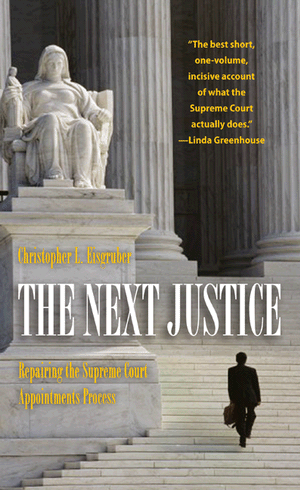
Contrary to John Roberts’ testimony, a Supreme Court justice has a unique and expansive role in our society. The Constitution contains too many abstract references and clauses for any justice to merely adhere to the rules based on a strict interpretation of the text. An example is the Constitution’s Equal Protection Clause. As the highly regarded legal scholar, Christopher L. Eisgruber, observes in his 2007 book, The Next Justice: Repairing the Supreme Court Appointments Process (Princeton University Press) the Equal Protection Clause reads,
“’No state shall deny to any person within its jurisdiction the equal protection of the laws.’

How should judges interpret this clause? Presumably, they must ask what it means for the laws to protect people equally. Yet that question takes judges straight to the nerve center of American ideological controversy. Liberals and conservatives disagree passionately about what it means for the laws to protect groups equally and about when it is appropriate for the laws to treat one group better than another.”
Overall, Eisgruber argues that due to the Constitution’s many vague abstractions, a Supreme Court justice is disproportionately influenced by their individual values and ideology in determining when it’s appropriate for the court to intervene and even overrule our country’s prior laws. How could it be otherwise when the Constitution’s text is frequently subject to broad interpretation as with the Equal Opportunity Clause? Hence, it is imperative the senate determines if the judicial philosophy of a Supreme Court nominee is representative of the country.

Some legal scholars such as Yale law professor Stephen Carter have argued that nominees to the Supreme Court should simply stay home because their testimony has ceased to contribute anything substantive. There is definitely merit to Carter’s point of view. Nominees since Robert Bork typically speak only in vague platitudes about practicing “judicial restraint” and are ultimately voted up or down based upon their reassuring television appeal.

Eisgruber however argues in his book that the senate should ask more open-ended questions of prospective nominees about their judicial philosophies. Too often senators attempt to trap nominees with “gotcha” questions or ask about specific issues such as abortion that that can easily be deflected to “preserve their integrity” prior to joining the Supreme Court. Ultimately, little is learned and unless opposition interest groups get any traction or a scandal emerges, the nominee is likely to sail through without defending or explaining their ideology.

One example of the sort of question Eisgruber suggests asking is,
“The late Chief Justice William Rehinquist wrote that ‘manifold provisions of the Constitution with which judges must deal are by no means crystal clear in their import, and reasonable minds may differ as to which interpretation is proper.’ Could you tell us something about the values and purposes that will guide you when you interpret provisions like the Equal Protection Clause? How do those values and purposes distinguish your approach from those taken by other justices?”
Eisgruber contends this approach has a better chance of determining the sort of justice a nominee is likely to be. He also argues that it will facilitate more moderate nominees and discourage stealth extremists.

Eisgruber, who previously clerked for U.S. Court of Appeals Judge Patrick E. Higginbortham (a conservative) and Supreme Court Justice John Paul Stevens (a liberal), agreed to a podcast interview with me over the telephone about his book. Among the topics discussed were the insights he gained clerking for two ideologically different judges, the importance of justice’s philosophy about judicial review, President Obama’s desire for a justice with “empathy” and whether we might have a justice who did not serve in the appellate courts. I also asked him numerous questions from my liberal perspective, including whether ideological balance on the court would be better served by appointing assertive liberals instead of moderates.

Please refer to the flash media player below.


This interview can also be accessed at no cost via the Itunes store by searching for either the “Intrepid Liberal Journal” or “Robert Ellman.”

Labels: , , , ,

 
by Valtin | 4/18/2009 01:39:00 PM
While the example of the Nuremberg Trials is used often these days to describe what prosecutions might look like, few seem to remember that the prosecution of war criminals after World War II was much larger and took place over a longer period of time than most people realize. This is important when one considers the context of President Obama's granting of immunity to lower-level CIA interrogators (if they acted in "good faith" upon "authoritative" legal advice).

What even a cursory examination of historical precedent demonstrates is that after World War II prosecution of war criminals and accessories to war crimes were not limited to the famous Nuremberg 22 high-level Nazis, nor the few hundred or so prosecuted through the Nuremberg tribunals, but thousands of accused throughout Europe.

What follows is a brief lesson in how these prosecutions occurred, who was involved, and where and when they took place. It may surprise you that the United States, for instance, has an Office of Special Investigations (OSI) at the US Department of Justice. Its mission was to hunt down war criminals and bring them to justice. Established only in 1979, the OSI has a sterling record:


As of 2008, OSI has successfully prosecuted 107 Nazi persecutors. OSI has also worked closely with the Department of Homeland Security to stop more than180 former European and Japanese Axis perpetrators and suspected perpetrators of acts of persecution at U.S. ports of entry and bar them from entering the United States.
But looking back to the immediate post-World War II period, I found this at Teachers Guide to the Holocaust:
In addition to the well-known Nuremberg Trials of 1945-46 [of 22 defendents], there were Subsequent Nuremberg Proceedings held between December 1946, and April 1949, which tried 177 persons. Individual countries also prosecuted war criminals in national courts of law. The British held trials of the commandant and staff of the Bergen-Belsen camp, those responsible for forced labor, and the owners and executives of the manufacturer of Zyklon B, among others. The Netherlands, Hungary, Norway, Poland, West Germany, and Romania were some of the other countries that brought war criminals to trial.
Prosecutions continued for decades after World War II. Many are familiar with the trials of Adolph Eichmann and Klaus Barbie. Consider this from Eli Rosenbaum, who in 2000 was Director of the OSI at the US Department of Justice:
Let us look, if you will, just at the past month, February 2000. In one month, my office won two prosecutions. One at the United States Board of Immigration Appeals, the other, two weeks ago, at the United States Supreme Court, involving the case of former Auschwitz SS man Ferdinand Hammer. The Canadian government, just last week, won its citizenship case against Helmut Oberlander, a member of a mobile killing unit. And just last month, the British authorities won the appeal of the Sawoniuk case, a Ukrainian perpetrator, at the High Court in London. And only a few months ago the Croatian government, which frankly had to be dragged kicking and screaming into this prosecution, successfully prosecuted Dinko Sakic, the former commandant of the Jasenovac concentration camp.
Then, there's also the Documentation centers established to bring war criminals to justice (from the Danish Center for Holocaust and Genocide Studies):
After World War II, centres, commissions and offices were established with the purpose of bringing Nazi war criminals to trial. They collect information, investigate crimes, pass on names of Nazis to their respective governments and take action against Nazi criminals in their own countries.

‘Zentrale Stelle Ludwigsburg’ is Germany’s documentation centre, which collects evidence for the prosecution of crimes committed during the nazi regime in the period 1933-1945.

Immediately after World War II, the provisional Polish government established the ‘Central Commission for Investigation of German Crimes in Poland’. The main commission has since then investigated nazi crimes committed in Poland during World War II and these days exist under a different name, the 'Main Commission for the Investigation of Crimes against the Polish Nation'....

The ‘Simon Wiesenthal Center’ in Vienna, founded by the Nazi-hunter Simon Wiesenthal, is perhaps the most famous documentation centre. Since World War II, the centre has tracked down many Nazi war criminals.
And the trials continued:
Poland was relatively quick to convict the camp personnel from Auschwitz – at least those that could be found. Trials were initiated against at least 600 members of the Auschwitz camp personnel. Among these were the two camp commandants, Rudolf Höss and Arthur Liebehenschel, who were sentenced to death in 1947. Rudolf Höss was hanged in Auschwitz in 1941. A total of 21 were executed....

In West Germany the so-called Auschwitz Trials were conducted against the camp guards from the concentration and extermination camp at Auschwitz. The largest of these trials took place in Frankfurt am Main between 1963 and 1965, where 20 were accused. 17 were given jail sentences....

On 3 July 1964 twelve of the personnel in the extermination camp Sobibor stood accused of participating in the murder of Jews in the camp. All twelve were accused of assisting in the killings. The trial itself began in Hagen on 6 September 1965 and ended on 20 December 1966. More than 100 witnesses were called.
Major war crimes trials occurred in over 30 European cities between 1943-1947, from Paris to Riga, from The Hague to Bratislava, Bucharest, and Kharkov. Among those prosecuted were "concentration camp guards and commandants, police officers, members of the mobile killing squads, and doctors who participated in medical experiments."

The U.S. National Holocaust Memorial Museum has this to say:
The overwhelming majority of post-1945 war crimes trials involved lower-level officials and functionaries. In the immediate postwar years, the four Allied powers occupying Germany (and Austria) -- the United States, Great Britain, France, and the Soviet Union -- held trials in their zones of occupation and tried a variety of perpetrators for wartime offenses. Many of the earliest zonal trials, especially in the U.S. zone, involved the murder of Allied military personnel who had been captured by German or Axis troops. In time, however, Allied occupiers expanded their juridical mandate to try concentration camp guards and commandants and others who had committed crimes against Jews and others who suffered persecution in areas the Allies now occupied. Much of our early knowledge of the German concentration camp system comes from the evidence and eyewitness testimonies at these trials....

Allied Control Council Law No. 10 of December 1945 authorized German courts of law to pass sentence on crimes committed during the war years by German citizens against other German nationals or against stateless persons. For this reason, occupation officials left Euthanasia crimes -- where both victims and perpetrators had been predominantly German nationals -- to newly reconstructed German tribunals. These proceedings represented the first German national trials in the early postwar period. Both the German Federal Republic (West Germany) and the German Democratic Republic (East Germany) continued to hold trials against Nazi-era defendants in the decades following their establishment as independent states. To date, the Federal Republic (in its old manifestation as West Germany and in its current status as a united Germany) has held a total of 925 proceedings trying defendants of National Socialist era crimes. Many detractors have criticized German proceedings, particularly those held in the 1960s and 1970s, for doling out acquittals or light sentences to aging defendants or defendants who claimed superior orders.

Many nations which Germany occupied during World War II or who collaborated with the Germans in the persecution of civilian populations, especially Jews, have also held national trials in the years following World War II. Poland, the former Czechoslovakia, the Soviet Union, Hungary, Romania, and France, among others, have tried thousands of defendants -- both Germans and indigenous collaborators, in the decades since 1945. The Soviet Union held its first trial, the Krasnodar Trial, against local collaborators in 1943, long before World War II had ended. Perhaps Poland's most famous postwar national trial was held in 1947 in Krakow. The proceedings tried a number of functionaries of the Auschwitz concentration camp and sentenced Auschwitz camp commandant Rudolf Höss and others to death.
Another source notes the French tried over 2,000 "lesser criminals for crimes against humanity and war crimes" (see footnote 9 at link).

As we can see, the amount of people prosecuted for war crimes is much more than most people (even myself, prior to doing this research) imagined!

As the protest over the immunity granted by Obama to CIA torturers continues -- as to how much immunity it really grants, whether it was smart, whether it was a capitulation to blackmail, or a wily maneuver to get the top leadership of the Bush years -- we should all consider the lessons of history as regards prosecutions for war crimes. This history, so recent it seems, is already largely forgotten or misunderstood as pertains to the prosecutions argument.

This brief essay is an attempt to correct those misconceptions, and restore a sense of continuity with the precedents set by our immediate forebears as regards who should be prosecuted for war crimes. The criminals who are or recently were in the U.S. government should soberly consider the many decades the pursuit of war crimes can persist.

If I were them -- and I say this with a straight face -- I'd turn myself in and throw myself on the mercy of the court.

Also posted at Invictus

Labels: , , , , ,

 
by Robert Ellman | 4/12/2009 02:46:00 PM
The topic below was originally posted on my blog, the Intrepid Liberal Journal.

On January 1, 2007, Yale Law School professor Heather Gerken published a widely read article in the LegalTimes entitled, “How Does Your State Rank on The Democracy Index.” Gerken argued that just as the Environmental Performance Index (“EPI”) shamed countries such as Belgium to upgrade their environmental practices, a “Democracy Index” would embarrass state and localities into reforming their electoral administration through competition.

Since Bush vs. Gore in 2000, the debate about electoral reform has been dominated by anecdotes and overheated abstractions. Liberals like me have long suspected that states such as Ohio and Florida were deliberately disenfranchising minority voters sympathetic to Democratic candidates. Conservatives complained that voter fraud and urban political machines were allowing ineligible voters to cast ballots at the expense of Republican candidates. With her article, Gerken contended that a Democracy Index would replace a debate dominated by shouting with data driven arguments instead:
“This index should take what Ohio State University law professor Daniel Tokaji calls a ‘moneyball approach.’ The word ‘moneyball,’ of course, refers to Michael Lewis’ book of the same name about the success of the Oakland A’s after management substituted hard numbers and empirical research for the gut-level judgments of baseball scouts in making hiring decisions.

Similarly, the Democracy Index could change the terms of the debate by giving voters something new: moneyball politics. It would offer cold, hard numbers and comparative data in place of atmospherics and anecdotes. It would provide bottom-line results in place of subjective judgments. It would let reformers talk like corporate executives, not starry-eyed idealists. And, most important, it would enable the voters to hold election officials accountable for their missteps.

In the end, a ranking system would work for a simple reason: No one wants to be at the bottom of the list.”


Gerken further described her Democracy Index proposal and identified the major obstacles to good election practices with her new book, The Democracy Index: Why Our Election System Is Failing and How To Fix It (Princeton University Press). Her book is an accessible 181 pages and postulates that we need more facts about our election practices and that a ranking metric is our best hope to facilitate accountability and reform. Gerken also contends that our broken electoral system has less to do with intended malice than “deferred maintenance,” a term typically applied to failed infrastructure such as broken bridges.

Shortly after Gerken’s LegalTimes article was published, Both Barack Obama and Hillary Clinton, put her concept into proposed legislation and within a year, Congress set aside $10 million to fund model data collection programs in five states and the Pew Center. Other foundations also sponsored conferences and initial research. On March 1, 2007, Obama referred to these initiatives on the Senate floor as,
“an important first step toward improving the health of our democracy. We are all familiar with the problems that have recently plagued our elections: Long lines, lost ballots, voters improperly turned away from the polls. These are basic failures of process. Until we fix them, we run the risk in every election that we will once again experience the kind of chaos and uncertainty that paralyzed the nation in 2000. We can do better. We must do better. But to do better, we need more than anecdotal information. We need better, nonpartisan, objective information.”
Hence, Gerken's efforts illustrated at least the potential for action from the body politic to facilitate electoral reform but obviously, more needs to be done.

With respect to electoral law, Gerken is among the most authoritative voices in the country. In 2006, Gerken joined the Yale Law School faculty where she teaches election and constitutional law. Previously, Gerken clerked for Supreme Court Justice David Souter and was an assistant professor at Harvard Law School, where she was granted tenure and won the Sachs-Freund teaching award. She has also written for the New Republic, Roll Call, and Legal Affairs and has been a frequent media commentator.

Gerken was among several commentators who appeared on Charlie Rose’s program the very evening the Supreme Court rendered its fateful decision in Bush vs. Gore. During the 2008 presidential election, Gerken served on Barack Obama’s election protection team.

Gerken agreed to a podcast interview with me over the telephone about her book and proposal for a Democracy index. Our conversation was just over seventeen minutes and can be accessed via the flash media player below.


This interview can also be accessed at no cost via the Itunes Store by searching for either “Intrepid Liberal Journal” or “Robert Ellman.”

Labels: , , , ,

 
by Gordon Taylor | 4/09/2009 03:34:00 AM


One treads carefully in the Turkish presence. Turkey is no joke.
--Jan Morris

It's a tough crowd, the Turkish parliament. Say the wrong thing and you'll quickly discover the disadvantages of growing a mustache. The above photograph was taken 21 December 2008 after a Kurdish deputy of the Democratic Society Party (DTP) got up and told his fellow MPs that it was high time for Turkey to face up to the Armenian Genocide of 1915. As a Kurd, of course, he had his motives for this deliberate provocation: he knew that until the Turks confronted the truth about 1915, they would never recognize reality about the Kurds. It was a gutsy move. He, his DTP party colleagues, and millions of other people are still waiting for something other than a fist in the face.

On April 6, in Ankara, Barack Obama faced the same uncertainties. You could see it on the videos: the tiniest dent in that iron assurance we have come to expect of him. Perhaps it was because Michelle, his partner in world conquest, had left him to be with their daughters back home. In any case, he seemed slightly hesitant as he spoke to the Turkish parliament. "Who are these people?" one can almost hear him thinking; or, perhaps he was mesmerized by the sight of all those mustaches. This was not an easy crowd, nothing like those cheerful Europeans in Prague and London, delirious at having found a U.S. President who actually seemed to have a brain in his head. Most of Obama's Ankara speech, said reports, was greeted with silence.


But, to begin with a generalization, it was as good a speech as one could expect, given the occasion. In it nuance, nonsense, diplomacy, and willful disregard of reality found equal expression. Someone from the military-industrial-diplomatic complex worked hard on this text, and it showed.

First, the nonsense. Those who take a jaundiced view of Turkish nationalism can find plenty of it in Obama's words. He began his speech with the usual--a homage to Ataturk, the Republic's founder--by referring to the morning's signal event, the requisite wreath-laying at Fred's tomb. Here his restraint was admirable. At no point did Obama point out the absurdity of a free and quasi-democratic people, a NATO member and EU-aspirant, bowing and scraping before a personality cult that rivals that of Kim il-Sung.

Obama then moved on to the main event: friendly persuasion and flattery. There were references to Turkey's democracy, a dubious concept, as well as to the friendship between our two peoples--which really is a lie, since I doubt that more than five Americans out of a hundred could find Turkey on a map. (Hell, they can't even find their own country!) Here the message was, Let's Cooperate. The two nations, he said, were working together for peace and prosperity, as was appropriate. Obama affirmed U.S. support for Turkey's EU candidacy. (Which he can do because he knows that France and Germany will have the guts to tell them No.) Cliches like Resolute Ally, Responsible Partner, and Bridges Over the Bosphorus were given the requisite airing. Two Turkish basketball players were duly noted. Obama praised the Turks for their progress (non-existent) on penal code reform, as well as for their establishment (scorned by most Kurds) of a TV station broadcasting in Kurdish. This is where it began to get interesting:
These achievements have created new laws that must be implemented, and a momentum that should be sustained. For democracies cannot be static: they must move forward.
In other words, We know that you've passed a few laws. But you have to make them work; otherwise it's just an empty form. (Which is the game, Turkey-watchers know, that the Turks have always played.)
Freedom of religion and expression lead to a strong and vibrant civil society that only strengthens the state, which is why steps like reopening the Halki Seminary will send such an important signal inside Turkey and beyond. An enduring commitment to the rule of law is the only way to achieve the security that comes from justice for all people. Robust minority rights let societies benefit from the full measure of contributions from all citizens.
Note: "a strong and vibrant civil society that only strengthens the state." This is the toughest sell of all, the idea that the freedoms Turkish officials fear so greatly could actually strengthen their beloved, all-important Turkish State. This is the heart of the matter. And the Halki Seminary? It's an interesting gambit, a reference to a long-closed seminary near Istanbul which the Greek Orthodox Patriarchate desperately needs to have reopened if it is going to sustain itself in its ancient home. If you really become a democracy, Obama is arguing, you become stronger. And upholding minority rights is the key.
I say this as the President of a country that not too long ago made it hard for someone who looks like me to vote. But it is precisely that capacity to change that enriches our countries. Every challenge that we face is more easily met if we tend to our own democratic foundation.
Note: "that enriches our countries"; using the language of inclusion to cajole the listeners into going along. Obama then moved on to admission of past American sins, like slavery, in order to slide into that most treacherous of quicksands, the Turkish treatment of Armenians.
Human endeavor is by its nature imperfect. History, unresolved, can be a heavy weight. Each country must work through its past. And reckoning with the past can help us seize a better future. I know there are strong views in this chamber about the terrible events of 1915. While there has been a good deal of commentary about my views, this is really about how the Turkish and Armenian people deal with the past. And the best way forward for the Turkish and Armenian people is a process that works through the past in a way that is honest, open and constructive.
No one, I submit, is ever going to make a more diplomatic, nuanced statement about this subject. With this Obama and his speechwriters have slipped through a narrow opening indeed. If the "full and frank exchange of views" of diplomatic doublespeak were taken literally, a visitor might have said, "Grow up, people, and stop being afraid. Yes, the murderers of a million Armenians were your ancestors, but the ordinary Turks who worked to save their Armenian neighbors were also your ancestors, as were the army units which refused to participate, and the Ottoman generals and officials who refused to go along. Ataturk himself called it a 'shameful act.' So what is your problem?" Obama would never have said such a thing, but for what he did say he deserves credit.

So for the Greek patriarchate and the Armenian Genocide, two touchy subjects, we can give Obama decent marks. He went on to make a statement which was, for America's tone-deaf news media, a big deal: "[T]he United States is not at war with Islam." And he made a pitch for Turkey's cooperation in Iraq and Afghanistan. But for Turkey's biggest problem, the Kurds, Obama was as silent as a Turk at Easter. True, he had declared himself in favor of "robust minority rights." But in a Turkey defined by the Lausanne Treaty of 1923, "minority" does not apply to the Kurds. Unlike Jews, Greeks, and Armenians, 15 million Kurds do not have official "minority" status in Turkey. They are full-fledged citizens, indigenous residents of Anatolia for thousands of years, who have a culture and language that has never been recognized by the Turkish Republic.

In a short meeting with Ahmet Turk, vice-chairman of the DTP and the "grand old man" of Kurdish politics in Turkey, Obama expressed "sympathy" for the Kurds but said what he had to say, that violence was not a solution for the Kurdish problem. As he said this, Turkey's Kurdish provinces were still reeling from the latest outbreaks of police violence, which left two Kurds dead and a Kurdish female deputy of the DTP injured after being beaten by the state's "security forces." Despite these almost daily reports, it is still official U.S. policy that the PKK, which has made repeated offers of negotiation, is a "terrorist group"; and the Turkish government, which rarely sees a head that doesn't deserve beating or an F-16 that isn't worth buying, is a beacon for democracy in the Middle East.

So nothing really has changed. Obama's speech made some intriguing gambits, and the symbolism of meeting with Kurdish MPs, a group that has been shunned up to now, will no doubt resonate; but without straight talk and an abandonment of the lavish armaments contracts that are the true core of Turkish-American relations, nothing ever will change. Like a baby in an iron womb, Turkish democracy has gestated for decades without hope of accouchement. Turkey's governance has always had one goal: to maintain the state and its power. And the pattern continues. For the sake of the all-important State, political parties have been closed, papers shut down, reporters imprisoned, YouTube prohibited, websites darkened, letters of the alphabet proscribed, and thought crimes punished. While murderers of liberals and ethnic minorities, caught red-handed, go unpunished, people who speak the simplest truths are arraigned and convicted within weeks. Inquiries into the most blatant thuggery drag on, without resolution, for years. Judges render verdicts that defy common sense, then retire to drink tea out of tulip-shaped glasses.

And so it goes.

Cross-posted at The Pasha and the Gypsy.

Labels: , , , ,

 
by Robert Ellman | 3/22/2009 04:17:00 PM
The topic below was originally posted on my blog, the Intrepid Liberal Journal.

I first became aware of William Greider after the publication of his 1981 Atlantic Monthly profile of President Reagan’s embattled Office of Management and Budget Director (“OMB”), David Stockman. At the time I was just a kid and the Reagan administration insisted they could simultaneously balance the budget, cut taxes and increase defense spending exponentially.

Greider’s reporting however exposed that even Stockman, doubted the fiscal prudence of Reaganomics. After the article’s publication, Stockman absorbed public humiliation when President Reagan took him “to the woodshed.” I trace that article as a seminal moment in my own political awareness.

Over the years, Greider has been a determined voice of truth against a backdrop of America’s pro-war, pro-Wall Street governing elites and their enablers inside the corporate media. While Alan Greenspan was celebrated, Greider warned that the Federal Reserve and other regulatory agencies were guilty of dereliction. When celebrated economists such as Paul Krugman extolled the virtues of free trade and globalization, Greider warned of diminished wages at home and condemned the shameful exploitation our consumption habits subsidized abroad.


Greider’s latest book, Come Home, America: The Rise and Fall (and Redeeming Promise) of Our Country, just published by Rodale, is a manifesto of hope and warning. In Chapter One, Greider writes:
“Think of America at this point as a muscular teenager, full of talent, adolescent energy, and youth’s over-reaching impulses. This is a critical stage in human development and for our nation it could go either way. Some nations that acted like willful children when they were young formed balanced societies when they became adults. Other nations have never really grown up.

The question, I think is whether-we-the people who proudly call ourselves Americans – can mature as a society. The country can develop a deeper sense of what matters most in life and what doesn’t. It can shed some self-destructive reflexes and acquire a wiser sense of national self-interest that is anchored in the nation’s ideals. Wisdom tempers egotism. This is true for both people and nations.

Or, the United States can plunge ahead self-indulgently, repeating destructive habits, acting out reckless ambitions, and getting into deeper trouble. We all know children who, for whatever reason, got older but never found themselves. This is possible for nations too, especially ones that refuse to reconcile themselves to new realities.

I am betting we will grow into our maturity and hoping that lots of Americans agree.”
Greider’s book chronicles why America is in dire straits and proposes numerous solutions to facilitate a better economic foundation for America's struggling middle class. His recommendations include consolidating many of the Federal Reserve’s functions within the executive branch to ensure public accountability for monetary policy, replacing private pension plans such as 401ks with government pension plans instead and capping U.S. trade deficits through a general emergency tariff authorized under the charter of the World Trade Organization.

Even more than any singular remedy however, Greider’s book urges outraged citizens to embrace activism as a means of forcing the powerful in the public and private sectors to finally put our national interests above corporate greed. Ultimately, Greider's book argues that the current crisis is an opportunity for citizens to reengage and facilitate a more just and equitable society.

Greider is the best-selling author of five previous books, including One World, Ready or Not; Who Will Tell the People; and Secrets of the Temple. He’s written for the Washington Post and Rolling Stone as well as serving as an on-air correspondent for six PBS Frontline documentaries. Currently, Greider is the national affairs correspondent for The Nation.

Greider agreed to a podcast telephone interview with me this afternoon about his book and views. Our conversation was just over forty-eight minutes and among the topics we discussed were the current A.I.G. bonus controversy, the Democratic Party’s culpability in overriding state and local laws against usury, his recommendations to overhaul the Federal Reserve and America’s pension system, our destructive relationship with China, America’s excessive militarism and the fine line being walked by activists who support the Democratic Party and President Obama while simultaneously pushing for real change.

Please refer to the flash media player below.


This interview can also be accessed via the Itunes Store at no cost by searching for either the "Intrepid Liberal Journal" or "Robert Ellman."

Labels: , , , ,

 
by Robert Ellman | 2/08/2009 04:22:00 PM
The topic below was originally posted on my blog, the Intrepid Liberal Journal.

Building consensus within America’s body politic and national security establishment for a new way forward with Muslims worldwide is a formidable challenge. Many Americans still don’t appreciate the complex nuances of Muslim society and remain stubbornly Islamophobic almost seven and half years after 9/11. Equally formidable is earning the goodwill of Muslims worldwide following the Iraq War as well as American atrocities perpetrated upon Islamic detainees at Guantanamo Bay and Abu Ghraib. Hopefully, President Obama’s historic election has finally opened a path for constructive conversation about how America can most effectively engage the Muslim world.

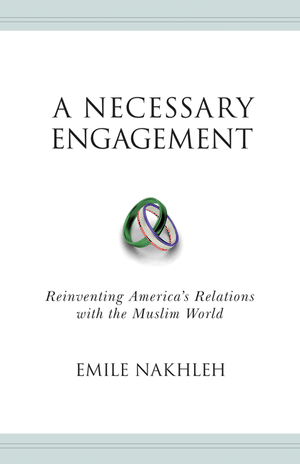
The CIA’s former point man on Islam, Emile Nakahleh, has vigorously entered this conversation with his new book, A Necessary Engagement: Reinventing America’s Relations With the Muslim World (Princeton University Press). From 1991 to 2006, Nakahleh served as the director of the Political Islam Strategic Analysis Program in the Directorate of Intelligence at the CIA. He holds a PhD in international relations and is a member of the Council on Foreign Relations.

Nakhleh’s book combines a revealing memoir with in-depth analysis and proposals for the future. Ever since his retirement from the CIA in 2006, Nakhleh has been a vociferous critic of the Bush Administration’s legacy with respect to American-Muslim relations. Indeed, in September 2006, Nakhleh told Harper’s Magazine that because of Bush’s policies,
“We've lost a generation of goodwill in the Muslim world.”
Nakhleh's proposals for improving American-Muslim relations stems from his conversations with Muslim "interlocutors" spanning three decades. These conversations include government ministers, Islamic activists, academics and radicals. Nakhleh also examined and analyzed considerable polling data of Muslims worldwide.


Overall, Nakhleh contends that the vast majority of Muslims and America have common interests and values. His blueprint includes robust dialogue with mainstream Islamic political parties as well as a tangible commitment towards democracy in the Muslim world, even if we don’t always like the short-term electoral results. His book is an accessible 160 pages and divided into four chapters: (Chapter 1) Political Islam and Islamization, (Chapter 2) Intelligence, Political Islam, and Policymakers, (Chapter 3) Public Diplomacy: Issues and Attitudes and (Chapter 4) Public Diplomacy: A Blueprint.

Nakhleh was born in Galilee, north of Nazareth in Palestine and raised a Greek Catholic. He emigrated from Israel to the United States approximately 50 years ago and attended a Benedictine university in Minnesota for his B.A., a Jesuit university in Washington, D.C., for an M.A. and was awarded a Ph.D. from the American University in Washington, D.C. Prior to joining the CIA he taught at a catholic college in Maryland for 26 years.

Nakhleh agreed to a telephone interview with me in podcast format. Among the topics we discussed was whether he believes the surge in Iraq worked, the proxy war between Saudi Arabia and Iran inside Iraq, President Obama’s new strategy in Afghanistan, Hamas and America’s role in resolving the Israeli-Palestinian conflict and his argument that American commitment to democracy in the Muslim world is imperative to our long term interests.

Some of Nakhleh’s answers and views may surprise many listeners. Our conversation was just over 47 minutes. Please refer to the flash media player below.


Either searching for the “Intrepid Liberal Journal” or “Robert Ellman” can also access this interview at no cost via the Itunes Store.

Please note I erred in the audio introduction when I said Emile Nakhleh worked for the CIA between 1991 and 1996. I meant to say he worked for the CIA between 1991 and 2006. Also, my apologies for the echo sound on Emile Nakhleh's side. Sometimes technology has its limits.

Labels: , , , , , , ,

 
by Ralph Brauer | 1/22/2009 10:28:00 PM


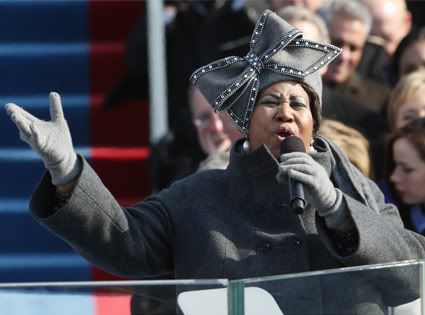
I doubt anyone will ever again sing "My Country Tis of Thee" the way Aretha Franklin sang it at the Obama Inauguration, because not even she will sing it that way again. That's because in gospel you sing what you feel. You testify. And if anyone testified on that singular day it was Aretha Franklin along with the man many term the father of the Civil Rights Movement, the Reverend Joseph Lowery.


As most people, know Franklin's roots are in gospel, in part because she is the daughter of one of the most revered figures in the African American Church, the Reverend C.L. Franklin, who also was a close friend of another African American minister, Dr. Martin Luther King, jr. Her first album, recorded when she was 14, was a gospel album which was produced for the same label whose recordings of her father's sermons had made him a national figure.

One of my favorite Franklin albums is an all-gospel production that was recorded at her father's church many years ago. At one point in the recording, C. L. Franklin remarks, "she never left the church." Like Ray Charles, Franklin brought the rhythms and sounds of gospel to popular music, earning her the title the "Queen of Soul."

Those skills were showcased at the Obama inauguration where, like Charles, she took a patriotic song and endowed it with the soul of gospel. You knew this was going to be a performance for the ages when she gave the words "sweet" and "liberty" a particular cadence that reverberated with meaning.

Think for a minute of the task she faced as an African American celebrating the inauguration of America's first African American President. Her "testimony" had to both acknowledge the struggles of the past and yet also the triumph of the present. By drawing out those two words the way she did, she made you pause and acknowledge those meanings.

This took on even more meaning when she reached the words "land where my fathers died." Shortly after that she did an extraordinary thing I have not seen anyone acknowledge--she changed the words to the song, so that it directly referenced Dr. King's immortal words. The original lyrics read "every mountain side" which Franklin changed to "mountain top" the words King used. In addition, to highlight the change she repeats the word "every" several times so it sinks in.

Franklin then went on to sing the song's lesser-known final verse. By the time she reached the last two stanzas, I had lost it. The second-to-last stanza begins with the words "protect us by thy might." Franklin repeats "protect" over and over, so it becomes a kind of prayer and, given circumstances which provoked an extraordinary amount of security, also a wish for both the new President and the country.

Listen to her sing that one line again and again, for she endows it with all the hopes Americans had that day and have for the incoming administration. When she ends the song Franklin and her backup choir repeat again the desire to let freedom ring, in a way that she knew she was testifying. Had she sung it that way in her father's church there is little doubt in my mind that the audience would have been spontaneously shouting their own reactions.

Unfortunately, Franklin's singing became lost in the uproar over her hat. It was Ellen de Generes who put her foot in her mouth by wearing a reproduction of Franklin's hat, turning it into a joke. Actually had de Generes known what she was poking fun at, she might have thought differently, for the wearing of special hats--especially unique ones with a bit of flash--is an old custom for African American church women.

Michael Cunningham and Craig Marberry celebrate this tradition in their book Crowns: Portraits of Black Women in Church Hats. Deirdre Guion calls it:
hattitude...there's a little more strut in your carriage when you wear a nice hat. There's something special about you.

The man who sold Franklin the hat, Luke Son, said the clientele for Mr. Song Millinery is 90% African American church-going women. So far from being a joke, Franklin's hat was the perfect accessory to her gospel-tinged version of "My Country Tis of Thee" and brought a historic piece of African American culture to the Inauguration.

The other person who brought a historic piece was the Reverend Joseph Lowery, who co-founded the Southern Christian Leadership Conference along with Dr. King. It would take a space longer than this essay to detail Lowery's achievements, so suffice it to say if anyone in America deserved to deliver the Benediction at Barack Obama's Inauguration it was Lowery.

Lowery's beard--or more properly it should be termed a goatee--reminded me of W.E.B. DuBois, whose book The Souls of Black Folk used verses from what he termed the "sorrow songs" to introduce each chapter and in a chapter titled "Faith of Our Fathers" wrote of the African American church. He wrote:
The black and massive form of the preacher swayed and quivered as the words crowded to his lips and flew at us in singular eloquence. (p. 190)

The eighty-seven year old Lowery brought his own singular eloquence, proving a better poet than the official poet who preceded him. The rhyme and rhythm of his first phrases brought a hush to the audience.
God of our weary years, God of our silent tears.

Now that is poetry whose rhythm directly echoes "My Country Tis of Thee." Think of the phrase "land where my father's died, land of the Pilgrim's pride." Lowery knew exactly what he was doing. To bring together weary years and silent tears, to hear those words from a man who knew exactly what he was talking about made he and Franklin the perfect bookends for the Inaugural. Ever the activist Lowery did not shy away from telling it like it is.
He has come to this high office at a low moment in the national and, indeed, the global fiscal climate.

For we know that, Lord, you're able and you're willing to work through faithful leadership to restore stability, mend our brokenness, heal our wounds and deliver us from the exploitation of the poor or the least of these and from favoritism toward the rich, the elite of these.

Lord knows what George W. Bush and Dick Cheney must have been thinking when they heard those words.

Having painted a picture of contemporary America, Lowery went on to preach of the hope that Obama's Presidency has brought to the nation.
And while we have sown the seeds of greed -- the wind of greed and corruption, and even as we reap the whirlwind of social and economic disruption, we seek forgiveness and we come in a spirit of unity and solidarity to commit our support to our president by our willingness to make sacrifices, to respect your creation, to turn to each other and not on each other.

Near the end, Lowery takes a cue from Franklin evoking the same word she used.
And as we leave this mountaintop, help us to hold on to the spirit of fellowship and the oneness of our family. Let us take that power back to our homes, our workplaces, our churches, our temples, our mosques, or wherever we seek your will.

Finally Lowery concludes with paragraphs that cannot help but complete the tie to his old friend Dr. King, even evoking the spirit and rhythm of that long ago day in Washington when King gazed toward where Lowery was speaking even as four score years later Lowery looked out to the place King had spoken from.
We go now to walk together, children, pledging that we won't get weary in the difficult days ahead. We know you will not leave us alone, with your hands of power and your heart of love.

Help us then, now, Lord, to work for that day when nation shall not lift up sword against nation, when tanks will be beaten into tractors, when every man and every woman shall sit under his or her own vine and fig tree, and none shall be afraid; when justice will roll down like waters and righteousness as a mighty stream.

In the midst of Black History Month, a day after Martin Luther King Day, both Franklin and Lowery reminded us of the pivotal role the African American church has played in American history. In a way, the African American church elected Barack Obama.

When I say the African American church I mean the African American church, for it is not so much about ministers as about congregations, not so much about Biblical fundamentalism and thou-shalt-nots as about principles. The Lowerys and Kings have justifiably earned their place in American history, but we forget the fact that as transformational leaders, they would have accomplished little without their congregations.

Much has been written about the Obama campaign, but no one has thought to link it back to the traditions of the African American church. Civil Rights veterans like Lowery would recognize the Obama campaign's tactics, as would anyone who has been a member of an African American congregation.

So when I say the African American Church elected Barack Obama I mean that in three ways. First, church leaders and congregations backed the candidate as they have backed no candidate in history. The huge African American turnout proved pivotal in this election. Without it Barack Obama would not have been standing behind Joseph Lowery waiting to take the oath of office.

The second way the church played a role in the campaign was to endow it with a sense of principle. The Civil Rights movement grew from the African American church's insistence on principle. The Obama campaign came to symbolize a renewal of principles for many Americans who voted for him.

The third way the African American church elected Barack Obama lay in lending its tactics to the campaign. The image of the Civil Rights Movement many Southerners tried hard to reinforce was that it was a top-down movement, that if leaders like King and Lowery could be stopped then the Movement would whither away. But in the records of the Mississippi State Sovereignty Commission--a secret police force formed after the Brown decision--lies another story, one of thousands of people who put their lives on the line for freedom.

One moment in the Movement could have served as a blueprint for the Obama campaign. Deprived of the right to vote for African American candidates by the State of Mississippi, the Freedom Democratic Party organized a shadow vote they called the Freedom Ballot. All across the state African Americans voted on Freedom ballots to show the segregationists that they would not be denied the right to express the franchise.

This grassroots effort, conducted with a major boost from African American churches, knit together people across the state. Nothing like it had ever been seen in Mississippi or in America. To minimize the violent segregationists that would be attracted like moths to a flame, organizers mailed the Freedom Ballot over a four-day period. The courage behind the effort remains difficult to imagine, for everyone involved in printing, distributing, filling out and counting the ballots literally put their lives on the line, testifying to a communal strength and resolve determined to rid the state of oppression. When the counting ended, over 50,000 African Americans had sent in ballots, a collective shout for freedom that reverberated across Mississippi to the very halls of Congress.

Nothing like the Obama campaign's grassroots effort had been seen until this November. Even on election night commentators could not quite believe it, but like those who participated in the Freedom Ballot, the campaign organizers knew the strength of their grassroots work.

As we now move forward into the Obama Administration, we would be wise not to forget the African American church, for just as it lay behind the election of Barack Obama, its people, principles and tactics will be there for him to call on when the going gets tough. Aretha Franklin all but said so as she sang, Joseph Lowery all but said so as he preached.

This is going to be a administration the likes of which America has never seen before.

Labels: ,