by Ralph Brauer | 12/09/2009 09:05:00 AM



It seems like the press can just never get it right especially when it comes to history. In the wake of You-Know-Who's new book tour, several publications, including the venerable New York Times, which should know better (especially if they read their own archives), are referring to the woman who guarantees to give Tina Fey a healthy income for quite some time as a--get this--Populist. The Times even ventured to compare her to none other than William Jennings Bryan!


Palin as Populist

Over the past few years I have tried to correct the misapprehensions of Bryan that still circulate among large numbers of Americans. Now the Times really messes things up with one of the most absurd paragraphs they have ever written.
Whatever else it said about America, her return brought into focus a big question for Republicans as they watched the intense reactions she generated: To what extent should they try to energize their electoral prospects by hitching themselves to the powerful but volatile strain of populism — characterized by anti-elitism and deep skepticism of government — that Ms. Palin has come to embody?

The Times goes on to provide a bizarre list of "populists" ranging from Bryan to Joseph McCarthy and George Wallace to--get this--Richard Nixon.

Sam Tanenhaus comes up with an equally bizarre list in this week's New Yorker.
Populists, from William Jennings Bryan and Huey Long through Joseph McCarthy and George Wallace, have always been divisive and polarizing. Their job is not to win national elections but to carry the torch and inspire the faithful, and this Palin seems poised to do.

Tanenhaus calls Palin "the first woman to generate populist fervor on such a scale" and thus a figure of "historic consequence."

Real (as opposed to reel) Populism

Somehow in their inevitable watering down and distorting of American history, the mass media have come to endow the term "populism" with such broad meaning that it has become meaningless, in consequence rendering an important chapter in our nation's past equally meaningless and muddled. In the media's terms a populist seems to be anyone with a popular following who is not from the East Coast.

In fact, as any high school history student knows, Populism with a capital "P" was a nineteenth century political movement that advocated a very specific platform and ideology--one far from the fans of Sarah Palin. In fact, to endow Palin with a term like populist is to raise her to a level where she does not belong and belittles the accomplishments of the real Populists.

The original Populists said little about big government, but had a lot to say about their main enemy--- big business. Anyone seeking to define Populism should start with the party's 1892 platform. The preamble to the People's Party of America (the official title of the Populist party--populist was the name given to members) platform has an uncanny contemporary ring to it.
The people are demoralized; most of the States have been compelled to isolate the voters at the polling places to prevent universal intimidation and bribery. The newspapers are largely subsidized or muzzled, public opinion silenced, business prostrated, homes covered with mortgages, labor impoverished, and the land concentrating in the hands of capitalists. The urban workmen are denied the right to organize for self-protection, imported pauperized labor beats down their wages, a hireling standing army, unrecognized by our laws, is established to shoot them down, and they are rapidly degenerating into European conditions. The fruits of the toil of millions are badly stolen to build up colossal fortunes for a few, unprecedented in the history of mankind; and the possessors of these, in turn, despise the Republic and endanger liberty. From the same prolific womb of governmental injustice we breed the two great classes—tramps and millionaires. The national power to create money is appropriated to enrich bond-holders; a vast public debt payable in legal-tender currency has been funded into gold-bearing bonds, thereby adding millions to the burdens of the people.

The 1892 platform also contained planks Joseph McCarthy, George Wallace, Richard Nixon and others on the New Yorker and New York Times lists of so-called populists would find hard to stand on. These included a graduated income tax, government ownership of railroads and the telephone and telegraph systems, and the demand that “all land now held by railroads and other corporations in excess of their actual needs be reclaimed by the government and held for actual settlers only.” The platform also called for a constitutional amendment to limit the President and Vice President to one term and demanded the abolition of “a large standing army of mercenaries, known as the Pinkerton system.”

As you can see, there is little in the Populist platform that Sarah Palin could support and quite a bit she would find positively socialistic.

Opposition to big government that the New Yorker and the New York Times equate with populism came with what I termed in The Strange Death of Liberal America the Counterrevolution, a Republican movement which adopted much of the anti-federal stance that was articulated in the Southern Manifesto authored by Strom Thurmond and other Dixie Congressman in opposition to Brown v Board. With Richard Nixon's Southern Strategy and later the election of Ronald Reagan, Thurmond's anti-government views became the ruling philosophy of the Republican Party.
Reagan’s genius lay in taking Thurmond’s states’ rights philosophy and dressing it in respectable clothes, turning it into opposition to “big government.” What some saw as unsophisticated prejudice received a makeover worthy of one of those television shows that turns a wallflower into a magazine cover. Employing anti-government rhetoric that mirrored Thurmond, the GOP reversed the country’s perceptions about government as a force for equity and turned it into the enemy of the people. (The Strange Death of Liberal America)

Palin and Bryan

If Sarah Palin is not a Populist, is she the heir of William Jennings Bryan as both the Times and the New Yorker imply? In word, no. Actually, this comparison is even more ridiculous and dangerous than the Populist one. In their defense the two mass media giants could fall back on the muddled and watered-down contemporary understanding of populism, but in the case of comparing Palin to Bryan, the historical record allows no such leeway.

Much as the press was using a loose contemporary definition of populism, its comparison of Palin to Bryan seems to rely more on Stanley Kramer's melodramatic Inherit the Wind than it does on the real Bryan. Originally a theatrical representation of the Scopes Trial that sometimes heavy-handedly preached its underlying theme of opposition to McCarthyism, Inherit the Wind portrayed Bryan as an egotistical, narrow-minded rube.

The film's characterization of Bryan is still held by many Americans. Even those who do not see Bryan in such extreme terms might know that he ran for President three times, but few are aware that Bryan proposed and advocated principles and programs that essentially laid a foundation for the American Century.

These included three constitutional amendments: voting rights for women, the income tax, and direct election of senators. Bryan opposed our intervention in the Philippines as “imperialism,” defended collective bargaining and fought for a minimum wage, demanded that candidates reveal the source of their campaign contributions, proposed a cabinet position for labor, championed the idea of insured bank deposits and banking system like the Federal Reserve, attempted to implement a foreign policy based on arbitration which anticipated the League of Nations and the United Nations, and spoke out for the public financing of campaigns, government subsidizing of farm prices, an end to the gold standard, limiting Presidential terms, and the perils of a large military establishment.

There is not much in this menu that Sarah Palin would find palatable.

The Brain Factor

Like it or not, one of the implied factors in the media comparison of Palin and Bryan has to do with the perception both are/were not exactly the brightest people to run for higher office. Do a search for "Palin" and "clueless" to get some idea of what many feel about Palin's grasp of the issues. On the other hand nobody attached the label "clueless" to William Jennings Bryan.

To imply Bryan lacked intelligence is to show a total lack of knowledge of his career. To understand this, forget that he delivered all his speeches from memory or extemporaneously or that he was one of the most feared debaters of his era (contrary to the image in Inherit the Wind), and go back to Bryan's first Congressional speech, which ranks as one of the most auspicious debuts in Congressional history.

It is a far cry from Sarah Palin's stumbling press interviews, her scripted speeches, and her lack of knowledge of domestic and world affairs. Even more than “Cross of Gold,” this speech remains Bryan’s most spectacular, for it has few parallels in American history. In three hours, the New York Times proclaimed, Bryan “Jumped at once to the front rank among speakers of the House.” (“Mr. Bryan at Washington,” New York Times, July 20, 1896)

The rules allotted Bryan only an hour, but Michigan Republican Representative Julius Burrow, whom Bryan biographer Michael Kazin describes as “bedazzled,” moved to give him more time. Several times Bryan attempted to conclude only to have the crowd shout, “Go on! Go on!”


When her husband took the floor Mary Bryan anxiously looked upon a half-empty chamber, because most representatives had left the floor during one of those arcane discussions—this one on how much to spend on copies of speeches-- that still has people muttering about Congress. Perhaps Hollywood best captured the spirit of Bryan’s debut in Mr. Smith Goes to Washington, for like Jimmy Stewart’s famous filibuster, Bryan’s speech began as a seemingly minor matter only to strike sparks that would flame across America, with Mary Bryan playing the Jean Arthur role of gallery support, prompting him, and, if the transcript is any indication, may have even sent him information as he spoke.

Bryan’s subject was the tariff, which at that time had all the flammability as an issue that taxes do today. The Democratic Party under Grover Cleveland supported the Republican concept of taxing imports to protect business much as contemporary Democrats have shown little inclination to oppose the GOP’s call for cutting taxes. A few choice passages from Bryan’s speech illustrate how he totally reframed the tariff issue, a break with the past that helped to lay the foundation for the American Century. Instead of arguing over tariffs on particular goods, which had been the main Democratic strategy, Bryan became one of the first Democrats of his era to condemn ALL protective tariffs:
This system is sustained simply by the cooperation of the beneficiaries of a tariff, and that they are held together by “the cohesive power of plunder.”…You can impose no tax for the benefit of the producer of raw material which does not find its way, through the various forms of manufactured product, and at last press with accumulated weight upon the person who uses the finished product. ( William Jennings Bryan and Mary Bryan, Speeches of William Jennings Bryan, New York: Funk and Wagnalls, 1913. pp. 3-78.)

Later in his speech hBryan articulated what would become a guiding principle for Democrats from Woodrow Wilson to John Kennedy:
Why are we right? Because, Mr. Chairman. We are demanding for this people equal and exact justice to every man, woman and child. We desire that the laws of this country shall not be made, as they have been, to enable some to get rich while many get poor.

After three hours of speaking (imagine Sarah Palin being able to talk without notes for even half an hour) Bryan did not disappoint with a conclusion that anticipates “Cross of Gold:”
The day will come, Mr. Chairman—the day will come when those who annually gather about this Congress seeking to use the taxing power for private purposes will find their occupation gone, and the members of Congress will meet here to pass laws for the benefit of all the people. That day will come and in that day, to use the language of another, “Democracy will be king! Long live the king!”

As Mary Bryan remembered it, the speech began uncertainly, but it did not take long for her husband to find his voice. As Bryan continued to speak, those in the chamber began streaming down the halls of the Capitol to summon their colleagues, their excitement testifying that something extraordinary was taking place. The New York Times, which at that time was not favorable to progressives, wrote:
The speech was like a beam of sunlight. It abounded in apt illustration. It was full of quotations, showing that the author of it had read, and occasionally there were passages that were so stirring that they quite betrayed the usually well-behaved audience in the galleries into storms of applause.

To those who had not heard him before, he was indeed a prodigy. Few men so young ever had held the House so long and so intent. His illustrations, humorous and sentimental, including quotations of poetry, were apt and they were well-delivered.

Maybe the Times should have checked their archives before they made their ridiculous comparison of Bryan and Palin. Unlike Palin, who does not seem to have much data in her head, Bryan packed his speech with enough statistics that even today these data provide an important portrait of our nation in 1892. Bryan cleverly alternated these with punchy anecdotes:
The number of sheep has continually decreased, until now if every woman in the State [of Nebraska] named Mary insisted upon having a pet lamb at the same time, we would have to go out of the state to get enough lambs to go around.

The 1892 speech is even more remarkable than “Cross of Gold” because most of the second half of it is a prolonged and spirited debate with his Republican rivals, the likes of which no one has ever seen on CSPAN, in which Bryan speaking without notes recites long passages of poetry and the Bible, quotes at length from documents such as Hamilton’s Report on Manufactures and weaves in a wide variety of primary sources including census data and economic reports.

In this speech Bryan also showed he could think on his feet with barbed come-backs to those who sought to discredit him. One exchange with New York Representative John Raines captures the spirit of that memorable afternoon. Raines was well-known for his ability to skew his opponents with rapier-like slashes that sometimes left them visibly wounded.
RAINES: I want to say to the gentleman that no trade paper was ever printed that could contain a list of all the tinplate liars of the United States.

BRYAN: I suppose that paper, then, has no biographical sketch of my friend from New York. I asked my friend from new York if we had any tin industries in this country—I have here a statement that the average price of tin plate for 1888 was $4.45 a box…The average price for 1891 was $5.68 a box…And I will place this on record as my authority that no article could be mentioned upon which the price had been increased.

For those who would disrespect Bryan by daring to compare him to Palin, that single exchange should show how absurd it is to place the two of them on an equal plane. First, note how Bryan parried Raines' thrust--and this after speaking for over an hour--with one of his own. But the real gem in this exchange is Bryan's ability to cite the relevant data with no prompting. There is no way Palin could pull this off.

The Advocacy Factor

The speech also highlights yet another important contrast between Bryan and Palin--their values and vision. If anyone out there can tell me what Palin's vision is for America please feel free to comment--and please when you do so cite something she has said, not a paragraph from a ghost-written book.

One example of the inability of Palin's supporters to focus on her vision for America comes in another Times piece, this a December 7 online commentary by Stanley Fish that favorably reviews Palin's book. In his entire essay, Fish says nothing about Palin's policies or what she believes in, but gives it a thumbs up because her book does a good job of suggesting the kind of person she is.
For many politicians, family life is sandwiched in between long hours in public service. Palin wants us to know that for her it is the reverse. Political success is an accident that says nothing about you. Success as a wife, mother and citizen says everything.

In other words, Palin's main asset is that she is s good mother. This may be commendable, but it hardly qualifies her to be President since it is a trait she shares with millions of other American women.

Plain's supporters appear to share Fish's view. The infamous video clip of MSNBC correspondent Norah O'Donnell interviewing Palin supporters at a Michigan book signing has been circulating all over the Internet and in emails.


If Palin's supporters seem to go tongue-tied when asked to name specific policies she advocates, few people at the turn of the nineteenth century did not know what William Jennings Bryan supported. A major reason for this is Bryan's tireless advocacy for those issues. The 1896 Presidential campaign is notable not because of the "Cross of Gold" speech but because it was the first time a candidate actively campaigned for the White House.

Bryan knew that the only way he could beat William McKinley was to take his case directly to the people. While McKinley ran what became known as the "Front Porch Campaign," Bryan embarked on a whistle-stop tour across the country. The sheer statistics of the 1896 campaign dwarf those of Harry Truman’s all-out 1948 effort: he traveled 18,000 miles, stopping in 26 states, averaged 80,000 words a day, and spoke to at least five million people.

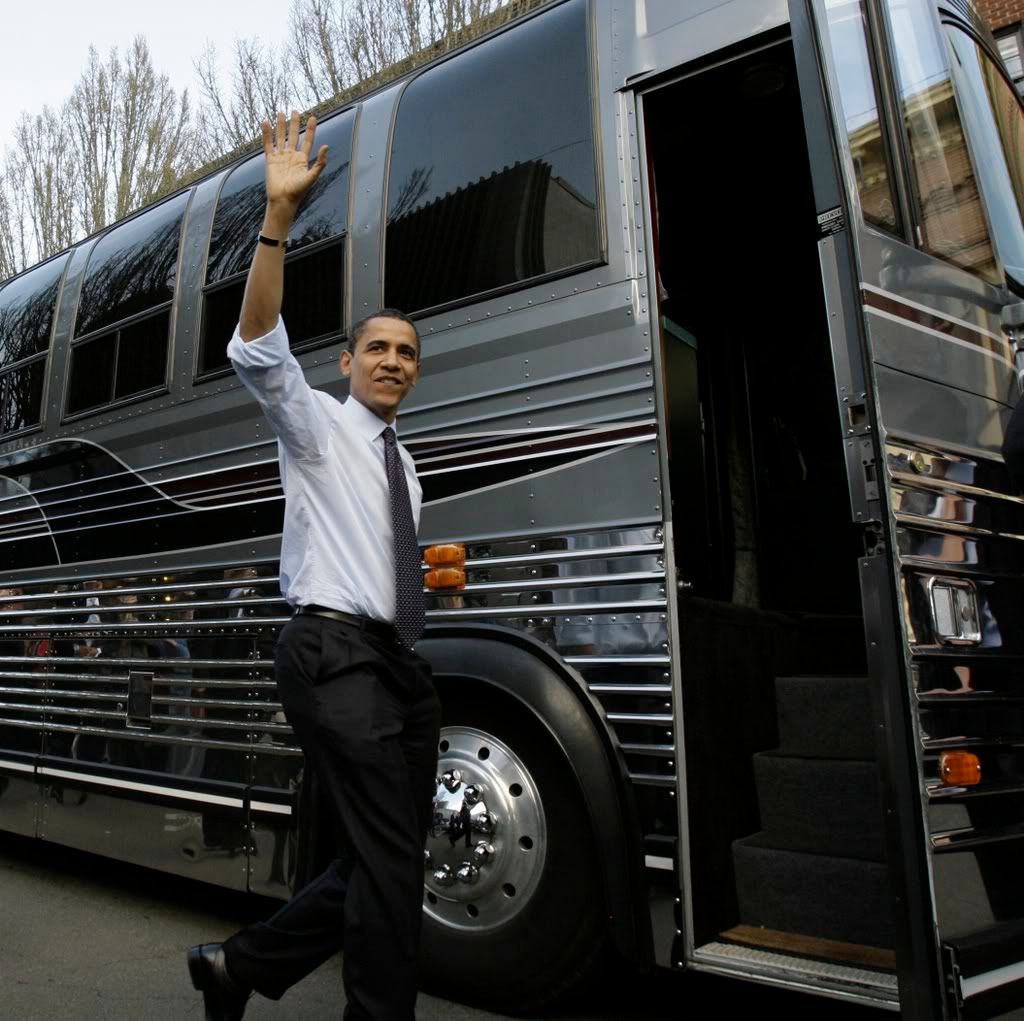
Contrast this even with Palin's book tour, which is now laboring under the revelation that Palin does not travel from signing to signing in a bus painted especially for the occasion, but in a private jet.

Clothes Make the Man and Woman

Nothing says more about the difference between William Jennings Bryan and Sarah Palin and their underlying political philosophies than their choice of clothing.

There is little doubt that Sarah Palin loves clothes and loves to be seen in them. She wants to be a cover girl, her picture peeking out from all those supermarket magazine racks. Despite her attempts to finesse the much-discussed 2008 campaign clothing expenses controversy in her new book, MSNBC asked the question puzzling many Americans in this observation about Palin during the 2008 campaign:
Can a candidate who portrays herself as a woman of the people spend this much on clothes and remain credible?

Even during the book tour, the Palin clothing controversy will not go away. Writing of Palin's wardrobe, Financial Times fashion editor Vanessa Friedman observed:
Her mouth may be saying no to Palin for President in 2012, but her clothes are saying maybe.

Bryan, on the other hand, deliberately dressed unfashionably. His "uniform" became an alpaca coat and a bow tie.
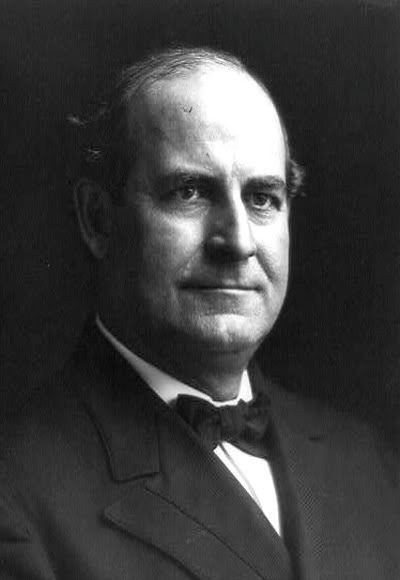


Character

There is one final and important contrast between Bryan and Palin that is especially germane to today's Era of Bad Feelings. During Bryan's lifetime, America experienced some of its most divisive economic, social and political conflicts and Bryan was at the frontlines of many of these. Yet despite the rancor of the times, Bryan had few genuine enemies.

The Times would acknowledge about Bryan:
He would have no enemies on the floor of the House. Search The Record during the two sessions of Congress he was entitled to occupy its pages, and not an instance can be found where he made a reply to an antagonist that would prevent him from meeting his opponent face to face in a moment after the debate.

Contrast this with Sarah Palin's famous nickname "The Barracuda." Pollster Dave Dittman, who worked for her gubernatorial campaign, told the conservative Weekly Standard magazine in 2007:
The landscape is littered with the bodies of those who crossed Sarah.

The "Sarah Barracuda" nickname perfectly captures Palin’s contradictions. Sarah is your next-door neighbor become a celebrity, a person millions of Americans believe is just like them. The Barracuda nickname embodies the anger felt by those same millions who are mad as hell and aren't going to take it anymore.

The Antis

This is a growing and disturbing contemporary American trend, heard in the hard edged rants on talk radio and in blogs of all political persuasions. The angry rant, complete with four-letter words has become the discourse of choice for many to argue about politics. If you want to characterize this group with any of those catchy titles cluster analysts love to use, you could call them the Antis.

In interviews with Palin supporters it comes through in no uncertain terms that the Antis on the right believe Palin finally gives them a voice. But the question is how long can Palin ride that tiger?

She found out that the Antis can quickly turn ugly when she walked away from a book signing in Noblesville, Indiana (something BTW Bryan would have never done) setting off a wave of anger that had an angry crowd gathered outside her bus, some of them loudly booing her. Palin hunkered down inside the bus, refusing to come out and address the crowd. In Palin's defense her staff may have felt it was unsafe for her to confront the crowd, but the scene still leaves an uneasy feeling.

If Sarah Palin can stir up such mob-like emotions and then prove unable to control them, what will happen if her supporters turn their anger on someone else or become a real mob?

A Final Word

Perhaps the most damning aspect of the portrait Stanley Kramer painted of William Jennings Bryan was to imply he was the instigator of a mob. Inherit the Wind wanted to show what can happen when zealotry gets out of control, trying to draw a warning about the excesses of McCarthyism, but in doing so it cast Bryan in a role he never played.

As the most electrifying speaker of his time--and perhaps in all of American history--it would have been very easy for Bryan to become the head of a mob. That certainly was at the root of the fear he inspired in the tycoons of the Gilded Age who worried that Bryan would lead a crusade against them that would turn violent.

Given the tone of an era characterized by two Presidential assassinations, pitched battles during the Homestead, Pullman and other strikes, the incendiary rhetoric of various radicals, and a sensationalistic and partisan press that makes Faux News look tame, such fears are understandable. Yet the irony is that for all the plutocrats' worries about the mob, Bryan disdained mob politics as much as they did.

Bryan was well aware of his ability to move a crowd. After the "Cross of Gold" Bryan would write in his memoirs, “The audience acted like a trained choir.” Yet he never incited a crowd in the fashion of prairie firebrands such as "Sockless Jerry" Simpson or Mary "Yellin" Lease.

The question is whether Sarah Palin will show the same restraint. If not, we may learn what happens when millions of people go rogue and America turns rouge.

Labels: , , , ,

 
by Ralph Brauer | 3/30/2009 09:15:00 AM


Iowa's fields of paradox lie shrouded in the gray mists of spring, the clouds churning overhead promising a white-out or a tornado. Rain changes to sleet, pelting the churned-up earth with a sound like birdshot. Only no pheasants arise with deliberate wings to seek a better refuge. It is that time of year when all hangs in the balance, when it could be sixty or sixteen, when the calendar could read March or November, when only fools think they know the shape of tomorrow.

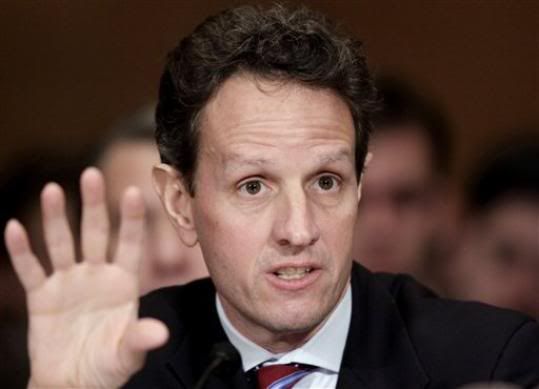
On this day the mood of the weather seems to reflect the climate of the nation, which seems to bounce from hope to fear to sheer incomprehension. A year after Barack Obama had walked from these very fields to Washington, the Capitol Dome is enveloped in rain and fog as the new Secretary of the Treasury testifies before the House Committee on Financial Services.


His testimony will outline the administration's much anticipated regulatory plans, explaining how the White House will bring some order to an out-of-control financial industry. Yet his words mirror the weather. The forecast for the nation's capital is for more fog; the forecast for the fields of paradox mentions snow.

The Background

In the previous essay I advanced the notion that a convergence in economic philosophy between Republicans and Democrats at the end of the last century caused the present crisis. A key to understanding this are Bush's economic appointments, many of whom were cast from the same mold as Timothy Geithner, Lawrence Summers and their mentor Robert Rubin, Bill Clinton's Treasury secretary.

Summers, Rubin and Bush appointees Henry Paulson and Ben Bernanke all share similar academic backgrounds. Bernanke and Rubin both hold a Harvard Economics degree; Summers an economic degree from MIT. Paulson has a Harvard MBA. Of course it is not unusual for Ivy League types to end up with high government posts, especially in academically-oriented policy areas such as economics.

What both Republican and Democratic economic advisors dating back to the Reagan years share is an intellectual affinity for what is known as "new" or "neo classical" economics. As Nobel Laureate Robert Lucas proclaimed in 1980:
One cannot find good, under-40 economists who identify themselves or their work as 'Keynesian.

Lucas was a student of Milton Friedman at the University of Chicago and with Friedman helped to turn Chicago into a famous enclave of anti-Keynesians.

In the early 1980s economic thinking on the Charles River also began to change as Marvin Feldstein, Stanley Fischer and Rudiger Dornbusch taught variations of the neo-classical approach to students such as Rubin and Bernanke. Justin Fox notes in a seminal article for Fortune:
The products of this atmosphere include a disproportionate number of the world's most prominent economists.

Fox explains what unites these policy-makers:
The members of this group don't fit into any neat ideological or doctrinal category, but they are generally skeptical of both unfettered capitalism and government efforts to fetter it. They share Keynes' conviction that markets can go wrong (some of the younger ones even call themselves new Keynesians) but have also accepted the criticisms of Friedman and Lucas.

As Fox points out, what unites both is a faith in the market that goes back to Adam Smith. The disagreements are over the degree to which one intervenes in the market. In general Republican policy makers such as Reagan economic advisor Feldstein tend to lean more towards the Friedman side, while Democrats such as Rubin lean more towards the Keynesian side.

The Democratic version of this has come to be termed "Rubinomics" in name of Bill Clinton's former Treasury Secretary. The New York Times gave perhaps the most succinct definition of Rubinomics:
Balanced budgets, free trade and financial deregulation.

All three are measures that both Republicans and Democrats have supported.

Early Warning Signs

Within economics the conflict between the neo-classists and those favoring other approaches has raged for several decades. In 2003 the Chronicle of Higher Education took note of the dispute in an article by Peter Monaghan which began:
How do you start a fire under a huge wet blanket? A faction of disgruntled economists says that is their predicament.

Bruce J. Caldwell, a historian of economic thought at the University of North Carolina at Greensboro worried:
Everyone is trying to be a little MIT or a little Harvard, and look exactly the same because that's the way you get scientific prestige.

As the 2008 election heated up, the dominance of disciples of Rubinomics on the Obama economic team inspired several warnings from those who believed Rubinomics played a role in the present crisis. Perhaps the loudest and most persistent critic is economist and New York Times columnist Paul Krugman. Just after the election Krugman wrote:
What worries me is there is not one person in the senior group who is the outsider to this club. Where is the diversity of opinion in this economic team?

In 2007 Thomas Palley wrote in The Nation:
Before Democrats can begin to reverse a generation of laissez-faire policy dominance that has put corporations and CEOs ahead of working families, they must debunk Rubinomics, which makes the budget deficit the central focus of economic policy.

This January the Wall Street Journal had the following obituary:
If our Washington, D.C., readers noticed a cortege of blue suits carrying a casket in front of the Brookings Institution last week, be not mournful. You were merely watching the leading economists of the Democratic Party burying the faith once known as Rubinomics. May it rest in peace.

Both the WSJ and the Nation make the same mistake--which in itself ought to tell you something--in focusing on balanced budgets as the defining characteristic of Rubinomics while ignoring the other two tenets identified by the Times--free trade and deregulation. Much has been made in recent months about the Democrats returning to Keynesianism because of the large deficits that are a central part of the Obama economic plan, but little has been said about the other two. That is why Geithner's was eagerly anticipated, for would it signal a complete break with Rubinomics by one of Rubin's own disciples and the Obama Administration?

A Divergence

It is the deficits that have stirred up an ideological battle many thought had died. The field shifted quickly after the last election. Where Republicans and Democrats had both shared a penchant for balanced budgets, it became clear that the ever-deepening economic crisis would require altering that idea. For a brief moment it seemed as though both parties had executed a swift 180, but that died as people began scrutinizing the Obama budget,

Normally after a watershed election such as 2008, the losing party moves more towards the center, but many in the GOP now blame attempts at moderation for their loss. They also have begun to look back on the eight years of George W. Bush as another straying from the righteous path. In their view what caused this Depression was not that Bush was a Republican, but that he was not Republican enough, which is why Bush may be one of the few Presidents vilified by both the opposition and his own party.

At the same time the Democrats seemed to borrow a page from the New Deal, proposing massive infrastructure investments and deficit spending. So was Rubinomics really dead? Had his two disciples Geithner and Summers changed their allegiance?

This is where Geithner's testimony--and the major remaining pillar of Rubinomics, deregulation--becomes extremely important for understanding the policy direction for the next few years.

Geithner's Testimony

Asked what ht thought about Geithner's testimony on National Public Radio's weekly review of events, New York Times columnist David Brooks answered as if he had been reading this series:
Second coming of Adam Smith.

His sidekick, Washington Post columnist E.J. Dionne (who also works for the Brookings Institution--the home of the Hamilton Project and a Rubinomics outpost) answered in true Rubinomics fashion:
They're playing things down the middle.

Hearing Dionne I thought of Jim Hightower's book There's Nothing in the Middle of the Road but Yellow Stripes and Dead Armadillos.

Geithner's testimony is notable not so much for what he said, but what he did not say. It is hard to believe that in yet another appearance before Congress, Geithner has yet to even mention the words Glass-Steagall. It is as though there is a taboo on them in the White House.

Glass-Steagall, of course, represents an economic philosophy that contradicts all three tenets of Rubinomics--Balanced budgets, free trade and financial deregulation--and Geithner was not about to repudiate his mentor or start a fight with fellow Obama economic advisor Summers. Instead both Dionne and Brooks got it about right.

Geithner began his pitch as of he had been prepping for his appearance by reading old Summers' speeches about the twin causes of economic recessions, only more than Summers Geithner put his emphasis on the system being "unstable and fragile." In true Rubinista fashion he notes:
Innovation and complexity overwhelmed the checks and balances in the system.

Then comes a key transition in his testimony when he admits there were problems:
Compensation practices rewarded short-term profits over long-term return. We saw huge gains in increased access to credit for large parts of the American economy, but those gains were overshadowed by pervasive failures in consumer protection, leaving many Americans with obligations they did not understand and could not sustain. The huge apparent returns to financial activity attracted fraud on a dramatic scale.

I quote this section at some length to point out a common theme running through Geithner's analysis:in each of these sentences Geithner is in essence saying individuals took advantage of the system. Clearly the Obama Administration has decided that its explanation for the crisis is going to be that at its root are those old villains excess and greed.

This has three implications. First it has the virtue of excusing Rubin and other policy-makers who have been accused of planting the seeds of this depression, for if greed and excess were the problems that means that policy had nothing to do with it. People took advantage of what were essentially sound policies. Second, by not fingering policies as the cause, Geithner and the Obama Administration also take George Bush and his administration off the hook, potentially buying good will with Republican votes that will be needed to pass any of Obama's economic legislation. Third, it plays to those in the media and the public who want someone to blame rather than something.

Once you have accepted this analysis then the solutions Geithner proposes fall into place. What are needed are regulations that will prevent this excess and greed from happening again. The system does not need an overhaul but a tune-up. This is clear in the second paragraph of Geithner's testimony:
To address this will require comprehensive reform. Not modest repairs at the margin, but new rules of the game. The new rules must be simpler and more effectively enforced and produce a more stable system, that protects consumers and investors, that rewards innovation and that is able to adapt and evolve with changes in the financial market.

Notice again the language, which you can be sure was carefully chosen. The key word is "reform" which fits well with the strategy of blaming people rather than the system for we reform criminals, but we restructure systems. Despite Republican rhetoric trying to portray the Obama economic strategy as the second coming of the New Deal, this actually is in stark contrast to the New Deal which involved significant restructuring.

The Consequences of Geithner's Testimony

By leaving two of the three pillars of Rubinomics untouched, the Obama Administration unwittingly has chosen to play the game on the Republican's court. The only one of the three pillars the administration has chosen to change is the one involving balanced budgets. This means over the last three administrations we have had some remarkable philosophical changes: the Clinton Administration's balanced budgets, the Bush Administration's record deficits and now the Obama Administration's deficit spending.

All of a sudden the GOP has found its voice again, you remember the one that talked about "tax and spend." In the fog and rain of the day Geithner testified this somehow seemed appropriate for it was as if a corpse had risen from the dead like one of those zombies in a bad horror movie. The situation would be as if the Republicans of the 1930s had decided to repudiate Herbert Hoover.

This is why I fear that the Obama Administration will be unable to deal with the crisis in a meaningful way as long as it continues to retain Rubinistas in key economic positions, for those officials will never disavow the policies that helped to cause this crisis. If individuals and not the system are the problem sooner or later the systemic causes of the crisis will again arise.

WHO is to Blame?

There is another reason Geithner's testimony could cause problems, for if you are going to blame people as the cause of the crisis that begs the question, "Which people?" If "financial activity attracted fraud on a dramatic scale" then which corporations and executives is he talking about?

For an economist--someone whose credibility depends on being able to marshal the evidence to support his conclusions--Geithner's testimony is strangely absent of specifics. Were his words written as a student paper he would receive the proverbial Ivy League "gentleman's C" or worse.

Maybe you can craft regulations that will prevent further abuses, but what people want to know is who is responsible for this mess and if they participated in "fraud on a dramatic scale" will they be prosecuted? Perhaps the most telling example of this is that three banks have been in violation of the 1994 Riegle-Neal Interstate Banking and Branching Efficiency Act which states:
The Board may not approve an application pursuant to paragraph (1)(A) if the applicant (including all insured depository institutions which are affiliates of the applicant)controls, or upon consummation of the acquisition for which such application is filed would control, more than 10 percent of the total amount of deposits of insured depository institutions in the United States.

Yet neither Geithner nor the Obama Administration have mentioned violations of this law, but instead have looked the other way. Even more disturbing is the question whether any of the three--Bank of America, Wells Fargo and J.P. Morgan--enhanced their market share using federal bailout funds.

The Law of Unintended Consequences

In fact I would argue that from a systemic point of view, Geithner's recommendations could make things worse rather than better. To understand this let's look at the crisis from a systemic perspective. As even Geithner and Summers grudgingly admit, the roots of the crisis came with the increasing concentration and integration that gripped the financial industry after the repeal of Glass-Steagall.

When you integrate and concentrate a system as happened to America's financial markets after the repeal of Glass-Steagall it triggers a host of possible consequences. First, it makes it easier for "greed and excess" to get out of control, allowing people like Bernard Madoff to pull off their schemes. Second, it means that any changes will be far-reaching and rapid. A concentrated system can be more efficient, but only when its efficiencies are aligned with circumstances.

If they are not, the results can be catastrophic. It is the systemic equivalent of that old saying, "The bigger they are; the harder they fall." The third consequence is that like a semi that has lost its brakes and is careening down a mountainside, a concentrated system that has lost its equilibrium is harder to rescue.

To see how this works, imagine America's financial system as a giant computer network composed of the networks of the institutions that are part of that system. Before Glass-Steagall the networks of those institutions were largely independent of each other. In some cases such as banks and financial institutions selling stocks and securities they were prohibited from interacting with each other.

The disciples of Rubinomics argue that this could be inefficient because all these different little networks could not compete with the larger, more integrated networks in some other countries. It takes longer for informati0n to flow through independent networks because by their very nature their connections and feedbacks are minimal. The Rubinomics supporters would even argue it is like a bunch of independent hardware or clothing stores trying to compete with Home Depot or Macys.

What we know is that every type of systemic organization has its trade-offs. Carter Glass, Franklin Roosevelt and some contemporary economists would argue that by separating banks and securities traders, they made it more difficult for those networks to become integrated. Because they were not integrated the information in one network could not "contaminate" that in another.

Now imagine each system hit by a particularly nasty virus--a recession or depression. In the more centralized system it will be easier for the virus to spread through the network because everything is interconnected. Or imagine a programming mistake or even outright fraud. In each case the more interconnected network will make it easier for these mistakes to migrate throughout the system.

In systems where the institutions are not directly connected it is far less likely for the virus to cause such extensive damage. Were Glass-Steagall in effect it would even prevent the virus from infecting certain parts of the system because they would be protected by an impenetrable firewall. Carter Glass and Franklin Roosevelt may have never heard about firewalls or computer viruses, but firewalls between banks and stock and securities traders are exactly what they were trying to build.

Take a large financial institution such as Citi. Its banking or insurance divisions may not have even been aware of what was happening in the mortgage divisions or if they were, a bad decision by the mortgage division or a bad investment by the derivatives division would have impacted the rest of the system like a virus infecting a computer network. The company may have known the bad decision/virus existed, but depending on how quickly they recognized it and the extent of the virus, it could work great damage before being finally contained. The mortgage division may have brought the virus into the system, but the interconnections allowed it to spread to other parts of the organization.

This is exactly what happened with the current recession. Geithner's proposals offer no solution to this systemic crisis because they leave this concentration intact. Instead his proposals could have the unintended consequence of further "tightening" the system, limiting its ability to maneuver. Putting a governor on a car may prevent a driver from speeding, but it also inhibits options that might avoid a crash.

There are those who argue we cannot go backwards; that we cannot break up these "too big to fail" (and getting bigger) financial giants, but that argument is a profound misreading of history. The historical parallel to the current crisis is 1893 not 1933.

The 1893 depression was triggered by concentration and integration remarkably parallel with that of today. The progressive anti-trust legislation at the end of the nineteenth century and the early twentieth century broke up the vertical monopolies that had become an economic liability for this country. The alternative would have been to follow the European example of nationalization.

The Glass-Steagall Act came about because Carter Glass and Franklin Roosevelt feared financial concentration. With its repeal the market concentrated and collapsed quickly. It was like the bursting of a balloon filled with too much hot air. Each merger and acquisition had a doubling effect just as each mortgage failure rippled through the system until it became a tidal wave. Had Glass-Steagall been in place the various sectors of the market would have been independent of one another, softening and perhaps even preventing the general meltdown that occurred.

I do not exaggerate when I say that the future of this nation hangs in the balance and neither political party currently has the right answer. Both are caught up in their common philosophical roots in neo-classical economics. One would have thought the current depression would have discredited that perspective, but unfortunately we find the people who caused the problem in charge of fixing it. It is as if FDR had hired Herbert Hoover's staff.

The End of Orthodoxy

What we need to recognize is that the prevailing economic mental models of both parties can not deal with this crisis. Rubinomics has revealed its shortcomings. To return to the laissez faire ideas some Republicans advocate, letting the market control everything with little or no government intervention would be disastrous. The Great Depression taught us that lesson and despite the efforts of revisionists like Amity Schlaes to rewrite history, no American who lived through the 1930s or has studied the 1930s would advocate abandoning the New Deal.

What we need is a new order of understanding that looks at the systemic consequences of economic policies. Systemic analysis does not offer solutions; it only lets us better understand the trade-offs. It is then up to the people to decide which trade-off is preferable.

With the financial crisis the people have never been directly presented with the trade-offs. Actually they are quite clear: we can have a more centralized system such as Rubinomics advocates that would allow us to match the giant financial institutions of other countries or we can have an independent system like we had under Glass-Steagall.

The crisis itself seems to hold the answers. Do we really want a future in which a centralized system jerks the economy back and forth between bubbles and bursts? This may benefit the "competitiveness" of those giants, their executives and major stockholders, but does it benefit the rest of us?

The alternative would be a more modernized version of Glass-Steagall that put some of the firewalls back in place. It seems obvious that giant financial institutions that contain banks that may hold our checking and savings accounts and perhaps our mortgages should not be using those funds to play roulette on the derivatives market. As Glass and Roosevelt recognized there needs to be a firewall there.

There also needs to be what Joseph Stiglitz terms more transparency. I doubt most of us knew that the same firms which held our conventional mortgages also were gambling in the subprime market. I speak from experience on that in that our mortgage was at one time held by ABN Amro and then Citi. We also did not know that our perfectly good mortagage was being bundled with more risky mortgages through "securitization." Had people known all this the "virus" that became the mortgage meltdown could have been curtailed much earlier.

Geithner's testimony offers twentieth century solutions to twenty-first century problems. It amounts to a tweaking of a bad system, making it even worse. To continue the computer analogy, instead of putting up firewalls it erects regulations which actually could make it more difficult for a concentrated system to contain viruses because any actions would have to be cleared by another layer of federal bureaucracy.

The Fields of Paradox

The fields of paradox have entrapped many a modern politician and policy-maker, for at the heart of the paradox is the tension between what statisticians term quantitative and qualitative analysis, or as an Iowan might say, between numbers and values. Barack Obama won Iowa because he understood this paradox better than Hillary Clinton. Where Clinton relied on the mircrotargeting strategy of Mark Penn, emphasizing staged media events, Obama went directly to the people.

It is ironic that this paradox describes the situation Obama's economic policy finds itself facing. Rubinomics is, above all, akin in many ways to Penn's microtargeting. Barack Obama, who is sitting in the White House largely because he understood the fields of paradox, now finds himself in the same position as Hillary Clinton. Maybe that is why his recent speeches have been strangely flat and incomplete. Were he as incompetent a communicator as George Bush he might find himself in deeper trouble.

Where Rush Limbaugh pointedly hopes that Obama will fail, few Americans share those sentiments because they know the consequences. An Obama failure may allow Limbaugh to gloat but for the rest of us it will mean more layoffs, foreclosures and bankruptcies and the erosion of the two assets the average American works a lifetime to build up--their homes and retirement (their health insurance is already all but lost).

The rain and fog that shrouded the nation's capital and the fields of paradox seem especially symbolic of America's current condition. Wall Street may be responding with a rally in response to Geithner's testimony but as David Brooks put it, Wall Street is stupid.

The rest of us still find ourselves in the equivalent of a cold drizzle, unable to discern the outlines of familiar landmarks. But what we really fear is that when the rain and fog clear they will reveal a desolate landscape because Barack Obama listened only to Geithner, Summers and Rubin and not the rest of us.

Labels:

 
by Ralph Brauer | 3/27/2009 07:28:00 PM


Their foot shall slide in due time. Deuteronomy 32:35.
--Jonathan Edwards text for "Sinners in the Hand of an Angry God"


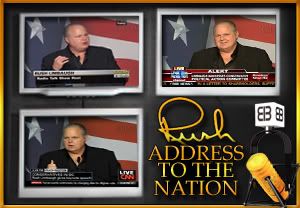
The people attending the Conservative Political Action Conference had come for a revival sermon, one that would pull no punches by casting sinners into the fiery furnace while promising that the righteous would be redeemed. To Rush Limbaugh's credit, his speech moved his audience more than any other recent Republican I have heard.


There were in Limbaugh's words and the reactions of his audience something of the Great Awakening of the eighteenth century when a preacher named Jonathan Edwards could set audiences screaming and fainting as he painted vivid pictures damnation.
Though hand join in hand, and vast multitudes of God's enemies combine and associate themselves, they are easily broken in pieces: they are as great heaps of light chaff before the whirlwind; or large quantities of dry stubble before devouring flames. We find it easy to tread on and crush a worm that we see crawling on the earth; so 'tis easy for us to cut or singe a slender thread that anything hangs by; thus easy is it for God when he pleases to cast his enemies down to hell.
But Edwards' main message--like Limbaugh's--was a simple one:
They deserve to be cast into hell.
Limbaugh probably wishes he had written one of the most famous passages in American literature:
The God that holds you over the pit of hell, much as one holds a spider, or some loathsome insect, over the fire, abhors you, and is dreadfully provoked; his wrath towards you burns like fire; he looks upon you as worthy of nothing else, but to be cast into the fire; he is of purer eyes than to bear to have you in his sight; you are ten thousand times so abominable in his eyes as the most hateful venomous serpent is in ours. You have offended.
YOU have offended, in that Edwards and Limbaugh would agree, only their yous are a bit different. For Edwards it was the backsliders of Puritan New England while for Limbaugh it is the backsliders of contemporary America.

The Backsliders

Limbaugh's speech was all the talk of the CPAC gathering precisely because of the disdain he holds for backsliders. Taking a page from Edwards he cast himself as the preacher who would remind the Republican Party how it had strayed from its ways and would remind them of the torments that awaited them should they continue on their sinful path.

Edwards was famous for delivering his sermons in a monotone which he purposely employed to better place the emphasis on his words. As he honed the technique, it would drive some audiences to near hysteria for his sheer lack of intonation carried an otherworldly quality that reinforced his message that those sinners in the audience were not worthy of anything human, not even a shouted curse.

There is something about Limbaugh's face that reminds me of Edwards' monotone delivery. Some analysts have said it is because Limbaugh is a radio voice, not a television actor, but his immobile face carries a similar frightening message to Edwards' monotone--sinners are unworthy of recognition. Limbaugh's rhetoric can become as worked up as Edwards', but he rarely moves his body to punctuate his words.

Where Limbaugh's delivery also differs from Edwards' is that Edwards delivered his sermon from notes or from memory. When the congregation in Enfield invited him to preach they expected to hear the same words he spoke in Northampton because they wanted to know that he had carefully honed every word.

We Don't Need Teleprompters

On the other hand, Limbaugh is famous for delivering what some detractors refer to as rambling rants. Certainly to call them speeches is to insult everyone who has sweated over addressing a group. Limbaugh makes it clear his choice of a rambling style is as deliberate as Edwards' rhetorical decisions, for to Limbaugh you should be able to say what is on your mind and in your heart without resorting to memorizing, notes or a teleprompter.
We don't have to make notes about what we believe. We don't have to write down, oh do I believe it do I believe that we can tell people what we believe off the top of our heads and we can do it with passion and we can do it with clarity, and we can do it persuasively.
This style strikes a responsive chord in these days when everything is packaged. While there is little question Limbaugh is as packaged as any bre4akfast cereal (just look at his web page if you doubt that), his appeal is based on making it appear he is unpackaged, right down to his slightly rumpled appearance.

There are very few speakers who have perfected and practiced this anti-style. The acknowledged master of it in the last century was Adolf Hitler. His propaganda minister Joseph Goebbels wrote:
There are two fundamentally different kinds of speakers: those who use reasoning, and those who speak from the heart. They reach two different sorts of people, those who understand through reason, and those who understand through the heart. Speakers who aim for the reason are generally found in parliaments, those who speak from the heart speak to the people.

One cannot imagine that the Führer ever spoke differently than he does today, or that he will ever speak differently. He speaks his heart, and therefore reaches the hearts of those who hear him.
The rhetorical tactic Limbaugh uses is akin to a magician's slight of hand for by convincing his audience he is talking off the top of his head and from the heart, he immediately takes his speech out of the realm of reason and into the realm of passion. In a large sense Limbaugh's audience does not care what he thinks. They only care what he feels. They crave an emotional connection with him because frankly most of today's teleprompted speeches have little emotional connection. It is as if every word were drafted by a focus group.

If Limbaugh twists his facts as he does when he misquotes the preamble to the Constitution or gets lost in his speech, it does not disturb his audience because only what he feels matters. There is a moment when Limbaugh loses track of time that captures this:
Many people think I lose my place in these speeches because -- by the way what time is it? We have plenty of time. We have to be out of here by-- [Applause] We have to be out of here by 6:00 -- okay, depends on how you behave. I'll decide as we go on.

Of course in the CPAC speech Limbaugh is jousting with one of the greatest public speakers of our times--Barack Obama. Limbaugh's allusions to teleprompters and notes are not-so-subtle digs at Obama, digs intended to convince the audience that because he uses such devices, Obama is not "authentic."

Trust the Force

Having taken his speech away from the realm of reason, Limbaugh need only connect with feelings. Strangely this is a theme that flows through the work of one of Limbaugh's avowed enemies--Hollywood. His rhetoric is Obe Wan saying to Luke Skywalker, "Trust your feelings. Trust the force."

This is also Jonathan Edwards' message. The Great Awakening represented an emotional wave that swept across a colonial America that hungered to connect with its feelings and at the same time trust in "the force." Although neither would admit it, both George Lucas and Rush Limbaugh are modern Puritans, convinced that only those who truly feel the force are on the right side.

The force Limbaugh trusts he terms conservatism, but his conservatism is not so much a set of beliefs as a collection of emotions. It is these he weaves his speech around coming back to them again and again like a weaver running his shuttle through the threads of his loom. Like the shuttle passing back and forth, Limbaugh may seem to wander but the warp of the loom remains in place as he crafts his tapestry.

The Core

Limbaugh's core beliefs could have been written by William McKinley or Horatio Alger, for he worships at the altar of the self-made entrepreneur. Again and again he comes back to this theme in his CPAC speech.
.The people that make this country work, the people who pay on their mortgages, the people getting up and going to work, striving in this recession to not participate in it, they're not the enemy.

They're the people that hire you. They're the people that are going to give you a job. They're the people that are going to give you a raise, the people that need you to do work for them.

On the other side are what Limbaugh terms "losers," those who do not have the gumption to pull themselves up by their bootstraps. Only Limbaugh, who looks for all the world like the kid who was the last one picked in some backyard game,loves to use athletic metaphors:
The liberals have made efforts to shut that aspect of our nature down. Wherever you live, I am certain that you, when you were a child or your kids today in youth sports are told not to keep score, because the losers, it's just not fair. They'd be humiliated, especially if one girl's basketball team can defeat another one 100 to nothing. And let's fire the coach who put that game together. It's so unfair. So let's not keep score. Well, here's the dirty little secret. The kids are keeping score. [Applause] You know they are. They don't want to lose. They know what winning and losing is.


Hard Times

This message resonated well during the dot com bubble when every American felt she or he was only one video game, one new line of code, one new piece of hardware away from striking it rich like one of those Forty-Niners who sloshed away in bitter cold water believing that the next swish of the pan would uncover the tell-tale flickers of gold flakes. You could believe then in the heart of Limbaugh's sermon, but can you believe it now when that world has not merely fallen apart but is being seen as the root of this crisis?

Far from working hard to get ahead it is becoming clearer that the wheelers and dealers of the 1990s were gambling with our money. They were as crooked as a riverboat card sharp and as clever as a carny pitch man. That had too many of us believing that we could win what in fact was a rigged game.

Those who in the 1990s Limbaugh regarded as the saved have now become revealed as sinners and Limbaugh's sermon shows he does not know what to make of this. Yet why was Limbaugh so warmly received at CPAC? Why did Fox and CNN choose to broadcast his speech? Why was it the talk of the nation for days after? Because this crisis is about emotion and anger. Limbaugh is gambling that he can blame "liberals" for this mess just as Hitler blamed the Jews. Hence his references to Bill Clinton and Barack Obama.
The architects along with Bill Clinton of the policy that gave us the whole sub-prime mortgage crisis, get to sit around and act as innocent spectators to investigate what went on when they largely had the biggest role in causing it.

President Obama is our president. President Obama stands for certain things. I don't care, he could be a Martian. He could be from Michigan, I don't know -- just kidding. Doesn't matter to me what his race is. It doesn't matter. He's liberal is what matters to me. And his articulated -- his articulated plans scare me.

Yet history is not on Limbaugh's side. No one has ever built a mass movement during a depression on defense of the rich. If he is to remain relevant Limbaugh will need new scapegoats. Liberals were not in the White House the previous two terms. Liberals were not in control of the Bush Congress. Why even liberals themselves have run up the white flag refusing to use the term.

The ending of Limbaugh's rant is instructive when compared with Edwards'. Here is Limbaugh:
Don't measure your success by how many people like you. Just worry about how they vote. And then at the end of the day how they live, but that's really none of your business once they close the doors.

Then Edwards:
Therefore let everyone that is out of Christ, now awake and fly from the wrath to come. The wrath of almighty God is now undoubtedly hanging over great part of this congregation: let everyone fly out of Sodom. Haste and escape for your lives, look not behind you, escape to the mountain, lest you be consumed.

Limbaugh is worried about how "they" vote because lately they have not been voting with him. Then there is that double-edged last sentence. The true tragedy of Rush Limbaugh is not so much in what he believes but why he believes it. As an entertainer his entire livelihood depends on his attracting as many listeners as possible--and in that he is no different than any vote-seeking politician.

Edwards, on the other hand, does not care if he is in the majority. In fact his sermon implies that true believers will always be a minority. For Edwards it is the beliefs that matter without any concern with numbers while for Limbaugh the numbers are what make the beliefs matter.

Where the numbers matter is that right now, in this economy all of us are losers. Some of us have lost the value of their stocks and homes, others have lost their retirement, too many have lost their jobs and homes. All through no fault of their own. As the furor over the AIG bonuses demonstrates there are not many left who would agree with Limbaugh's implication that those executives deserve to keep their money.

Limbaugh would be wise to take Edwards' sermon to heart. A recent CBS poll showed Limbaugh's favorable rating at just 19% while his unfavorable rating is 40%. But more tellingly, less than a majority of Limbaugh's Republican base gave him a favorable rating.

Maybe that is because of the most controversial part of his speech when he said he wanted Barack Obama to fail:
You can't say Mr. Limbaugh that you want the President to fail because that's like saying you want the country to fail. It's the opposite. I want the country to survive. I want the country to succeed.

Limbaugh may believe that if Obama fails that makes him a winner, but the truth is if Obama fails the losers and losses will be staggering and all of us will echo the last line of Edwards' sermon.


Labels: , , , ,

 
by Ralph Brauer | 1/22/2009 10:28:00 PM


I doubt anyone will ever again sing "My Country Tis of Thee" the way Aretha Franklin sang it at the Obama Inauguration, because not even she will sing it that way again. That's because in gospel you sing what you feel. You testify. And if anyone testified on that singular day it was Aretha Franklin along with the man many term the father of the Civil Rights Movement, the Reverend Joseph Lowery.


As most people, know Franklin's roots are in gospel, in part because she is the daughter of one of the most revered figures in the African American Church, the Reverend C.L. Franklin, who also was a close friend of another African American minister, Dr. Martin Luther King, jr. Her first album, recorded when she was 14, was a gospel album which was produced for the same label whose recordings of her father's sermons had made him a national figure.

One of my favorite Franklin albums is an all-gospel production that was recorded at her father's church many years ago. At one point in the recording, C. L. Franklin remarks, "she never left the church." Like Ray Charles, Franklin brought the rhythms and sounds of gospel to popular music, earning her the title the "Queen of Soul."

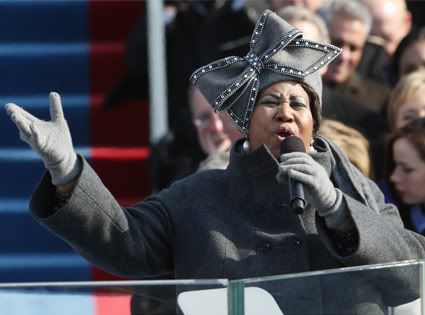
Those skills were showcased at the Obama inauguration where, like Charles, she took a patriotic song and endowed it with the soul of gospel. You knew this was going to be a performance for the ages when she gave the words "sweet" and "liberty" a particular cadence that reverberated with meaning.

Think for a minute of the task she faced as an African American celebrating the inauguration of America's first African American President. Her "testimony" had to both acknowledge the struggles of the past and yet also the triumph of the present. By drawing out those two words the way she did, she made you pause and acknowledge those meanings.

This took on even more meaning when she reached the words "land where my fathers died." Shortly after that she did an extraordinary thing I have not seen anyone acknowledge--she changed the words to the song, so that it directly referenced Dr. King's immortal words. The original lyrics read "every mountain side" which Franklin changed to "mountain top" the words King used. In addition, to highlight the change she repeats the word "every" several times so it sinks in.

Franklin then went on to sing the song's lesser-known final verse. By the time she reached the last two stanzas, I had lost it. The second-to-last stanza begins with the words "protect us by thy might." Franklin repeats "protect" over and over, so it becomes a kind of prayer and, given circumstances which provoked an extraordinary amount of security, also a wish for both the new President and the country.

Listen to her sing that one line again and again, for she endows it with all the hopes Americans had that day and have for the incoming administration. When she ends the song Franklin and her backup choir repeat again the desire to let freedom ring, in a way that she knew she was testifying. Had she sung it that way in her father's church there is little doubt in my mind that the audience would have been spontaneously shouting their own reactions.

Unfortunately, Franklin's singing became lost in the uproar over her hat. It was Ellen de Generes who put her foot in her mouth by wearing a reproduction of Franklin's hat, turning it into a joke. Actually had de Generes known what she was poking fun at, she might have thought differently, for the wearing of special hats--especially unique ones with a bit of flash--is an old custom for African American church women.

Michael Cunningham and Craig Marberry celebrate this tradition in their book Crowns: Portraits of Black Women in Church Hats. Deirdre Guion calls it:
hattitude...there's a little more strut in your carriage when you wear a nice hat. There's something special about you.

The man who sold Franklin the hat, Luke Son, said the clientele for Mr. Song Millinery is 90% African American church-going women. So far from being a joke, Franklin's hat was the perfect accessory to her gospel-tinged version of "My Country Tis of Thee" and brought a historic piece of African American culture to the Inauguration.

The other person who brought a historic piece was the Reverend Joseph Lowery, who co-founded the Southern Christian Leadership Conference along with Dr. King. It would take a space longer than this essay to detail Lowery's achievements, so suffice it to say if anyone in America deserved to deliver the Benediction at Barack Obama's Inauguration it was Lowery.

Lowery's beard--or more properly it should be termed a goatee--reminded me of W.E.B. DuBois, whose book The Souls of Black Folk used verses from what he termed the "sorrow songs" to introduce each chapter and in a chapter titled "Faith of Our Fathers" wrote of the African American church. He wrote:
The black and massive form of the preacher swayed and quivered as the words crowded to his lips and flew at us in singular eloquence. (p. 190)

The eighty-seven year old Lowery brought his own singular eloquence, proving a better poet than the official poet who preceded him. The rhyme and rhythm of his first phrases brought a hush to the audience.
God of our weary years, God of our silent tears.

Now that is poetry whose rhythm directly echoes "My Country Tis of Thee." Think of the phrase "land where my father's died, land of the Pilgrim's pride." Lowery knew exactly what he was doing. To bring together weary years and silent tears, to hear those words from a man who knew exactly what he was talking about made he and Franklin the perfect bookends for the Inaugural. Ever the activist Lowery did not shy away from telling it like it is.
He has come to this high office at a low moment in the national and, indeed, the global fiscal climate.

For we know that, Lord, you're able and you're willing to work through faithful leadership to restore stability, mend our brokenness, heal our wounds and deliver us from the exploitation of the poor or the least of these and from favoritism toward the rich, the elite of these.

Lord knows what George W. Bush and Dick Cheney must have been thinking when they heard those words.

Having painted a picture of contemporary America, Lowery went on to preach of the hope that Obama's Presidency has brought to the nation.
And while we have sown the seeds of greed -- the wind of greed and corruption, and even as we reap the whirlwind of social and economic disruption, we seek forgiveness and we come in a spirit of unity and solidarity to commit our support to our president by our willingness to make sacrifices, to respect your creation, to turn to each other and not on each other.

Near the end, Lowery takes a cue from Franklin evoking the same word she used.
And as we leave this mountaintop, help us to hold on to the spirit of fellowship and the oneness of our family. Let us take that power back to our homes, our workplaces, our churches, our temples, our mosques, or wherever we seek your will.

Finally Lowery concludes with paragraphs that cannot help but complete the tie to his old friend Dr. King, even evoking the spirit and rhythm of that long ago day in Washington when King gazed toward where Lowery was speaking even as four score years later Lowery looked out to the place King had spoken from.
We go now to walk together, children, pledging that we won't get weary in the difficult days ahead. We know you will not leave us alone, with your hands of power and your heart of love.

Help us then, now, Lord, to work for that day when nation shall not lift up sword against nation, when tanks will be beaten into tractors, when every man and every woman shall sit under his or her own vine and fig tree, and none shall be afraid; when justice will roll down like waters and righteousness as a mighty stream.

In the midst of Black History Month, a day after Martin Luther King Day, both Franklin and Lowery reminded us of the pivotal role the African American church has played in American history. In a way, the African American church elected Barack Obama.

When I say the African American church I mean the African American church, for it is not so much about ministers as about congregations, not so much about Biblical fundamentalism and thou-shalt-nots as about principles. The Lowerys and Kings have justifiably earned their place in American history, but we forget the fact that as transformational leaders, they would have accomplished little without their congregations.

Much has been written about the Obama campaign, but no one has thought to link it back to the traditions of the African American church. Civil Rights veterans like Lowery would recognize the Obama campaign's tactics, as would anyone who has been a member of an African American congregation.

So when I say the African American Church elected Barack Obama I mean that in three ways. First, church leaders and congregations backed the candidate as they have backed no candidate in history. The huge African American turnout proved pivotal in this election. Without it Barack Obama would not have been standing behind Joseph Lowery waiting to take the oath of office.

The second way the church played a role in the campaign was to endow it with a sense of principle. The Civil Rights movement grew from the African American church's insistence on principle. The Obama campaign came to symbolize a renewal of principles for many Americans who voted for him.

The third way the African American church elected Barack Obama lay in lending its tactics to the campaign. The image of the Civil Rights Movement many Southerners tried hard to reinforce was that it was a top-down movement, that if leaders like King and Lowery could be stopped then the Movement would whither away. But in the records of the Mississippi State Sovereignty Commission--a secret police force formed after the Brown decision--lies another story, one of thousands of people who put their lives on the line for freedom.

One moment in the Movement could have served as a blueprint for the Obama campaign. Deprived of the right to vote for African American candidates by the State of Mississippi, the Freedom Democratic Party organized a shadow vote they called the Freedom Ballot. All across the state African Americans voted on Freedom ballots to show the segregationists that they would not be denied the right to express the franchise.

This grassroots effort, conducted with a major boost from African American churches, knit together people across the state. Nothing like it had ever been seen in Mississippi or in America. To minimize the violent segregationists that would be attracted like moths to a flame, organizers mailed the Freedom Ballot over a four-day period. The courage behind the effort remains difficult to imagine, for everyone involved in printing, distributing, filling out and counting the ballots literally put their lives on the line, testifying to a communal strength and resolve determined to rid the state of oppression. When the counting ended, over 50,000 African Americans had sent in ballots, a collective shout for freedom that reverberated across Mississippi to the very halls of Congress.

Nothing like the Obama campaign's grassroots effort had been seen until this November. Even on election night commentators could not quite believe it, but like those who participated in the Freedom Ballot, the campaign organizers knew the strength of their grassroots work.

As we now move forward into the Obama Administration, we would be wise not to forget the African American church, for just as it lay behind the election of Barack Obama, its people, principles and tactics will be there for him to call on when the going gets tough. Aretha Franklin all but said so as she sang, Joseph Lowery all but said so as he preached.

This is going to be a administration the likes of which America has never seen before.

Labels: ,

 
by Ralph Brauer | 1/20/2009 12:36:00 PM

barack20obama20capitol


Blogging live on Inauguration Day, less than two hours before Barack Obama takes the oath of office.


The Backdrop: When the actor in Ronald Reagan moved the location of the presidential swearing-in from the front of the Capitol to the rear little could he have foreseen the consequences. Ever playing to the camera, Reagan chose to use the rear, which as millions of tourists know provides one of the most famous views in America as it looks down the mall towards the Washington Monument, Lincoln Memorial, and Jefferson Memorial and now the World War II Memorial. Across the river lies Arlington National Cemetery. There seems little question Reagan personally stage-managed this setting which he would invoke in his Inaugural Address.

With his actor's sense of symbolism symbolism Reagan thought that if the ceremony took in that view his words would resonate with the nation's past. The obelisk dedicated to the man known as the Father of Our Country would punctuate the event like a giant exclamation point while the stern visage of the Great Emancipator gazed on the scene. Across the river the dead at Arlington would lie like a Greek chorus silently overseeing it all. The Great Communicator worked the setting into his first Inaugural address, using it not at the beginning of his speech, as an ordinary speaker might have been tempted to do, but at the end:
This is the first time in history that this ceremony has been held, as you have been told, on this West Front of the Capitol. Standing here, one faces a magnificent vista, opening up on this city's special beauty and history. At the end of this open mall are those shrines to the giants on whose shoulders we stand.

Directly in front of me, the monument to a monumental man: George Washington, Father of our country. A man of humility who came to greatness reluctantly. He led America out of revolutionary victory into infant nationhood. Off to one side, the stately memorial to Thomas Jefferson. The Declaration of Independence flames with his eloquence. And then beyond the Reflecting Pool the dignified columns of the Lincoln Memorial.

Whoever would understand in his heart the meaning of America will find it in the life of Abraham Lincoln. Beyond those monuments to heroism is the Potomac River, and on the far shore the sloping hills of Arlington National Cemetery with its row on row of simple white markers bearing crosses or Stars of David. They add up to only a tiny fraction of the price that has been paid for our freedom. Each one of those markers is a monument to the kinds of hero I spoke of earlier. Their lives ended in places called Belleau Wood, The Argonne, Omaha Beach, Salerno and halfway around the world on Guadalcanal, Tarawa, Pork Chop Hill, the Chosin Reservoir, and in a hundred rice paddies and jungles of a place called Vietnam.

Today, a quarter century later, Reagan's decision endows what is already a singular moment in our history with even more resonance. When Reagan moved the ceremony--and the decision was his--no one could have possibly predicted that a little more than two decades later an African American would stand where Reagan stood, his eloquence punctuated by a monument to a man who used slaves to labor at Mt. Vernon and presided over a Constitutional Convention that declared African Americans three-fifths of a person, not because the drafters believed they were persons but to better ascertain their value as property and to pad the electoral votes of the very slave-owners who brutalized them. Nor could Reagan have foreseen that as he spoke Barack Obama's view would take in the monument to the man who set those slaves free but at the same time believed the best solution to what would become known as the "race problem" was for African Americans to return to Africa.

But what resonates even more is that the Lincoln Memorial provided the backdrop for Dr. Martin Luther King, jr.'s dream. In outlining that dream King did not even dare imagine that as he looked down the Reflecting Pool he would be looking at a place where a black man would stand to deliver an Inaugural Address.

Finally there is Arlington, a cemetery created to hold the dead from the nation's Civil War, a spot purposely chosen because it was the grounds of the mansion of Confederate commander Robert E. Lee, whose residence now lies surrounded by tombstones and looks towards the eternal flame of John F. Kennedy.

It is said that great leaders make the impossible seem inevitable. Perhaps nothing about this singular moment is more remarkable than what now appears as its inevitability. A year ago the people of Iowa and New Hampshire had just made their Presidential choices and the idea of an African American President seemed anything but inevitable. As the issue of race surfaced again and again in both subtle and not-so-subtle contexts it seemed to grow larger, not smaller, as the nomination of Barack Obama became more inevitable. Even on election night the network talking heads spoke of a Bradley Effect even as the map behind them continued to turn blue.

Today, as millions of Americans sit glued to their television sets, it is to those graves in Arlington that my thoughts drift. To anyone who has walked that hill and looked out over Washington, the experience cannot help but grab you by the throat, especially as you watch the changing of the guard at the Tomb of the Unknown Soldier, which takes place in an eerie silence punctuated only by the measured steps of the Marines as they execute their carefully choreographed walk.

Those dead in Arlington fought to free African Americans from the bonds of slavery. Later when African Americans fought for their own freedom, they were segregated in death as they had been in life until Harry Truman issued his order for "equality of treatment and opportunity for all persons in the armed service" in 1948. Cemetery historian Tom Sherlock comments on the special significance Arlington holds or people of color.
These soldiers knew what it was like to fight for their freedom perhaps more than any U.S. soldier before or since they were literally fighting for their existence.

The Speech

It must be strange to know what someone is going to say before they make a great speech, as so many in the press do because they have advance copies. It takes all the spontaneity, all the emotion from the moment. They even know what they are going to write.

My eyes stayed dry only until Aretha Franklin began to sing and then I lost it. She turned "My Country Tis of Thee" into a gospel song whose roots lay back in the church of her father, the Reverend C.L. Franklin and the churches before his and those whose rhythms and harmonies lay behind what she sang. If you have ever heard Aretha's gospel album or one of C.L.'s recorded sermons, you know what I mean. This was truly America transformed scarcely half a century after they would not let Marian Anderson sing on the Mall and Eleanor Roosevelt resigned form the Daughters of the American Revolution because of it.

Itzhak Perlman then follows Biden's oath of office with the old Shaker hymn "A Gift to be Simple," whose best-known incarnation is in Aaron Copeland's "Appalachian Spring." The Shakers received their name from their vigorous dancing which is described in the words to the song:
When true simplicity is gained
To bow and to bend we shan't be ashamed,
To turn, turn will be our delight,
'Till by turning, turning we come round right.

That the Chief Justice cannot get the words to the Oath of Office right somehow seems both symbolic and has a certain element of premonition in it, for this President will undoubtedly tangle with Roberts and the Gang of Four. The outcome of that struggle will determine much about the next four years. He also seemed to unnecessarily draw out Obama's middle name, the way right wingers did on the Internet.

That the Chief Justice should stumble over the word "faithfully" seems significant, for this is a Court whose defintion of faithfully has been the source of great consternation.

An analysis of Obama's words will have to wait until they all sink in, but their tone still rings. There was something almost clarion-like in Obama's voice today that I have never heard in previous speeches. His voice seemed to ring out with a sense of history and clarity that this nation has not heard for many a year. The word I would use for it is conviction. There was steel in the sound of that voice that perhaps only those lying in Arlington could understand.

The substance of that steel lay in values forged by history. Perhaps no President since John F. Kennedy has done such a skillful job of evoking American history and placing it in the context of the present. As with Kennedy that evocation of the past lent a strength and confidence to his words.

Random Observations


On CNN they kept showing the face of John Lewis. As Obama walked out Lewis whispered something to him. We may never know what Lewis said, but we can imagine that the old lion must have commented on a moment for which he had laid his life on the line. In whatever words Lewis spoke lay that moment when he lay bleeding near a bridge in Selma.

There could not have been a more appropriate person to deliver the final prayer than Joseph Lowery, who cofounded the Southern Christian Leadership Conference with Dr. King. His poetry surpassed that of the designated poet, but it was his ending that said it all. Lowery said "Amen," and paused. Then he said "Amen" again and paused. At this point you thought he was probably finished because he paused even longer. Then with a tone that was both triumphant and defiant he said one final "Amen."

Much is already being made of Obama's walking the Bush's to the Presidential helicopter. Throughout the ceremony Bush did not evidence the grumpiness of Herbert Hoover, but rather a smiling relief in being rid of burdens he proved unable to handle. Nothing more need be said about Dick Cheney leaving the Capitol in a wheel chair.

The sea of faces on the Mall may have been the most inspirational sight of the day so far. When the cameras closed in on their faces, some in tears, you had to believe these people were here not merely because the moment was historic but because they believed in the promise of Barack Obama.

Labels: , , , ,

 
by Ralph Brauer | 1/19/2009 06:13:00 PM


There may be no more perplexing nation than our own, but then maybe everyone thinks that about their home country. America can inspire and infuriate. It can move you to tears and fits of anger and then, when you least expect it, it can produce a moment that makes shivers run up and down your spine.


Even the sight of our flag can induce contrary emotions. Some people have wanted to burn it or fly it upside down. Others have turned it into a tacky trinket, a public relations figleaf or an advertising gimmick whose disrespect may be as despicable as spitting on the flag. Perhaps it is fitting our national anthem should be about the flag and that that very flag should be enshrined in a special case at the Museum of American History as if it were the holiest of icons.

Perhaps nothing inspires these contradictory emotions more than American history itself. As schoolchildren we are taught about our past as if it were a long march of names and dates always moving forward with a Biblical sense of purpose. But even before we graduate from high school we know there is more to it than that causing some of us to react like that storied kid who asked of a worshiped athlete who suddenly became enveloped in scandal, "Say it ain't so, Joe."

In recent years we cannot even agree on what should be in those history schoolbooks so a somewhat dutiful formula has set in that dictates various groups each receive their allotted pages. The formula is under constant readjustment as events cause yet another calibration which brings a formerly forgotten figure back from obscurity to be placed on the pedestal from which it fell. Sometimes the pieces are too shattered, too scattered for even horses and men to put them together again.

In yet another American irony many of those shattered pieces involve people who never even made it on to the pedestal. We will never really know even a tiny fragment about slavery from the perspective of the enslaved. Literally millions of stolen sacred Native American objects lie in obscure museum drawers severed from their context and traditions, treated by their keepers as curiosities or artifacts while those for whom they have the most meaning regard them as living not corpses to be dissected. For yet others who may have carefully written their inner thoughts during moments stolen from oppressive drudgery that weighed them down like the uncomfortable garments they were forced to wear, their past was often discarded as if it were little more than another piece of garbage which had the potential to make people feel uncomfortable.

To be a first generation American in such a nation only heightens all the contradictions precisely because your family came not because this country represented a city on a hill, but both more and less than that. My grandparents didn't even stay and my father always retained an accent my friends could detect but I could not.

To be the child of an immigrant--especially a political one--is to find yourself personally subjected to the best and worst of this country in ways only others in your position can truly understand. Your past is neither here nor there, but converges like two torrents into rapids that threaten to upset your equilibrium. But those torrents also pulse with creative energy that you find difficult to hold back even when you wish it would go away. In that creative energy is also a unique perspective for we know we would not be alive today were it not for America.

That is why for several decades now I have experienced considerable frustration at people, some of them friends, who have allowed their frustrations to occasionally slide into cynicism that becomes expressed as contempt for the American people. Yet to lose faith in the American people is to lose faith in our nation, for at the heart of this singular democratic experiment lies an extraordinary gamble where even all the machinations of the nation's founders could not cut the odds.

They feared what James Madison in one of the most extraordinary political documents ever written--Federalist #10--called the issue of faction. Yet in the end despite all the safeguards they put in place, safeguards any fifth-grader can recite, it is the people on which they wagered their lives, fortunes and sacred honor.

Perhaps that is why America senses how important tomorrow has become. First of all, it is testimony to the talents of one man, Barack Obama, who made that bet, but did so in a truly singular fashion against some pretty long odds. When I think of Obama and the moment he will place his hand on the Bible to become our first African American President, I can't help but think of buses.

It was a woman on a bus who symbolized the beginning of the path that pointed to this moment. She precipitated a bus boycott that brought forth a man whose holiday we celebrate today to the greatness that lay within him waiting to be awakened. It was buses that carried a delegation of Mississippi Freedom Democrats to Atlantic City in 1964 to remind America of what it stood for even as some sitting uncomfortably in their seats were not sure they would make it home alive.

It was from a bus that one of them, Fannie Lou Hamer, was pulled, placed in jail and beaten to near death. It was buses that carried the idealists of Freedom Summer and those participants of the march that ended in Lincoln's granite shadow where the man whose crusade had started with that bus boycott inspired this nation to its very soul.

Now again people are taking to the buses, only this time not in anger or protest but in celebration. I saw a picture of a woman climbing the steps to one of those buses and in her face was written the larger script of someone who had climbed on to one of those buses almost four score and seven years ago.

Buses are converging on Washington in a way they never have in America before for such an event. This is different than Coxey's Army or the Bonus March or any of dozens of other marches, for it is an expression of faith and hope. America has again confounded us. People like that woman perhaps understand perhaps best of all. The look on her face said that this is a moment to be there, to bear witness, to for once just be.

When those buses pull away from Washington in a few days carrying their loads of sated travelers they will again be enveloped in the fog that is America. No one can say where the visions they bear with them will travel, but all of us in America who are not on those buses should this time pledge to make sure they reach their destinations safely.

Labels: , , ,