by Robert Ellman | 7/19/2009 05:32:00 PM
The topic below was originally posted on my blog, the Intrepid Liberal Journal.

The phrase “knowledge is power” is a cliché in our culture. Yet as often as we hear it from others or speak it ourselves, how often have we contemplated the process of acquiring knowledge? Is there a blueprint for obtaining knowledge and wisdom? Are we encouraging children to be intellectually curious or merely teaching them that every question has an instant and obvious answer?

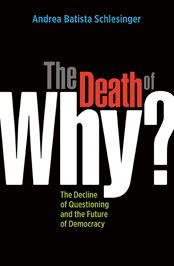
In her book, The Death of Why?: The Decline of Questioning and the Future of Democracy (Berrett-Kohler Publishers), New York City policy expert Andrea Batista Schlesinger writes that,
“Why is the first question most children ask. With this question we express, to the delight and chagrin of our parents, our power.

In my life, questions have always been power. Asking them enabled me to overcome the challenges I faced as a young woman sitting at tables where I didn’t automatically belong.”


Although only thirty-two, Schlesinger has operated in the arena of policy debates locally in New York City and nationally for over a decade. Since 2002, Schlesinger has applied her background in public policy, politics, and communications to transform the Drum Major Institute (“DMI”) into a progressive policy think tank with national impact. During her tenure as Executive Director, DMI created its Marketplace of Ideas series which highlights successful progressive policies from across the country and launched two public policy blogs that reach several thousand readers a day; and embarked on a national program to nurture careers in public policy for college students from underrepresented communities.

Recently, Schlesinger took a leave of absence from DMI to serve as a senior policy adviser to the re-election campaign of New York City mayor Michael R. Bloomberg – a decision that is controversial among New York City liberals like myself. Prior to joining DMI, Schlesinger directed a national Pew Charitable Trusts campaign to engage college students in discussion about the future of Social Security and served as the education adviser to Bronx borough president and mayoral candidate Fernando Ferrer.

The one life lesson Schlesinger has learned above all others in her career and promotes passionately her book is that questions equals power. It is Schlesinger’s contention that our culture promotes instant answers at the expense of inquiring.

With this book, Schlesinger has four primary objectives:

1) Convince readers of the importance of inquiry in our democracy

2) Illustrate how the very institutions that should be encouraging inquiry such as schools, the media, and government, the Internet are instead undermining intellectual curiosity in our society;

3) Inspire readers with hopeful examples of people working to restore inquiry to its rightful place of importance;

4) Convey a sense of urgency among citizens to develop effective “habits of the mind” and not be easily seduced by instant easy sound bite answers to complex challenges such as global warming.

Death of Why, is a well researched and scrupulously sourced eleven chapters and 215 pages of text. Where Schlesinger’s book is especially provocative is when she takes bloggers like me to task for engaging in robotic group-think and avoiding engagement with people possessing different viewpoints.

Former New York Governor Mario Cuomo said that,
"The road to wisdom is asking 'why'? Andrea Batista Schlesinger has been asking 'why?" and supplying her own bright and thoughtful answers for long enough so that some of us suggested she write a book. It's foruntate for all of us that her answer was 'why not!'"
The publisher of The Nation, Kathleen vanden Heuvel added that,
"From her start in politics as a teenager Andrea Batista Schlesinger has asked the important questions. Now she asks her most important: are we teaching young people to value inquiry, and if not, what hope can we have for the future of democracy?"
Schlesinger graciously agreed to a telephone podcast interview with me this afternoon about her book. She was engaging and assertive in a conversation that was just over forty-six minutes. Among the topics discussed and debated is her contention that we’re ideologically segregated, her argument that the Internet has reinforced a destructive group think mentality in our society, her advocacy for civics education and objection to teaching “financial literacy” in public schools and we closed by discussing her decision to join Mayor Bloomberg’s re-election campaign as a senior policy adviser.

Please refer to the flash media player below.


This interview can also be accessed at no cost via the Itunes Store by either searching for the “Intrepid Liberal Journal” or “Robert Ellman.”

Labels: , , , ,

 
by Robert Ellman | 4/12/2009 02:46:00 PM
The topic below was originally posted on my blog, the Intrepid Liberal Journal.

On January 1, 2007, Yale Law School professor Heather Gerken published a widely read article in the LegalTimes entitled, “How Does Your State Rank on The Democracy Index.” Gerken argued that just as the Environmental Performance Index (“EPI”) shamed countries such as Belgium to upgrade their environmental practices, a “Democracy Index” would embarrass state and localities into reforming their electoral administration through competition.

Since Bush vs. Gore in 2000, the debate about electoral reform has been dominated by anecdotes and overheated abstractions. Liberals like me have long suspected that states such as Ohio and Florida were deliberately disenfranchising minority voters sympathetic to Democratic candidates. Conservatives complained that voter fraud and urban political machines were allowing ineligible voters to cast ballots at the expense of Republican candidates. With her article, Gerken contended that a Democracy Index would replace a debate dominated by shouting with data driven arguments instead:
“This index should take what Ohio State University law professor Daniel Tokaji calls a ‘moneyball approach.’ The word ‘moneyball,’ of course, refers to Michael Lewis’ book of the same name about the success of the Oakland A’s after management substituted hard numbers and empirical research for the gut-level judgments of baseball scouts in making hiring decisions.

Similarly, the Democracy Index could change the terms of the debate by giving voters something new: moneyball politics. It would offer cold, hard numbers and comparative data in place of atmospherics and anecdotes. It would provide bottom-line results in place of subjective judgments. It would let reformers talk like corporate executives, not starry-eyed idealists. And, most important, it would enable the voters to hold election officials accountable for their missteps.

In the end, a ranking system would work for a simple reason: No one wants to be at the bottom of the list.”


Gerken further described her Democracy Index proposal and identified the major obstacles to good election practices with her new book, The Democracy Index: Why Our Election System Is Failing and How To Fix It (Princeton University Press). Her book is an accessible 181 pages and postulates that we need more facts about our election practices and that a ranking metric is our best hope to facilitate accountability and reform. Gerken also contends that our broken electoral system has less to do with intended malice than “deferred maintenance,” a term typically applied to failed infrastructure such as broken bridges.

Shortly after Gerken’s LegalTimes article was published, Both Barack Obama and Hillary Clinton, put her concept into proposed legislation and within a year, Congress set aside $10 million to fund model data collection programs in five states and the Pew Center. Other foundations also sponsored conferences and initial research. On March 1, 2007, Obama referred to these initiatives on the Senate floor as,
“an important first step toward improving the health of our democracy. We are all familiar with the problems that have recently plagued our elections: Long lines, lost ballots, voters improperly turned away from the polls. These are basic failures of process. Until we fix them, we run the risk in every election that we will once again experience the kind of chaos and uncertainty that paralyzed the nation in 2000. We can do better. We must do better. But to do better, we need more than anecdotal information. We need better, nonpartisan, objective information.”
Hence, Gerken's efforts illustrated at least the potential for action from the body politic to facilitate electoral reform but obviously, more needs to be done.

With respect to electoral law, Gerken is among the most authoritative voices in the country. In 2006, Gerken joined the Yale Law School faculty where she teaches election and constitutional law. Previously, Gerken clerked for Supreme Court Justice David Souter and was an assistant professor at Harvard Law School, where she was granted tenure and won the Sachs-Freund teaching award. She has also written for the New Republic, Roll Call, and Legal Affairs and has been a frequent media commentator.

Gerken was among several commentators who appeared on Charlie Rose’s program the very evening the Supreme Court rendered its fateful decision in Bush vs. Gore. During the 2008 presidential election, Gerken served on Barack Obama’s election protection team.

Gerken agreed to a podcast interview with me over the telephone about her book and proposal for a Democracy index. Our conversation was just over seventeen minutes and can be accessed via the flash media player below.


This interview can also be accessed at no cost via the Itunes Store by searching for either “Intrepid Liberal Journal” or “Robert Ellman.”

Labels: , , , ,

 
by Robert Ellman | 6/20/2008 06:52:00 AM
The topic below was originally posted yesterday evening when the interview originally took place on my blog.
Shari’a is a code of law based on the Koran. In the Muslim world, many want to replace corrupt autocratic regimes with the Shari’a and establish traditional Islamic states. Western countries regard the Shari’a as a threat. Islamic parties are winning elections on it. Militants have used the Shari’a to justify acts of terrorism. Meanwhile, secular minded people find their most severe provisions repugnant.

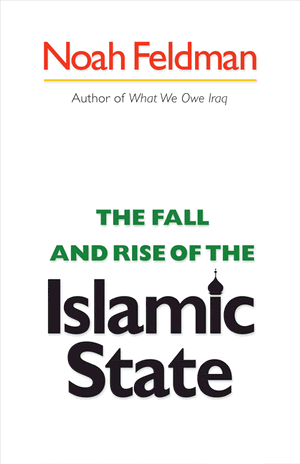
In his latest book, The Fall and Rise of the Islamic State (Princeton University Press), Noah Feldman tells the story behind the populist movement in the Muslim world to establish the Shari’a. Feldman addresses questions about why the Shari’a is popular in spite of its harsh code and whether the Islamic state can succeed.

He also explains how the classical Islamic constitution governed and was legitimized by law. Feldman argues that prior to the reforms of the modern era, the Shari’a operated under an effective system of checks and balances between scholars who interpreted the law and executive power.


Knowing the history of the Shari’a itself is important for context and Feldman’s book covers the promising beginnings of the traditional Islamic constitution and its downfall in the Ottoman Empire. Throughout the book, Feldman contends that if the Shari’a is combined with modernized institutions, successful Islamic states based on law and justice can be established.

Muhammad Qasim Zaman, author of The Ulama In Contemporary Islam, had the following praise for Feldman’s book:

“Scholarly and sophisticated yet highly accessible, this book makes an extremely important contribution to contemporary discussions of both Muslim politics and Islamic law. Feldman’s work provides a historical depth that has often been lacking in studies of law and constitutionalism in modern Muslim societies.”


Feldman is not without his critics however. In a recent article for The New Republic, Leon Wieseltier writes,

“Feldman is shilling for a soft theocracy--for other people, naturally. This is, among other things, hypocritical. Don't Muslims, too, have the right to sin?”


Noah Feldman is a professor at Harvard Law School and a contributing writer for the New York Times Magazine. He is also an adjunct senior fellow at the Council on Foreign Relations and the author of three previous books: Divided by God, What We Owe Iraq and After Jihad.

Feldman agreed to a podcast interview with me over the telephone about his provocative book. Among the topics we discussed was Sharia’s history, women’s rights in Muslim society, geopolitics, how Barack Obama's candidacy was being received in the Muslim world and I also specifically asked him to respond to Leon Wieseltier’s critique. Our conversation was approximately twenty-eight minutes. Please refer to the media player below.


This interview can also be accessed at no cost via the Itunes store by searching for the "Intrepid Liberal Journal."

Labels: , , ,

 
by Robert Ellman | 6/01/2008 03:09:00 PM
The topic below was originally posted on my blog, the Intrepid Liberal Journal and cross-posted at Progressive Historians, the Wild Wild Left, The Peace Tree, the Independent Bloggers Alliance and Worldwide Sawdust.

The centrifugal force in American politics today is the establishment’s failure to deliver prosperity and security. In 2006, Americans voted for a change of direction in Iraq and economic policies at home. Instead, President Bush’s “surge” in Iraq was enabled by a feckless congress as fuel prices soared, the cost of healthcare kept spiraling out of control and corporate CEOs continued to enjoy the benefits of a twenty-first century Gilded Age. Senseless privatization, predatory crony capitalism, political corruption, incompetence and corporate greed have combined to put the American Dream out of reach for people who work hard and play by the rules.
Indeed, a self-gelding plutocracy machine of ineptitude currently governs America. We’re not respected abroad and institutions designed to protect working people at home no longer function properly. Nobody on the Right or Left is satisfied with our immigration policy. Young people are not properly educated to compete in a global economy while too many senior citizens are forced to choose between paying for medication and buying food. Young men and women are dying to sustain two failed military occupations in Iraq and Afghanistan. Meanwhile, our over extended military has been forced to resort to a back-door draft as America fails to rebuild after Hurricane Katrina.

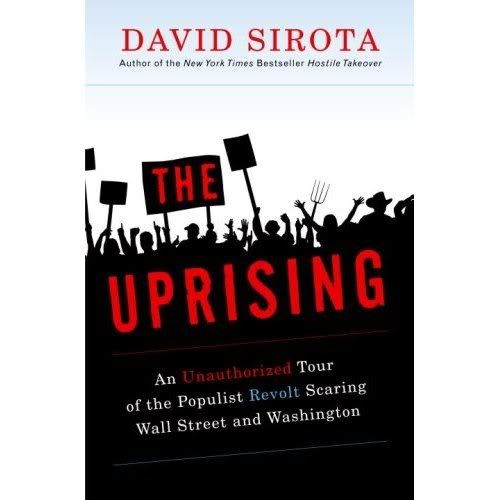
Is it any wonder that Americans across the political spectrum are yearning for change? In his provocative new book, Uprising: An Unauthorized Tour of the Populist Revolt Scaring Wall Street and Washington, (The Crown Publishing Group), David Sirota investigates whether populist outrage can be harnessed into a unified and enduring political movement. Sirota’s spent a year traveling the country and his book chronicles uprisings across America’s ideological and cultural spectrum.


He closely observed progressive netroots bloggers, workers at union halls in Albany and Seattle as well as the Minutemen’s headquarters at the California-Mexico border. Sirota also obtained close up access to the epic struggle over tax policy with Montana’s Governor Brian Schweitzer, his Democratic allies in the legislature and their ultra conservative anti-tax government-hating adversaries. He later traveled to Washington D.C. to learn how newly elected anti-establishment Senators Sherrod Brown of Ohio, Jon Tester of Montana and Bernie Sanders of Vermont are reconciling their populist objectives within a culture that abhors change.

From the Workers Family Party in New York State to the Lou Dobbs program on CNN, and the protest industry struggling to end the Iraq War, David Sirota provides readers with his close up observations and analysis of an angry country fed up with the status quo. Thomas Frank, author of What’s the Matter With Kansas had the following praise for Sirota’s book:
“After so many decades of fake populism-of revolts by the wealthy, red-state fantasies, and stock-picking grandmas-could we finally be looking at the real thing? In this compelling book, rooted in history but as contemporary as this morning’s newspaper, David Sirota gives us reason to hope.”
David Sirota is a frequent guest on several national news programs, including Comedy Central, The Colbert Report and MSNBC’s Countdown With Keith Olberman. After years of working in the trenches of political campaigns on capital hill, including then Congressman Bernie Sander’s staff, he became a journalist and nationally syndicated columnist. Two years ago, his book Hostile Takover was a New York Times bestseller.

Sirota blogs regularly at Credo Action and is currently on a book tour. He is scheduled to appear in New York City on Monday June 2nd @ 45 Bleecker Street between 9:00PM and 10:00PM as well as The Strand Book Store @ 11th Street and 4th Avenue from 7:00PM to 8:00PM on Tuesday, June 3rd.

Sirota agreed to a podcast interview with me over the telephone about his book and observations of the populist movement in America. Our conversation was approximately twenty-three minutes. Please refer to the flash media player below.


This interview can also be accessed at no cost via the Itunes Story by searching for the “Intrepid Liberal Journal.”

Labels: ,

 
by Robert Ellman | 5/16/2008 09:35:00 PM
This podcast interview with Barbara Slavin was originally posted on my blog on October 21, 2007. At the time, Slavin's book about American-Iranian relations was just published. It also took place shortly before the National Intelligence Estimate with respect to Iran's nuclear program was released to the public.

This week, President Bush equated negotiating with Iran as "appeasement" during a speech in Israel. The speech appeared to be an attack on presidential candidate Barack Obama who has advocated for diplomatic engagement with Iran. Bush's speech resulted in a firestorm of political acrimony between the Obama and McCain campaigns.

There is considerable ignorance among the American public about Iranian society as well as the back story of American-Iranian relations. Hence, I opted to make this my first post at the new Progressive Historians.


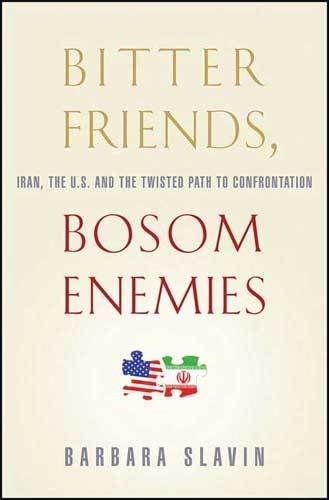
Barbara Slavin, senior diplomatic correspondent for USA Today since 1996 and author of the recently published book, Bitter Friends, Bosom Enemies: Iran, the U.S., and the Twisted Path to Confrontation (St. Martin’s Press), writes that,
“Iran and the United States are like a once happily married couple that has gone through a bitter divorce. Harsh words have been exchanged – husband and wife have come to blows and employed others to inflict more punishment. Apologizing is hard and changing behavior even harder. This relationship is unequal, with one side or the other feeling more vulnerable at any given time and afraid the other will take advantage of concessions.”
Currently, the public faces of both nations, presidents George W. Bush and Mahmoud Ahmadinejad, have been content to throw rhetorical bombs and raise the diplomatic temperature – increasing the likelihood of war. Indeed, at times it appears that conservative hardliners in both countries are eager for conflict as a means to maintain their respective grips on power.

The journey from the CIA backed coup that overthrew Iran’s democratically elected leader Mossadeq in 1953 and replaced him with the Shah, to the Islamic Revolution of 1979 and current tensions is replete with ill conceived schemes that damaged both nations. Slavin, using her extensive contacts among the powerful inside Iran and the United States, documents missed opportunities for reconciliation between both countries during the administrations of the first President Bush as well as Bill Clinton and George W. Bush.


The combination of her remarkable access to people such as Madeline Albright, Condelezza Rice, Iranian reformers like former President Mohammad Khatami, longtime establishment figures such as Ali Rafsanjani, as well as dissidents like Akbar Ganji and everyday citizens, allows Slavin to shed sunlight on a nation most Americans know very little about. She is also the first newspaper reporter from the United States to interview Iranian President Ahmadinejad.

Slavin has accompanied three secretaries of State on their official travels and reported from Iran, Libya, Israel, Egypt, North Korea, Russia, China, Saudi Arabia and Syria. She is also a regular commentator for U.S. foreign policy on National Public Radio, the Public Broadcasting System's Washington Week In Review and C-Span. This month, she joined the U.S. Institute of Peace as a Jennings Randolph fellow, to continue her research on Iran. Slavin also serves as a member of the Council on Foreign Relations.

Prior to joining USA Today, Slavin was a Washington-based writer for The Economist and the Los Angeles Times, covering domestic and foreign policy issues, including the 1991-93 Middle East peace talks in Washington. From 1985-89, she was The Economist's correspondent in Cairo. During her career, Slavin has traveled widely in the Middle East, covering the Iran-Iraq war, the 1986 U.S. bombing of Libya, the political evolution of the Palestine Liberation Organization and the resurgence of Islamic fundamentalism. Earlier in the 1980s, Slavin also served as The Economist's correspondent in Beijing and reported from Japan and South Korea.

Prior to moving abroad, she worked as a writer and editor for The New York Times Week in Review section and a reporter and editor for United Press International in New York City.

Slavin agreed to a podcast interview with me about her book, Iran and their turbulent relationship with the United States. Please refer to the media player below. Our conversation is just under thirty minutes. This interview can also be accessed at no cost via the Itunes Store by searching for “Intrepid Liberal Journal.”


Labels: , , , ,