by Gordon Taylor | 4/17/2008 07:30:00 PM

I didn't want to publish it at first. I was, frankly, being too sensitive. But by now the image has been all over the world: and who am I to hide from reality? Demonstrators in virtually every European nation have put this photo on banners or in websites by the score, and the nondescript name "Cuneyt Ertus" (joo-nate air-toosh) now gets Google hits in the thousands. The boy has been discharged from prison, and the pro-Kurdish/pro-PKK news services have all published interviews with him. His experience is exactly as one would have expected -- fear,confusion, brutality, and pain -- but it bears repeating. And still there is no one in the mainstream Turkish or American media that has paid the least attention.


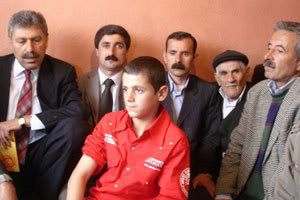
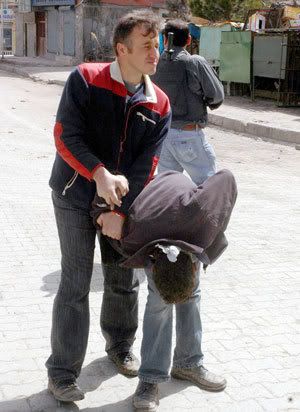
The most extensive interview is here, with a photo of "C.E." (his face obscured) and his father Hussein. Cuneyt, who still cannot use his right arm, showed great emotion as he recounted the events. "On March 22," said Cuneyt, "I went down to the market. I didn't know that Newroz events were going on, and I found myself in all this confusion. The police came right to me and collared me. Three policemen. Then they started manhandling me. First they twisted my arm. My arm went out of place [dislocated]. Then they took me to the Emniyet headquarters in a police vehicle. In the van they continued beating me; 3 or 4 of us were riding together. Inside the vehicle they called us "kufur" [infidels: an insult] and continued to hit us." At the station, Cuneyt recounts, the beating continued with kicks and truncheons aimed at the genitals.

And so it continued. At the station, for hours, the detainees were all kicked, beaten, and insulted. "Apo's [Abdullah Ocalan's] bastards" was one of the more choice insults, along with the opinion that they were no better than "filthy infidels." After the first day's interrogation Cuneyt was let go. "I couldn't sleep," he said, "from the pain in my arm." The very next day, however, while in the center of town again [For God's sake, Cuneyt, why did you go there?--g.t.], Cuneyt was again arrested, taken to the Emniyet and beaten. "They showed us their guns. Then before our eyes, they took the bullets out of their magazines, put them between the fingers of our hands, and then crushed our hands around them. That was extremely painful." From the Hakkari Emniyet, Cuneyt was transported to a prison in Bitlis, a city many miles away. Still he could not escape the beatings. His dislocated arm kept him in excruciating pain. No one was allowed to see him, neither aid workers nor his family nor lawyers. His fellow prisoners, he says, could see what pain he was in and tried to help him, but they could do nothing to stop it. Meanwhile, the casual beatings continued. "In prison from time to time they would let us out into the fresh air. Both going out and coming in they would hit us," Cuneyt says. "They treated us like animals."

While very happy to be reunited with his son, Huseyin Ertus is, as one might expect, outraged at the treatment he received. "My son is very young," Huseyin noted, "and he committed no crime at all. And yet, in plain view of everyone, they turned him around and broke his arm. This is a disgrace to humanity...There is no excuse for it at all." Cuneyt's father, meanwhile, is quite worried about the injuries he has received. He will be searching for treatment. In the published photographs Cuneyt is shown with no cast, sling, or bandages of any kind on his arm. "My humanity," said Huseyin Ertus, "tells me that no one should have to go through this kind of pain."

The facts are plain for all to see, yet of course the Turkish government will deny them, if they even deign to acknowledge the case. As for the U.S. government, we know them well enough. Turkey, after all, is "a vital partner in the War Against Terror."


Labels: , , , , ,

 
by Gordon Taylor | 4/13/2008 10:53:00 PM
There's always news from Turkey, where repression bears down, emotions run hot, and something is always boiling over. (Rather like the rest of Planet Earth, but at a greater concentration.)


First, there is information about Cuneyt Ertus, the 15-year-old boy whose arm was mangled on-camera by a security agent during recent Newroz demonstrations. After his arrest in Hakkari, the boy was taken to prison in Bitlis, many miles away and a long day's drive for his parents and lawyers, at the west end of Lake Van. His case has only recently been adopted by Amnesty International, who urged members to write Turkish officials about him. Today Cuneyt was released, and after inspection at the State Hospital in Van he was allowed to go home to Hakkari. It remains to be seen what long-term injuries, if any, he sustained. We'll come back to this story if new information is posted.

Next there is pleasant news: not exciting, not troubling, just--nice. In the southeast, on the Iraqi border, the town of Silopi sits amid a triangle of land bounded by the Tigris on the west, the Khabur and Hezil rivers on the south and east, and to the north the mass of Cudi Dağı (pron. Judi Daah), a mountain about which I have written before. The Khabur River provides the town's biggest source of income, for on the north side of that stream sits the only border gate between Turkey and the Kurdish region of northern Iraq. Here the Turkish Army is massed in a threatening (and useless) array, and here the Iraq-bound trucks sit baking in the sun for days and weeks, in a line ten miles long. Between the trucks on one hand and Turkish tanks on the other, Silopi's people eke out a living.

This weekend Silopi is celebrating neither trucks nor rivers but their mountain. These people know the "genuine" landing-place of Noah's Ark, after all; it has been part of local tradition for thousands of years, long before a European traveler tagged the other, Armenian, mountain as the Biblical Ararat. And since they know the story, they are using this springtime of rising water in the Tigris to celebrate the second annual "Silopi Cudi Noah Culture and Arts Festival." Sporting the slogan, "Art Comes Alive with Cudi," the festival features visiting musicians, folk dancers, and art exhibits (including one at the local prison entitled "Freedom Behind Walls"), as well as plenty of mayors from nearby towns to shake hands, make speeches, and give it an official air. (Most of these politicians and artists, by the way, had to pass through military check-points in order to get there.) Give these people credit, folks. In the least likely of places, they are celebrating the life they have.

For other news, I'll first put in a link to Mizgin, who has her own post about America's "model democracy" for the Middle East. Of war and repression there is always news aplenty, and Cuneyt was not the only victim of Newroz violence. Yuksekova, another mountain town near the Iranian border, was rocked by the Newroz events. Two people were shot to death by police during the week of demonstrations, and now a third, Fahrettin Sedar, 37, has died of bullet wounds in the hospital at Van. According to reports, over 600 vehicles accompanied his body on its return journey to Yuksekova, and 10,000 people walked with his family to the cemetery. The crowd shouted pro-PKK slogans and made repeated calls for revenge. One of the slogans, "Youth to Botan, Freedom to the Country" made reference to the mountain district where the PKK makes camp and fights a lot of its battles. (Bohtan [or Botan], a geographical area shared by Turkey and Iraq, was the emirate ruled by the Bedr Khan family, prominent figures in Kurdish nationalist history.)

Given this kind of anger, we can perhaps believe a PKK spokesman named Bozan Tekin, who, during a recent interview with Agence France-Presse, claimed that guerrilla ranks have now swollen to between eight and ten thousand fighters. [Same thing posted at Rasti.] Obviously there is no way to confirm this figure; however, I think it's significant that he made the boast at all. Previously the guerrillas have claimed about 5,000 soldiers. Even if we cut his estimate considerably we have to say that it jibes with recent PKK announcements which told of new graduating classes at their "military academy" in the mountains. This shows that the war is likely to get worse, not better. When PKK leader Abdullah Ocalan was captured in the late 1990s, an anonymous American diplomat was quoted as saying that, with his capture, "ninety percent of Turkey's excuses for not solving the Kurdish problem are now gone." That was almost ten years ago, and the PKK was on the ropes. Now the Turks have managed to build up the PKK's strength from nearly nothing to a reputed 10,000. Tebrik ederim, beyler. Many congratulations indeed.

The Turks' big offensive of late February to March had scarcely ended before new clashes were reported by both the Turkish Army and the PKK's website, and they have continued into April. I have no intention of rehashing press releases by either side, but what is remarkable is the geographical scope of the clashes: not only their number, but the widely separated places in which they have occurred. The PKK has claimed attacks in a swath of territory stretching from Hatay (formerly the Sanjak of Alexandretta), on the Mediterranean, to Mt. Ararat, on the Armenian and Iranian borders. The Besta Mts. clash (in Sirnak, just north of the Iraq border) seems to have been the biggest, with (says the PKK) twenty Turkish soldiers killed, one Cobra helicopter downed, and four PKK guerrillas (including photographer/filmmaker Halil Uysal) dead. Further north, in Tunceli (Dersim) province, the PKK reported an attack by one of their YJA-STAR units: in other words, girls in pony tails carrying Kalashnikovs and looking to blow your head off. (They will do it, too; but they will also die, as several have done already in 2008.) All this, as I've said, will get worse. One pro-PKK newspaper, Ozgur Gundem, is already reporting that a joint operation is being planned by the Turkish Army and Iran's Revolutionary Guards. Their aim: probably PKK and PAJK (anti-Iranian Kurds) installations in the region of Qandil Mountain. Such an operation, of course, will not succeed; it will, if anything, only succeed in killing more sheep and goats.

I'll close with links to three stories.

First, the horrific. The nude body of a young Italian artist, Pippa Bacca, was found this weekend in bushes near the town of Gebze, on the Sea of Marmara south of Istanbul. The details are too painful to recount. The mass-market daily Hurriyet proclaimed in a headline, We Are Ashamed! This BBC link tells her story. I will only say this: DO NOT HITCH-HIKE IN TURKEY. Do not do it. Turkish peasants are the kindest of people. Any village will take in a traveler and treat him as an honored guest. The Turkish transportation system has been designed to accomodate every class of passenger. It is easy to find cheap transport. Ordinary Turkish workers and peasants simply do not understand it when middle-class kids from rich western nations come to Turkey and beg for rides. Especially this would be true if they were girls dressed up in bridal gowns as a stunt. DO NOT HITCH-HIKE IN TURKEY. PAY THE FARE AND RIDE A BUS.

Next, from the Times of London, the story of Yakup Satar, a Crimean Tatar, aged 110, who was Turkey's last living soldier from the Great War. Now they are virtually all gone. Highly recommended.

And last, in a week which saw the death of that phoniest of heroes, Charlton Heston, we get the story of Ragip Zarakolu [also at Rasti], a Turkish publisher who has spent a lifetime making books and going to jail for having made them. I've said in past posts that if the Nobel Committee wanted to find qualified recipients for the Peace Prize, they could come to Turkey and find a dozen more qualified than Al Gore in less than a day. Ragip Bey is one of those people.

Labels: , , , ,

 
by Gordon Taylor | 3/30/2008 02:15:00 AM
About suffering they were never wrong,
The Old Masters: how well they understood
Its human position; how it takes place
While someone else is eating or opening a window or
just walking dully along;

~W.H.A., "Musee des Beaux Arts"

Once again, my apologies. You probably didn't enjoy your first "Day at the Office," and now here I am putting you through another. Never fear. I will be as gentle as possible. No self-righteous rhetoric. And no photos--links only. This isn't because I want to shield anyone else from unpleasantness. It's because I want to shield myself. I simply do not enjoy the sight of naked human suffering, especially that of a child, and I couldn't stand having the photographs in front of me as I wrote the piece.

And in spite of my revulsion, this will be a composed--though short--piece. For there is a lot for an historian to glean from this incident, concerning both the past and a very instructive present.


First, the incident itself. It evidently happened on March 22, the day after the equinox, when Newroz (New Year) would have been in full swing in all Kurdish cities. In Hakkari, a mountain town near the Iraqi and Iranian borders, the Turkish governor had banned celebrations. They happened anyway, and when the police attacked, violence ensued. As expected, there were plenty of Kurds on hand to voice their support for the PKK, which has been fighting against the Turkish government for about 25 years.

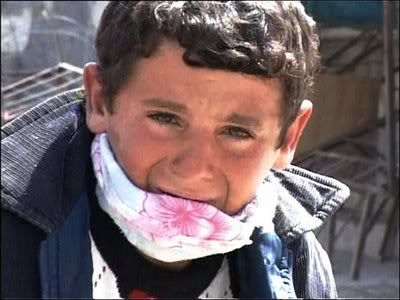
The first photograph tells you the facts. Note especially the satisfied look on the face of the Meatman [my own coinage, based on the Turkish MIT, or National Intelligence Organization, for whom he probably works]. This follows his previous expression, in the third of the series of photos I published yesterday, in which he looked like a man straining at the reluctant lid of a pickle jar. The second photo is the boy himself. His name is Cuneyt Ertuş (joo-nate air-toosh), and he is 15 years old. By God I hope he survives this and regains the use of his right arm. But as far as I can tell he is still in jail, and there's no telling what--if any--medical care he is getting. The incident took place right in front of representatives of the press (whether pro or amateur we can't tell), and both still photos and video have been published from several angles. Cuneyt may have been throwing rocks, or he may have just been in the wrong place at the wrong time. Nothing justifies what you see. He was taken in on a charge of "resisting an officer of the State," and no word was given about his medical treatment or the charges to either his family or to attorneys.

Cuneyt's father related his own story to DIHA, the Dicle Haber Ajansi (Tigris News Agency), a pro-Kurdish outlet which publishes in Turkish from Europe. Zubeyir Ertuş told DIHA that his son went on a shopping trip to the center of Hakkari (formerly Julamerk, or Colemerg), the capital city of Hakkari province, on March 22. After the events of that day he didn't hear from his son, and he thought that Cuneyt had been detained. "At last," he said, after two days of searching, "I found him on Roj-TV." If only he hadn't. Zubeyir: "The police were breaking my son's arm right in front of the representatives of the press. I looked away in horror. I didn't want to believe my eyes."

It's a wonder that he saw anything. For Roj-TV is not a Turkish channel. It is not an Iraqi channel. And it certainly is not Syrian or Iranian, two other dictatorships with sizable Kurdish minorities. Roj-TV is a Kurdish-owned satellite channel that broadcasts out of Denmark, and the Kurds of Turkey use satellite dishes in order to get it. During this year's Newroz festivities in Diyarbakir (permitted by the State), Roj-TV managed to broadcast the whole thing live--a first. This under the noses of the Turkish government, which is trying to shut them down. So far the Danish government has resisted. The Turks claim that Roj-TV is a terrorist organization. (But of course they do. If the Turks got a sunburn, they'd claim that ultraviolet rays were part of a terrorist plot.) The Danes have asked the Turkish government for more information, and in the meantime several Kurdish websites are gathering signatures to urge the Danish government to do the right thing. But if they don't, the Kurds will simply go elsewhere.

In the meantime, we have Zubeyir Ertuş and his son Cuneyt, who because of a satellite channel and the sharing of photos on the Internet, are suddenly not alone. In a past posting about the Turks' recent invasion of northern Iraq, I talked about another pro-PKK news outlet, Firat News, and the dozens of reports that they constantly get in detailing the movements of Turkish government forces. Here we see the same thing, as the Kurds have constructed their own "virtual Kurdistan" from the reports, videos, and digital photos of their own people.

Not that the father and son would really have been alone. For the family's surname, Ertuş, indicates a very strong attachment to the local population. It is a tribal name; in fact, it is the name of what was traditionally the biggest tribe in the Hakkari region and beyond. In old travel books about Kurdistan it is variously spelled: Ertoush, Hartoushi, Ertushi, etc. When Asahel Grant, M.D., of Utica and Waterville, NY, arrived in Julamerk in 1839, it was these same Ertushi Kurds and their emir, Nurullah, that he dealt with. The story remains unfinished. In the cities of Turkey's southeast, hundreds are wounded, or in jail, or both. Cuneyt's father, meanwhile, says, "My economic situation is not good. But I'm going to the bar association and I'm going to find a lawyer."


Labels: , , , , ,