by Gordon Taylor | 3/30/2008 02:15:00 AM
About suffering they were never wrong,
The Old Masters: how well they understood
Its human position; how it takes place
While someone else is eating or opening a window or
just walking dully along;

~W.H.A., "Musee des Beaux Arts"

Once again, my apologies. You probably didn't enjoy your first "Day at the Office," and now here I am putting you through another. Never fear. I will be as gentle as possible. No self-righteous rhetoric. And no photos--links only. This isn't because I want to shield anyone else from unpleasantness. It's because I want to shield myself. I simply do not enjoy the sight of naked human suffering, especially that of a child, and I couldn't stand having the photographs in front of me as I wrote the piece.

And in spite of my revulsion, this will be a composed--though short--piece. For there is a lot for an historian to glean from this incident, concerning both the past and a very instructive present.


First, the incident itself. It evidently happened on March 22, the day after the equinox, when Newroz (New Year) would have been in full swing in all Kurdish cities. In Hakkari, a mountain town near the Iraqi and Iranian borders, the Turkish governor had banned celebrations. They happened anyway, and when the police attacked, violence ensued. As expected, there were plenty of Kurds on hand to voice their support for the PKK, which has been fighting against the Turkish government for about 25 years.

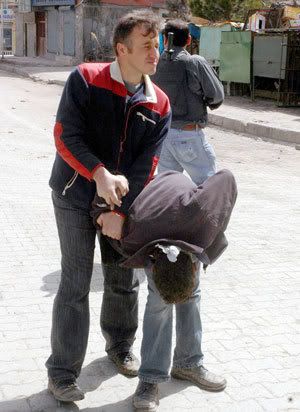
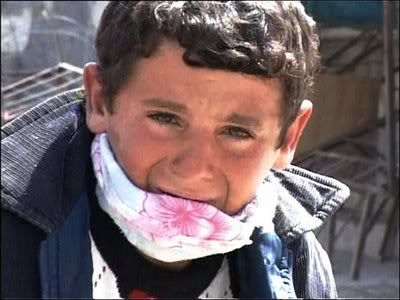
The first photograph tells you the facts. Note especially the satisfied look on the face of the Meatman [my own coinage, based on the Turkish MIT, or National Intelligence Organization, for whom he probably works]. This follows his previous expression, in the third of the series of photos I published yesterday, in which he looked like a man straining at the reluctant lid of a pickle jar. The second photo is the boy himself. His name is Cuneyt Ertuş (joo-nate air-toosh), and he is 15 years old. By God I hope he survives this and regains the use of his right arm. But as far as I can tell he is still in jail, and there's no telling what--if any--medical care he is getting. The incident took place right in front of representatives of the press (whether pro or amateur we can't tell), and both still photos and video have been published from several angles. Cuneyt may have been throwing rocks, or he may have just been in the wrong place at the wrong time. Nothing justifies what you see. He was taken in on a charge of "resisting an officer of the State," and no word was given about his medical treatment or the charges to either his family or to attorneys.

Cuneyt's father related his own story to DIHA, the Dicle Haber Ajansi (Tigris News Agency), a pro-Kurdish outlet which publishes in Turkish from Europe. Zubeyir Ertuş told DIHA that his son went on a shopping trip to the center of Hakkari (formerly Julamerk, or Colemerg), the capital city of Hakkari province, on March 22. After the events of that day he didn't hear from his son, and he thought that Cuneyt had been detained. "At last," he said, after two days of searching, "I found him on Roj-TV." If only he hadn't. Zubeyir: "The police were breaking my son's arm right in front of the representatives of the press. I looked away in horror. I didn't want to believe my eyes."

It's a wonder that he saw anything. For Roj-TV is not a Turkish channel. It is not an Iraqi channel. And it certainly is not Syrian or Iranian, two other dictatorships with sizable Kurdish minorities. Roj-TV is a Kurdish-owned satellite channel that broadcasts out of Denmark, and the Kurds of Turkey use satellite dishes in order to get it. During this year's Newroz festivities in Diyarbakir (permitted by the State), Roj-TV managed to broadcast the whole thing live--a first. This under the noses of the Turkish government, which is trying to shut them down. So far the Danish government has resisted. The Turks claim that Roj-TV is a terrorist organization. (But of course they do. If the Turks got a sunburn, they'd claim that ultraviolet rays were part of a terrorist plot.) The Danes have asked the Turkish government for more information, and in the meantime several Kurdish websites are gathering signatures to urge the Danish government to do the right thing. But if they don't, the Kurds will simply go elsewhere.

In the meantime, we have Zubeyir Ertuş and his son Cuneyt, who because of a satellite channel and the sharing of photos on the Internet, are suddenly not alone. In a past posting about the Turks' recent invasion of northern Iraq, I talked about another pro-PKK news outlet, Firat News, and the dozens of reports that they constantly get in detailing the movements of Turkish government forces. Here we see the same thing, as the Kurds have constructed their own "virtual Kurdistan" from the reports, videos, and digital photos of their own people.

Not that the father and son would really have been alone. For the family's surname, Ertuş, indicates a very strong attachment to the local population. It is a tribal name; in fact, it is the name of what was traditionally the biggest tribe in the Hakkari region and beyond. In old travel books about Kurdistan it is variously spelled: Ertoush, Hartoushi, Ertushi, etc. When Asahel Grant, M.D., of Utica and Waterville, NY, arrived in Julamerk in 1839, it was these same Ertushi Kurds and their emir, Nurullah, that he dealt with. The story remains unfinished. In the cities of Turkey's southeast, hundreds are wounded, or in jail, or both. Cuneyt's father, meanwhile, says, "My economic situation is not good. But I'm going to the bar association and I'm going to find a lawyer."


Labels: , , , , ,

 
by Gordon Taylor | 3/28/2008 11:05:00 AM
This post won't be a lot of fun. I apologize for that, and I apologize for the photograph which is visible when you click through to the rest of the story. There's no blood; rest assured that I haven't splashed gore across the pages of PH. However, it is disturbing. It's what we can call "a day at the office" for the hard-working men of MIT (pron. Meat), or Milli Istihbarat Teskilati: the National Intelligence Organization of Turkey. To see the video from which the overleaf pictures were taken, go to: http://www.youtube.com/watch?v=4ENIwySnfNM
For the ultimate heartbreak, to see the face of the boy himself, go to Mizgin's blog.


Photobucket

OK, here we are. I got this on the front page of Yeni Ozgur Politika, a left-wing Turkish- and Kurdish-language paper that is based in Europe. The headline says, "Adini Siz Koyun!" which means, by my translation, "You name him!" In other words, they want to know the name of this policeman, and his companions. On the actual front page of the paper, larger images of the three policemen's faces were posted.

These frames are from video taken on the streets of Hakkari, capital of the province of the same name, in southeast Turkey, during the recent Newroz (New Year) demonstrations. Obviously they turned ugly. If you look in the background, especially of picture #4, you can see in the distance the rocky, snowclad slopes of Sumbul (Hyacinth) Mountain, whose 12,000-foot summit towers over the town. But of course, you're not looking at the mountain, you're looking at a plainclothesman from the Turkish secret police giving us a demonstration of how to break a 15-year-old boy's arm. Let's not dwell on it. Every once in a while historians must confront everyday reality, and this is it. I am not one to use red-flag words idly; in fact, I despise the debasement of language that results when pejorative labels are endlessly purveyed in contexts that do not warrant them. This, however, is a case where the "F" word is fully justified. This is fascist thuggery, pure and simple.

For a more complete rundown on recent events, see the following article from the Eurasia Daily Monitor, a feature of the Jamestown Foundation's website:


KURDISH DEMONSTRATORS CLASH WITH TURKISH SECURITY FORCES DURING NEWROZ

By Gareth Jenkins

Tuesday, March 25, 2008


Over a period of four days from March 21-24, two people were killed and several hundred injured in clashes with Turkish security forces, as hundreds of thousands of Kurds took the streets to celebrate the Kurdish New Year of Newroz. No reliable figures are available for the number of demonstrators detained by the security forces, although Turkish media reports suggest that several hundred were taken into custody (Hurriyet, Radikal, Cumhuriyet, Milliyet, Yeni Safak, NTV, CNNTurk, March 22-24).

Newroz is not an exclusively Kurdish holiday. It is celebrated on March 21 each year from the Balkans through the Caucasus and Iran and across Asia into northern China. However, during the late 1980s and early 1990s, Newroz celebrations were banned in Turkey on the grounds that they encouraged Kurdish separatism. Attempts to mark the holiday were broken up, usually violently, by the security forces. In 1992 over 60 people were believed to have died in clashes with the Turkish security forces during Newroz celebrations.

The situation changed in 1995 when the Turkish authorities decided to rediscover Newroz as “Nevruz,” an authentically Turkish spring holiday with its origins in Central Asia. Although Kurds continued to be prosecuted if they referred to it as Newroz rather than by its Turkish name, the authorities not only began to allow celebrations, but state officials joined in the traditional Newroz ritual of jumping over a fire to symbolize rebirth and renewal.

Initially, the strategy of appropriating Newroz appeared to have worked. During the late 1990s, most of the celebrations passed peacefully, and killings and arrests became relatively rare. However, the newly rediscovered festival of Nevruz failed to capture the imagination of most ethnic Turks, who still regarded it as essentially a Kurdish celebration. In recent years, violence at Newroz celebrations has begun to rise again. The main reason is that participants have increasingly begun to use the festival not just as a public demonstration of their Kurdishness but of their support for the PKK. There is also little doubt that the opportunity has been deliberately exploited by the PKK itself, for whom newspaper photographs and television footage of defenseless demonstrators being beaten and sometimes killed by the Turkish security forces are a propaganda gift.

Significantly, the worst of the recent clashes – and both of the deaths – occurred in southeast Turkey in cities such as Van, Yuksekova, and Hakkari, which have long been hotbeds of PKK support and where the authorities banned any Newroz celebrations this year for fear that they would be hijacked by the organization. But demonstrators gathered anyway, chanting pro-PKK slogans, waving PKK flags and holding posters of the organization’s imprisoned leader Abdullah Ocalan. The result was several days of rioting. In Hakkari, life virtually ground to a halt. Stores remained closed and shuttered for three days as the streets became a battleground between stone-throwing youths and members of the security forces (Radikal, Hurriyet, Milliyet, Zaman, March 22-24).

But there were also clashes at Newroz celebrations between PKK supporters and the security forces in the cities of western Turkey, which all now have their own substantial Kurdish populations as the result of migration from southeast Turkey. In Istanbul, which in terms of sheer numbers is now the largest Kurdish city in the world with perhaps up to 4 million ethnic Kurds among its total population of 14 million, more than 100,000 Kurds gathered in the Kazlicesme neighborhood, some of them chanting pro-PKK slogans and carrying banners with portraits of Ocalan (Milliyet, Hurriyet, Radikal, NTV, Dogan Haber Ajansi, March 24).

The Turkish authorities took the opportunity of the Newroz demonstrations to flex their ideological as well as their military muscle. Both in the southeast and in Istanbul, where 10,000 police were assigned to the Kazlicesme demonstration alone, members of the Turkish security forces marched through the streets chanting slogans such as: “Everything for the motherland”; “How happy is the one who says I am a Turk”; “Every Turk is born a soldier”; and, in a reference to Kurdish demands for education in their native language, “One state, one language.”

It is currently unclear whether such attempts at intimidation will do anything either to reduce support for the PKK or to defuse Kurdish demands for greater political and cultural rights. But Turkish television footage of young, male demonstrators clashing with the security forces at Newroz coincided with the publication of a study by the state-owned Turkish Statistical Institute (Turkstat) on the median age of the Turkish population by geographical region. The results suggested that the median age of the Turkish population rises steeply as one moves from the east to the west of the country. Turkstat reported that, in the predominantly Kurdish provinces of southeastern Turkey, the median age was in the range 17.4 to 21 years, rising to 31.8-35.4 years along the Turkish Aegean coast. The median age in Istanbul was in the range 28.3-31.8 (Radikal, March 23).

The southeast of Turkey has also long been the most underdeveloped region of the country. In some provinces, per capita income is less than 20% of the national average. In many of the cities of southeast Turkey the unemployment rate among young people often reaches 50-60% (see EDM, March 18). As has been once again demonstrated by the clashes during Newroz, the combination of ethnic unrest, poverty, a young population, and a high rate of unemployment is rarely a recipe for social stability.
Amen to that. I would only add: more employment won't really matter. You aren't going to quash this kind of violence with more jobs, more cars, and more cell phones. And you certainly aren't going to do it by breaking the arms of teenagers. I'll let these ladies have the final say:

Photobucket

The message is simple. They're saying, "It is enough."

Labels: , , , , ,