by mark | 4/20/2009 12:01:00 PM


" ...he was one of the most extraordinary individuals to have ever walked the earth. He above all others deserves to be called, "the Great'."

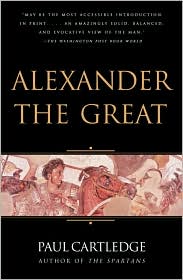
Alexander the Great by Paul Cartledge

Cambridge classicist Paul Cartledge has the rarest of talents among professional historians - the ability to write books that simultaneously appeal to academics and popular audiences alike. Alexander the Great has his trademark "concise depth" that Cartledge also brought to bear in The Spartans and later to Thermopylae: The Battle That Changed the World; there is enough historiographic "meat" for the scholar and the casual student of history or of war will enjoy Cartledge's depiction of Alexander as a "ruthless pragmatist", engaging in calculated gestures of epic magnaminity and brutal murder of his closest comrades in arms with equal certitude. One who, despite his mysticism and growing tyranny, had imperial ambitions that "....can symbolize peaceful, multi-ethnic coexistence".


Cartledge, despite the above quotation, is not an Alexander-worshipper but a realist or a mild skeptic, rejecting hyperbole and hidden agendas in the ancient sources, which he discusses in detail, along with the more extreme portraits painted of Alexander by modern historians, such as "...the titantic and Fuhrer-like Alexander of Fritz Schachmeyer". Cartledge's Alexander is a military genius and an inspirational visionary to be sure, but his icy ruthlessness of calculated murder of potential opponents and superannuated followers like Callisthenes or Parmenion is never far away. Cartledge uses the term "purges" several times in the text and it is appropriate; Alexander, with his suspicions aroused, had the same irrevocable instinct for savage reprisal as did Joseph Stalin. Alexander running through Cleitus the Black with a spear in the midst of a banquet, a man who had saved Alexander's life, or who ordered the destruction of Thebes was the same Alexander who honored the religions and customs of his conquered subjects and tried to build his Overlordship of Asia on a fusion of Pan-Hellenism and ancient Persia:
"Alexander's importation and integration of oriental troops into the Macedonian army was a crucial and controversial issue. by the end of 328 he had units of Sogdian and bactrian cavalry, so presumably he was drawing also upon the excellent cavalry of western and central Iran. In 327 he recruited more than thirty thousand young Iranians. Since Greek was to be the lingua franca of the new Empire, replacing the use of the Achaemenids use of Aramaic, he arranged for them to be taught the Greek language as well as the demonstrably supeior Macedonian infantry tactics. when they arrived at Susa in 324, he hailed them as ' successors' - to the Macedonian soldiers understandable consternation" [ 204 ]

Cartledge discusses Alexander's generalship and his abilities as an adaptive military innovator, building on a his father Philip's original military reforms or improvising when faced with unexpected difficulties at river crossing or in siege warfare. He misses though an opportunity to explain the dreadful effectiveness in Alexander's hands of the Macedonian phalanx, a more heavily armed, lightly armored, mobile and deadly version of the original Greek Hoplite formation. While Alexander and his cavalry garnered most of the glory, the ordinary Macedonian phalanx cut through Persian ranks like an implacable meat grinder, mowing down enormous numbers of the enemy and trodding their dead and dying bodies underfoot. Understandably though, this is a biography of Alexander and not a history of his wars but the real scale of the slaughter Alexander inflicted is given far less attention than the skill with which he inflicted it, or his political and religious policies that came in their wake.

Alexander's religious sentiments and his mysticism, which spilled over in to his political vision for Asia and for himself as a semi-divine ruler are given much consideration by Cartledge, ranging from his at a distance dealings with subject state Athens, to his "contracting" a relationship with the Egyptian god Ammon, to his ideation with Achilles as a model for himself. There appears to have been something of a feedback loop between Alexander's military acheivments, which were truly superhuman, and his growing religious superstitions, both of which fed a kind of megalomania according to Cartledge, and led to Alexander's unsuccessful demand that his Greek and Macedonian soldiers adopt proskynesis in the Persian style. A more or less blasphemous act of hubris ( though not quite absolutely, as Cartledge explains, given the precedent of the deification of Lysander) that led to a break between Alexander and his most loyal followers. This craving for divinity later was expanded posthumously to fabulous extremes in the traditions of the Alexander Romance, where Alexander the Great becomes a symbolic and heavily mythologized figure for dozens of peoples and regimes. Alexander himself began cultivating the myths.

Cartledge has done an excellent job demystifying one of the archetypal figures of Western history, the man whom other would-be world conquerors had to measure themselves against - reportedly, Julius Caesar wept in despair because Alexander's glory was beyond his reach. He has also brought out the extent to which Alexander saw himself not as a Westerner, or a Hellene, but as a bridge to the East, a synthesizer of civilizations.

Labels: , , , , , ,

 
by elle | 12/08/2008 04:07:00 AM
***crossposted at elle, phd***

When I took an African American literature class as an undergrad, my teacher tried to demonstrate to us physically the nature of the middle passage. Nothing in a well-lit, comfortably-temperatured university classroom can suffice, but she tried anyway.

She had all of us who would, to gather into a corner and move closer and closer to each other until the girl nearest to the wall asked that we stop. Many of us were visibly shaken, unable to put words to our feelings when the professor asked.

It was a voluntary activity and I still have mixed feelings about it (she did not tell us that we would be closing in on ourselves).

And we were, in terms of age, adults.

k8 sent me this article about a similarly-minded teacher of middle-school children:
WHITE PLAINS, N.Y. – A white social studies teacher attempted to enliven a seventh-grade discussion of slavery by binding the hands and feet of two black girls, prompting outrage from one girl's mother and the local chapter of the NAACP. After the mother complained to Haverstraw Middle School, the superintendent said he was having "conversations with our staff on how to deliver effective lessons."

"If a student was upset, then it was a bad idea,"* said Superintendent Brian Monahan of the North Rockland School District in New York City's northern suburbs.
Well.


There are so many levels of wrong in this that I won't pretend that I can address or even see them all. It's not a matter of being age inappropriate (my point above was that I don't know if such activities are appropriate for any age in a classroom setting). But I am struck by the fact that the teacher called on two teenagers, two girls who, like so many teenagers, may have been inordinately self-conscious of being the center of their classmates' attention in what they perceived as a negative light.

And then she thought it was okay to BIND them. To tie their hands and feet. With apparently no thought of how traumatic that may have been, no knowledge of any experiences these girls may have had that BINDING them might trigger, no thought to how absolutely powerless and vulnerable and scared it makes you feel when some one else strips you of the ability to control or move your own body.

She also did not think about what these girls' perception of slavery was. So many black people are taught that it was shameful for slaveowners and the enslaved. That the whole identity of our ancestors was subsumed by the designation "slave," because so much of that history comes from the slaveowners. That there must have been no pride, no dignity, no agency, no self-definition.

And always, beneath the surface, is an unspoken accusation of almost-complicity--that people of African descent accepted slavery and the Jim Crow aftermath meekly until the 1950s. One of my comps questions was about the "lack" of what would commonly be called slave uprisings. One of my white male students in my African American history class asked me, when we discussed Redemption, "Why didn't black people do something, stand up for themselves?" and none of my responses was enought to change his opinion or stop the dismissive shake of his head.

I have heard black people my whole life say, "I couldn't have lived back then, because I would have..." We are ashamed because we were taught the "happy darkies working in the field and being beneficently cared for" lie so long. We are also taught that our "honorable" history begins and ends with the Civil Rights Movement.

And she asked those girls to assume all of that in a classroom:
On Nov. 18, [Eileen] Bernstein was discussing the conditions under which African captives were taken to America in slave ships. She bound the two students' hands and feet with tape and had them crawl under a desk to simulate the experience.
If her point is to teach that the middle passage was devastatingly traumatic, why would she want middle-schoolers to re-enact it?
_____________________________________________
*Emphasis mine, because I didn't realize there was a correlation between students' " upsetness" and the determination of whether or not something is a "bad idea."

Labels: , , ,

 
by Valtin | 10/20/2008 04:54:00 PM
Meteor Blades has an interesting post up over at Daily Kos. He describes his previous association with David Gilbert, who, like Bill Ayers, was a member of the Weather Underground approximately 40 years ago. MB makes the obvious point:
As others have observed, palling around with terrorists has a long and sordid history in America. Just take the six decades I’ve been alive. Venerated Senators and Representatives made common cause with the Ku Klux Klan and their ilk, whose murders were the ultimate backstop for maintaining American apartheid. That system, you may recall, rested on ruthless white rule over the portion of the United States which allegedly lost the Civil War. It reinstituted slavery in a visible but widely ignored form, and for 90 years it destroyed every civil right of African-Americans, enforcing this with terror, including lynchings and other murders.

Fast forward to Henry Kissinger, the architect of raining terror on Cambodia, a policy that led to tens of thousands of dead civilians and contributed to the ascendance of the previously minuscule Khmer Rouge. Their astounding butchery and terrorism against their own people was not enough to persuade the United States to stop supporting them in their effort to keep control of Cambodia’s U.N. seat after their cross-border aggression was defeated, government overthrown and genocide stopped by Vietnam. Not to mention Kissinger’s role in Indonesia and Chile.


Please note that war criminal and terrorist Kissinger is also an honorary co-chair of McCain's campaign, although because he is a member of the U.S. elite, that connection is not seen as nefarious by the establishment press and its blogger tail.

Meteor Blades goes on to mention other atrocious criminals in American government who better deserve the terrorist label than Bill Ayers, a former WU member involved in some symbolic bombings who later became a local liberal-radical activist along more traditional lines, and hence came into contact with Barack Obama. Ayers never thoroughly renounced his WU past. Why?

To answer that question, I reproduce here my comment over at MB's Daily Kos post, as it is relevant to both the question of "terrorism" in general, and on the meaning of attacking Ayers and linking him to liberal presidential candidate Barack Obama, more specifically. I've added a few links to my comment, for the benefit of my readers:
The modern left begins with the fight among the Russsian social democrats as to whether they should support the terrorist tactics of the Narodniks, who were fighting in the latter 19th century to overthrow the czar.

Although few know it, the faction that would later call themselves the Communists opposed terrorism as a tactic, as it tended to bring strong oppressive reaction while at the same time sending a message to the people at large that they did not have to engage in political struggle, leaving such struggle to a heroic elite. Hence, at a time of greater oppression, the masses of people were disarmed by non-involvement in political struggle.

However, the early left made a distinction between the terror tactics of left -- the actions ostensibly to support an oppressed people, or to oppose imperial power - and the terror tactics of the government or the right, which were meant to silence the left, or to further seal state or right-wing power against the workers, farmers/peasants, and lower middle-classes.

The Weather Underground members had lost faith in a working class, classic-style revolution. They also believed that the bulk of the middle class was bought off by the excess wealth generated by the exploitation of the "third world". Hence, despairing of any other way, they sought terror as a method of "sparking" resistance, which they hoped would begin among the most impoverished sections of U.S. society, e.g., poor black Americans, native Americans, etc. In this, they were supported by agents provocateurs working for the government, as an perusal of the subject of "Cointelpro" or the Church Committee hearings in Congress will demonstrate to anyone so interested.

The attacks against Obama on the Ayers issue represent, in part, a continuing struggle over the meaning of the Southeast Asian colonial wars, in which the United States butchered over a million people, and tortured tens of thousands. As Meteor Blades makes so very clear, the really hardcore terrorists were Kissinger, MacNamara, Johnson, Nixon, and so many more (including Alexander Haig, a McCain supporter).

On one hand, the purported Ayers-Obama link is just plain silly, as there's really nothing to it. But the politics behind it is very real. Ayers and other radical supporters of the antiwar movement were no criminals: they were trying to stop a massive crime being committed. That they sometimes chose self-defeating methods is very regrettable, but the damage they caused was nothing compared to the damage caused by the great evil they opposed.
MB's story of his experience with Students for a Democratic Society (SDS), its internecine splits, the communal left such as it existed in the 1960s-1970s, and the fights over strategy and tactics, and how this all affected the individuals involved, is worth reading in and of itself. I only wish it had been longer, as its evident MB has a lot of experience to relate.

Also posted at Invictus

Labels: , , , , , , , ,

 
by Valtin | 9/30/2008 04:24:00 PM
While many of us find ourselves swallowed up by the panic stimulated by 24-hour news cable services and the dying daily press, when we consider the current credit crunch and threats of doomsday, it is important to get some perspective on what is really happening.

History provides us that perspective. The following description of the famous economic panic that followed the collapse of the speculative bubble that surrounded railway expansion in Britain in the mid-nineteenth century presents an illustrative example.

The economist writing here looked back at this famous economic collapse and drew some serious conclusions. The parallels between then and now are striking, even if "then" was over 150 years ago (emphases added):


The years 1843-5 were years of industrial and commercial prosperity, a necessary sequel to the almost uninterrupted industrial depression of 1837-42. As is always the case, prosperity very rapidly encouraged speculation. Speculation regularly occurs in periods when overproduction is already in full swing. It provides overproduction with temporary market outlets, while for this very reason precipitating the outbreak of the crisis and increasing its force. The crisis itself first breaks out in the area of speculation; only later does it hit production. What appears to the superficial observer to be the cause of the crisis is not overproduction but excess speculation, but this is itself only a symptom of overproduction. The subsequent disruption of production does not appear as a consequence of its own previous exuberance but merely as a setback caused by the collapse of speculation....

In the years of prosperity from 1843 to 1845, speculation was concentrated principally in railways, where it was based upon a real demand, in corn, as a result of the price rise of 1845 and the potato blight, in cotton, following the bad crop of 1846, and in the East Indian and Chinese trade, where it followed hard on the heels of the opening up of the Chinese market by England.

The extension of the English railway system had already begun in 1844 but did not get fully under way until 1845, In this year alone the number of bills presented for the formation of railway companies amounted to 1,035. In February 1846, even after countless of these projects had been abandoned, the money to be deposited with the government for the remainder still amounted to the enormous sum of 514 million and even in 1847 the total amount of the payments called up in England was over £42 million of which over £36 million was for English railways, and £5 1/2 million for foreign ones. The heyday of this speculation was the summer and autumn of 1845. Stock prices rose continuously, and the speculators' profits soon sucked all social classes into the whirlpool. Dukes and earls competed with merchants and manufacturers for the lucrative honour of sitting on the boards of directors of the various companies; members of the House of Commons, the legal profession and the clergy were also represented in large numbers. Anyone who had saved a penny, anyone who had the least credit at his disposal, speculated in railway stocks. The number of railway journals rose from three to twenty. The large daily papers often each earned £14,000 per week from railway advertisements and prospectuses. Not enough engineers could be found, and they were paid enormous salaries. Printers, lithographers, bookbinders, paper-merchants and others, who were mobilized to produce prospectuses, plans, maps, etc; furnishing manufacturers who fitted out the mushrooming offices of the countless railway boards and provisional committees — all were paid splendid sums. On the basis of the actual extension of the English and continental railway system and the speculation which accompanied it, there gradually arose in this period a superstructure of fraud reminiscent of the time of Law and the South Sea Company. Hundreds of companies were promoted without the least chance of success, companies whose promoters themselves never intended any real execution of the schemes, companies whose sole reason for existence was the directors' consumption of the funds deposited and the fraudulent profits obtained from the sale of stocks.

In October 1848 a reaction ensued, soon becoming a total panic. Even before February 1848, when deposits had to be paid to the government, the most unsound projects had gone bankrupt. la April 1846 the setback had already begun to affect the continental stock markets; in Paris, Hamburg, Frankfurt and Amsterdam there were compulsory sales at considerably reduced prices, which resulted in the bankruptcy of bankers and brokers. The railway crisis lasted into the autumn of 1848, prolonged by the successive bankruptcies of less unsound schemes as they were gradually affected by the general pressure and as demands for payment were made. This crisis was also aggravated by developments in other areas of speculation, and in commerce and industry; the prices of the older, better-established stocks were gradually forced down, until in October 1848 they reached their lowest level.
Perhaps, if you read all the way through, you would have guessed the economist in question was Karl Marx, writing in November 1850 for the Neue Rheinische Zeitung Revue. His analysis of how the boom and bust cycles of capitalism persist was worked out a long time ago now. But, of course, "Marxism" is relegated to the dustbin of history by the triumphant U.S. rulers, who believed that the fall of the Soviet Union meant the eclipse of Marxist socialism.

But no great thinker or scientist has to worry that their ideas will be lost. The earth revolves around the sun, and gravity affects all celestial bodies, no matter how much the Roman Catholic Church had condemned Galileo. The anti-evolutionists can pillory Darwin, but evolution continues nevertheless, every day, as the continuing crisis over evolving bacteria and the problem of finding new antibiotics to combat them makes clear.

And capitalist cycles of overproduction, speculation, and economic recession/depression continue no matter how much free market ideologues produce diatribes (with a twinkle in their eye) over the demise of Marxism, denouncing either its error, or its lack of contemporary relevance.

Yet today, the failure of the capitalist system looms as a mighty sword of Damocles above the heads of billions, living as we do in a very interlocked world of economic ties. We depend on each other now more than ever. Yet antiquated systems, whether they are based on religious doctrines or Harvard Business School economic models, threaten the survival of us all.

Even more, these antiquated national systems form the basis of an international organization of nation states existing in competition with each other. The ruling class fetishizes competition as something good, until the irrationality of individuals -- or at another level, of individual nation states -- seeking gain at the expense of others degenerates into economic collapse, evoking the nightmare of the war of all against all, producing, perhaps, a third and devastating world war.

The defeat of the bailout plan in Congress early this week saw a temporary alliance of free market ideologues, eschewing state intervention (falsely) as "socialism", and a nascent populist or leftist opposition opposing a giveaway to the richest speculators and capitalists who got us in this position in the first place.

Neither group has yet grasped what was widely known only a generation or so ago: capitalism is doomed to create these cycles, and with it untold suffering. The effort to create socialist states and an alliance of same in the world met with horrendous defeat in the 20th century, victim of unremitting attack by the non-socialist world, and of its own internal weaknesses and irrationalities (e.g., trying to believe socialism could be created in a single country, irrespective of the rest of the world's organization or economy, which was the program of Stalinism).

Oh disbelieving reader, ask yourself this: if Marx could accurately predict the kind of scenario we are seeing today over a century ago, perhaps there is far more of value in Marxist analysis than you thought. Today, it is a scary thing still to be called a "communist," just as it was in Marx's time. The epithet persists as a form of unconscious recognition that something terrible is amiss in our world. It is not like being called someone who believes in the divination of the future by means of examining animal entrails; it is not an object of humorous ridicule. It is something to be feared. There is force, yet, in the word. That's because it represents something repressed. It represents the eruption into modern consciousness of a necessary truth. And the time has come to grab that truth again and wrest it into the world as a tool against the exploiters.

Also posted at Invictus

Labels: , , , , , ,

 
by Clio Bluestocking | 6/26/2008 06:45:00 PM
Yesterday my parents were in town. They weren't here to see me specifically. Being unrepentant band geeks from high school, they still play in several brass bands of the sort that you hear sounding off the oeuvre of John Philip Sousa (they named their dog, a basset hound, Sousa) at your average patriotic, country fair gatherings. One of these bands had traveled up here as a group to play in some sort of band festival, then they went down to Williamsburg and played at another festival there. Since I was out of town until Sunday (or, rather Monday morning), we didn't get to visit until they were on their way out yesterday.

We met at the Korean War Veterans Memorial, which I didn't know existed. Neither did the cab driver, who took me to the Vietnam memorial. "Not the Vietnam memorial," I told him, "the Korean memorial."

"Yes," he said, pointing toward the Wall, "Korean war."

"No," I said, "Vietnam."

This is the third cab driver that has known less about a city than I have. That is the second reason that I don't take cabs. The first is the cost. I can usually walk faster, but I was a bit lost yesterday, and in a bit of a hurry.

We eventually straightened the mess out. He still thinks the Wall is the Korean War memorial. My Human tried to explain to me that an African can't really be expected to know the difference between the two wars. I explained to him that a cab driver doesn't need to know the history that the two memorials represents, but he should know the location of two different landmarks. Am I an Ugly American for thinking that? (The point of this whole story is below the fold.)


Anyway, I met with my parents and we shared horror stories about airlines. I won. Then we talked of Boudreaux, my nephew, and dogs. After about an hour or so, their tour bus took them and the other band geeks to the airport.

Since I was in the Mall for the first time in ages, I decided to take a look around before rushing off home to arrange for the deliver of my new couch. A migraine prevented me from truly sucking of the marrow of the experience, but I did see a few things that caught my eye.

Did you know that there is a World War I memorial? Officially, it is called the District of Columbia World War Memorial. You can find it tucked back amid a little grove of trees on one side of the reflecting pool between the Lincoln and Washington monuments.

The war itself is referred to only as "The World War" or "The Great War for Civilization," which indicates that the monument predates the second world war and the way that the memorialists interpreted that war. The memorial is shaped like a Greek gazebo, and looks like it might have been intended to act as a bandstand or some sort of platform for speakers or gatherings.

Around the base of the monument, you can find the names of the veterans of the war who lived in D.C. I remember when the Vietnam Memorial was first proposed, and the use of the names of the dead was considered bad form at the time. Yet, over here was an example of the names being used a full half century earlier. I've seen smaller memorials in village greens and courthouses all over the country, that use the names of the dead, too.

The World War II memorial is a bit less modest, but then it is the National World War II Memorial, not just the memorial for D.C. residents. Like many of the memorials around the reflecting pool, particularly the newer ones, the thing is a park unto itself. You don't just look at it. You walk into it, and immerse yourself. This method seems to force you to contemplate the events that it memorializes, except that you don't learn a thing about World War II and the men who fought it just from this memorial; or any others in D.C. for that matter.

The design of the World War II memorial is supposed to symbolize the war. Two large arches lie at the furthest points of an oval surrounded by smaller arches or double columns that each support iron wreaths and have the names of each state carved on their bases. In the middle of the oval is a spectacular series of fountains and pools that are supposed to represent the oceans. Or something like that.

The tour guide on my parents' bus told them what everything in the monument is supposed to mean, and it is all very grand and patriotic.

The overall effect, however, is perhaps not what the designers intended. Upon approaching the monument, I could have sworn that I heard the strains of "Deutschland Uber Alles." Yes, the World War II monument, dedicated partially to the men who fought to overthrow fascism and defeat the Third Reich looks very much as if it were designed by Albert Speer. The wreaths, the fountains, the Greco-Roman motif: the whole thing looks like a set for "Triumph of the Will." That could not possibly be what the architects intended, but that is the result.

Then, again, perhaps they might have revealed a bit of an architectural Freudian slip. The effort to commemorate the "Good War" -- not even the veterans of the war, since they are not mentioned, but the war itself -- as something simply and gloriously patriotic conjured the same Roman-inspired images that seems to inspire most other western conceptions of glory and patriotism. This language of design was one in which Speer and Hitler also worked. So, perhaps what is going on here (and, to a much lesser extent, in the World War I design) is a not entirely subconscious expression of a will to conquer that lay behind the Roman empire, the Third Reich, and the American manifest destiny and imperialism that guides the people who work only blocks away from this very monument.

In light of this, the memorials to the less glorious wars that followed World War II more intriguing monuments. Although I did not go to see the Vietnam War Veterans Memorial yesterday (damn migraine), most Americans over the age of 35 are probably familiar with it's design, referred to most commonly as "The Wall." Before I first saw it in 1994, I had assumed from the pictures and descriptions that it was literally a wall of jet-black granite, shaped like a wedge, standing up on the ground. While it is wedge-shaped, the wedge cuts into the side of a hill, forming a sort of half-trench, and the granite lines the wall of this trench. The names of the dead are carved into the granite.

People still leave little tokens to their departed loved ones here, in a marked contrast to the World War I monument on the opposite side of the pool. Few World War I veterans (if any) still survive, and anyone who remembers them as living people are either dead themselves or don't remember the veterans' status as central to their identities. This made me think of a line in an Ani DiFranco song in which she says "100 years, and then your grave is not your own." I think of that song in old cemeteries, too. After about a century, who is alive to remember us and the things we did as something real and alive, not as history? In fifty or so years, the Vietnam memorial will be shrouded in trees, with tourists passing by saying "I wonder what that's all about."

I remember when this monument was proposed, back when I was a teenager. People objected to its references to death, and to the Asian architect. To assuage the critics, a set of statues of soldiers, representing three races, was added to the design. Similarly, the contributions of women to this war had been, as usual, overlooked. So, a memorial to the women was placed nearby, representing all of the traditional feminine virtues.

The Korean War Veterans Memorial architects obviously learned from this because it incorporates elements of the Vietnam memorial design and revision, but with a greater sense of cohesion. Like the Vietnam War memorial, the Korean War memorial has both a granite wall and statues of soldiers, includes images of all sorts of participants in the war, and indicates and some understanding of war as something other than glorious.

The wall in this memorial is made of grey stone and is, in fact, a wall standing on the ground to one side of the site. Instead of names, this wall contains a mural that seems to be carved with a laser and creates a neat little illusion of depth so that you seem to be looking at ghosts within the stone. The mural depicts figures from various branches of the military, different races including Koreans, women, different occupations, different religions, and even graves. In fact, it is perhaps the most inclusive image of any of these wars memorialized in this park.

The statues that stand in front of this wall are all male infantry, but of different races. They are dressed in combat and rain gear, and are placed in a V-formation. Each figure looks about, as if expecting attack at any moment. Some look fearful, some alert, some resolved. These are men at war.

An actual soldier from the war stood nearby, in full dress uniform. His wife held up a camera to take his picture in front of the statues. She teased him, "Do you recognize any of those guys?" He wasn't having any of that. He scanned them, pressed his lips together and posed. "No," he said.

Maybe my migraine was making me too grumpy, but I looked around the mall from the Washington Monument to the Lincoln Memorial and thought "this is a really butch place." I liked that these last two memorials to war were attempting to be more inclusive and somber in their memorialization of war. Still you could go to each of these monuments, as well as the ones to the presidents here and nearby, and walk away not knowing a damn thing about them.

Also, despite the efforts of the Vietnam Women's Memorial and some of the images in the Korean War memorial, this space around the reflecting pool is extremely masculine place. It is also an extremely warlike place. Washington, general in the War for Independence and president, has a monument rising at one end of the park. Lincoln, commander-in-chief in the Civil War sits at the other end. In between lie the memorials for four separate conflicts. Are only wars supposed to be commemorated here? I thought of other events that happened here. Battles in civil wars of their own.

I thought of the Bonus Army, of the Poor People's Campaign, and, mostly, of the March on Washington for Jobs and Freedom. If we have memorials to wars, should we not also have memorials to reform movements, events that took place right on that spot where I was standing yesterday?

I went up onto the Lincoln memorial, up to where Martin Luther King, Jr. and John Lewis stood to speak truth in the city of power. There, at the top of the second to last flight of step, you can find a panel on the ground. It says "I Have A Dream, Martin Luther King, Jr., March on Washington for Jobs and Freedom." You might miss it if you aren't looking for it. Most people do.

(Cross-posted at Clio Bluestocking Tales, with pictures.)

Labels: , ,

 
by mark | 6/22/2008 09:42:00 PM
Previously, Jeremy Young, our primus inter pares, called for a symposium on the question of what is a historian:


The argument we're (not quite) having here -- and to which Adam
Hochschild
in Historically Speaking makes another important
contribution -- concerns a series of rich and timeless questions: what exactly is a historian? Should the term be applied only to those who possess doctoral degrees and publishing histories, or are historians a more broad and multifaceted group? Is everyone a historian, as Carl Becker
famously argued? And assuming we can define the "wheat" and the "chaff," what separates the two? What does the "trained" historian have to offer that the "amateur" does not, or vice versa?

Good questions all. Let me start with what historians are not.

Historians are not theorists, though they may entertain certain theories in the course of interpreting an event they do not begin with answers as does a theorist but with questions. Questions they try to answer with research and evidence because history, while not a science, is an empirical discipline. Historians are not poets, they do not aim to create sweeping, romantic, myths, though like anyone else, historians admire mythic ideals but their task is to reveal where reality may have fallen short. Historians are not social scientists, though they sometimes borrow their tools; nor are they economists constructing abstract models hoping to predict events. A historian who tries to predict what will happen based upon the past is engaging in futurism, a very different and more difficult art.

None of this is meant to disparage political scientists, poets, economists, sociologists, anthropologists, authors of historical fiction or futurists. They all do worthy and interesting things, it's just that their work cannot properly be called "history". A historian is someone who tries to cogently explain what really happened, based upon the best evidence available; amateur or professional status matters less than skill, persistence and intellectual integrity in pursuing this task.


Historians have a varied set of skills. They are researchers, at times, detectives. They must consume and accurately recall vast amounts of historigraphical literature. Historians must think analytically foremost but also intuitively and sometimes, toward a synthesis. They must communicate clearly with the spoken and written word; and they must be teachers, literally in a classroom or in the larger sense of writing history to educate society. Few historians excel equally well at all of these different aspects but most good historians are strong or even exemplary in many of them.

In regard to the respective virtues of professional vs. "amateur" or "popular" historians ( many popular historians are or were also academics - Howard Zinn, Stephen Ambrose, Niall Ferguson and so on) it is important to recognize that they write for different audiences. Popular or amateur historians write for the intelligent reading public while academic historians write primarily for other academic historians. This is not a slam on profesional scholars but a recognition of differences in scope, scale and level of historical knowledge between the two groups of readers.

The public is not well prepared to handle or comment upon historical monographs of an esoteric or technical nature, only other specialists can do that. Nor are historians who have spent most of their career in a very rarefied subfield - say researching currency fluctuations in the Spanish Netherlands during the early modern period or Women's social status in the Caribbean during the late Colonial era - well positioned to write a panoramic history of Western civilization, of the history of technology or similarly big picture subjects desired by the layman who wants to "read some history". At least not without a major time investment.

The relationship between academic and popular/amateur historians is an interdependent one; the former are usually creating the monographic bricks with which the latter build their sweeping and entertaining literary edifices while popular historians "hook" readers into studying history more deeply - perhaps deeply enough to become a professional historian! One is not "better" than the other, simply different with distinct objectives.

The door of history is open to anyone - you simply need to walk through it.

Labels: , , , , ,

 
by Real_PHV_Mentarch | 6/11/2008 11:09:00 AM
While these come too little too late, the articles of impeachment against President Bush presented to Congress are nevertheless historic.

For your information, here are the 35 articles of impeachment:


Article I
Creating a Secret Propaganda Campaign to Manufacture a False Case for War Against Iraq;

Article II
Falsely, Systematically, and with Criminal Intent Conflating the Attacks of September 11, 2001, With Misrepresentation of Iraq as a Security Threat as Part of Fraudulent Justification for a War of Aggression;

Article III
Misleading the American People and Members of Congress to Believe Iraq Possessed Weapons of Mass Destruction, to Manufacture a False Case for War;

Article IV
Misleading the American People and Members of Congress to Believe Iraq Posed an Imminent Threat to the United States;

Article V
Illegally Misspending Funds to Secretly Begin a War of Aggression;

Article VI
Invading Iraq in Violation of the Requirements of HJRes114;

Article VII
Invading Iraq Absent a Declaration of War;

Article VIII
Invading Iraq, A Sovereign Nation, in Violation of the UN Charter;

Article IX
Failing to Provide Troops With Body Armor and Vehicle Armor;

Article X
Falsifying Accounts of US Troop Deaths and Injuries for Political Purposes;

Article XI
Establishment of Permanent U.S. Military Bases in Iraq;

Article XII
Initiating a War Against Iraq for Control of That Nation's Natural Resources;

Article XIIII
Creating a Secret Task Force to Develop Energy and Military Policies With Respect to Iraq and Other Countries;

Article XIV
Misprision of a Felony, Misuse and Exposure of Classified Information And Obstruction of Justice in the Matter of Valerie Plame Wilson, Clandestine Agent of the Central Intelligence Agency;

Article XV
Providing Immunity from Prosecution for Criminal Contractors in Iraq;

Article XVI
Reckless Misspending and Waste of U.S. Tax Dollars in Connection With Iraq and US Contractors;

Article XVII
Illegal Detention: Detaining Indefinitely And Without Charge Persons Both U.S. Citizens and Foreign Captives;

Article XVIII
Torture: Secretly Authorizing, and Encouraging the Use of Torture Against Captives in Afghanistan, Iraq, and Other Places, as a Matter of Official Policy;

Article XIX
Rendition: Kidnapping People and Taking Them Against Their Will to "Black Sites" Located in Other Nations, Including Nations Known to Practice Torture;

Article XX
Imprisoning Children;

Article XXI
Misleading Congress and the American People About Threats from Iran, and Supporting Terrorist Organizations Within Iran, With the Goal of Overthrowing the Iranian Government;

Article XXII
Creating Secret Laws;

Article XXIII
Violation of the Posse Comitatus Act;

Article XXIV
Spying on American Citizens, Without a Court-Ordered Warrant, in Violation of the Law and the Fourth Amendment;

Article XXV
Directing Telecommunications Companies to Create an Illegal and Unconstitutional Database of the Private Telephone Numbers and Emails of American Citizens;

Article XXVI
Announcing the Intent to Violate Laws with Signing Statements;

Article XXVII
Failing to Comply with Congressional Subpoenas and Instructing Former Employees Not to Comply;

Article XXVIII
Tampering with Free and Fair Elections, Corruption of the Administration of Justice;

Article XXIX
Conspiracy to Violate the Voting Rights Act of 1965;

Article XXX
Misleading Congress and the American People in an Attempt to Destroy Medicare;

Article XXXI
Katrina: Failure to Plan for the Predicted Disaster of Hurricane Katrina, Failure to Respond to a Civil Emergency;

Article XXXII
Misleading Congress and the American People, Systematically Undermining Efforts to Address Global Climate Change;

Article XXXIII
Repeatedly Ignored and Failed to Respond to High Level Intelligence Warnings of Planned Terrorist Attacks in the US, Prior to 911;

Article XXXIV
Obstruction of the Investigation into the Attacks of September 11, 2001;

Article XXXV
Endangering the Health of 911 First Responders.
And thus these have been entered in the records of Congress.


(Cross-posted from APOV)

Labels: , , , , ,

 
by mark | 6/10/2008 11:23:00 PM
Jeremy's post on the political commentary of Princeton historian Sean Wilentz caught my attention with this argument:

There is nothing in this statement that prohibits historians from making mistakes in public. There is nothing that says they shouldn't be partisan, or even that they shouldn't lose their objectivity and engage in "sloppy political forecasting." And there is nothing that says they have to be right.What it does suggest is that historians' opinions on the questions of the day are more than just opinions. They are opinions backed up by knowledge, by information and analytical skills that are not available to the average person. And it suggests that historians have not only a right, but a duty to publish these historically-informed opinions in a public place, where they can enlighten and edify lay readers.

I will second Jeremy's call for historians to take a more active role as public intellectuals and shapers of policy and opinion. I will also offer a gentle caution because historians, even as we clearly see the analytical shortcomings of journalists, political scientists, economists and others, have blind spots of our own.


Historians have a great deal to offer as analysts because of their command of informational context and practiced experience evaluating the credibility of new evidence within their disciplinary subfields. Ideally, historians approach a question with skepticism and attempt to explain causation within an accurate context by working backwards toward the point of origin. “Primary source” documents are privileged as evidence by which historians mean certain kinds of documents, preferably government records and memoranda, alongside private papers, These are scrutinized with great care and are supplemented by authoritative secondary material that helps the historian understand the primary sources within the accurate context of the time rather than anachronistically.

Again, ideally, these discrete facts and clues are then reinterpreted by the historian in the form of a comprehensible narrative that does not deviate from the evidentiary trail and clearly separates fact from speculation. Historians not only attack the evidence analytically - breaking down and deconstructing specific events - they also synthesize and construct analogies to elucidate larger, general, patterns of human conduct and it is here that historians are most often helpful to policy makers or in educating the general public.

Ironically, this is also where we as historians are most apt to go astray.

As a profession, historians develop a methodological outlook that can make us prone to particular distortions of perception. The first is our obvious preference for the authority of the written word which means we tend to focus on an evidentiary trail that is a) far more incomplete than we tend to realize and b) less reliable than we would like to imagine.

Of the records we use, we give greater weight to official documents than did the bureaucrats, statesmen and various officials who wrote them at the time with different motivations, not least of which could be to say as little as possible or to advance the career of the author. Some bureaucracies are less than meticulous as institutional record keepers and some regimes lie with Orwellian abandon or attempt to bury records forever behind secrecy laws.

Then there is the problem of what risk theorist Nassim Nicholas Taleb calls the " silent evidence" of the larger picture that does not attract our attention. For example, for decades, historians discounted the veracity of oral tradition until recently discovering that this method of communication could often be more reliable than the official record. Artifacts other than written documents such as art, physical spaces, machinery and personal effects tell powerful stories of their own. Alternatives not taken were often avoided for important but unrecorded reasons that drove the choices that people and groups did make but these are not always readily discernable. Statesmen seldom - Richard Nixon excepted - record their most revealing thoughts. It is all too easy for historians, in other words, to mistake what we know for the general parameters of what is important to know.

By all means, historians should be robust participants in public debate and can be confident that their knowledge and analytical skills are a useful contribution. But some humility is also in order; our methodological tools have their limitations.


Labels: , , , , ,

 
by Unitary Moonbat | 5/12/2008 03:35:00 PM

Would-be imperialists beware: You gotta be careful when you go to pick a fight with a country possessed of a 5000-year history, for such a nation will inevitably have in its historical record an example of every kind of victory and every kind of loss, and every kind of human triumph and failing in between. In these countries, ideas like a Declaration of Human Rights aren't imports; they're the original products of ancestors and fellow countrymen. Been through a few golden ages, followed by periods of decline and ruin? Check. Dealt with foreign aggressors and internal revolt? Check. Been led by people that history remembers as "the Great," as well as by guys so incompetent that they make George W. Bush look adequate? Check.

Join me, if you will, in the Cave of the Moonbat, where tonight we'll take a look at Persia in the Classical Age – and find out that Iran's willingness (and ability) to go toe-to-toe with the West's greatest superpowers is not something that first emerged in the Era of Petroleum. As a courtesy to the neo-imps among us, I should give fair warning: We may also find that the Iranian contemporaries of Rome influenced the makings of our modern world far more than might first seem apparent.


Historiorant: The original Persia series was posted shortly after I started posting on DKos, in February and March, 2006, and wound up consisting of seven diaries that were considerably shorter (and less illustrated) than the present incarnation of a History for Kossacks piece. Accordingly, I've decided to commemorate the occasion of my anniversary with a navel-gazing ceremony, retrofitting some of these earlier diaries into the format that evolved in their wake – such was the case with the episode from two Sundays ago, Ancient Persia.

Apologies for last week's hiatus, btw: early in the evening, I was unable to divert my attention from my beloved New England Patriots, and afterwards, I was preoccupied with bemoaning their fate and rending my garments. – u.m.


Ride of the Horse Archers
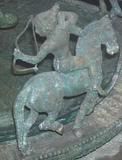
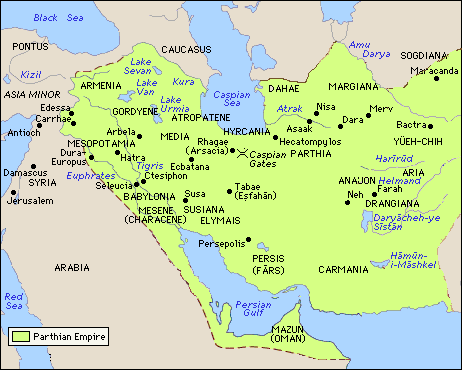
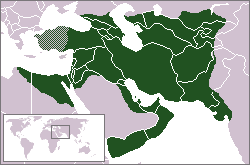
PhotobucketWhen last we gathered for an historiorant, a particularly ambitious (and blithely arrogant) Roman named Crassus had just led tens of thousands of men to their doom in The Imperial Surge of 53 BCE. The people who slaughtered the Romans on the dusty plain of Carrhae (in extreme southeastern Turkey) were the Parthians, descendents of the semi-nomadic Parni tribe that had migrated from their homeland east of the Caspian Sea and adopted many of the ways of the people they found already living in the region of Parthia (northern Iran). The blending of military styles, in particular, made the Parthian 2.0 no slouch on the battlefield; expanding behind armies of highly disciplined horse archers and heavily armored cataphract knights, the Parthians at one point (ca. 100 BCE) dominated an area stretching from Armenia to the borders of India.
Photobucket

In time, the Parthians came to think of themselves as the bloodline-bona fide rulers of Persia, claiming descent from Artaxerxes II (r. 404-358 BCE), and by extension, from Cyrus the Great himself. Basing themselves south of the Caspian Sea and north of the Alborz Mountains, the Parthians created themselves a reborn Achaemenid Dynasty (the line of Cyrus, Darius, and Xerxes from three centuries before), though some aspects of their culture were a bit Hellenistic in flavor owing to the Seleucids – courtiers spoke Persian and wrote in the Pahlavi script, but Greek was used on coins until the 2rd century CE – whose 150-year hold on power was weakening around the same time as the Parthians were growing in strength.

The Parthian Dynasty (246 BCE-224 CE) – sometimes called the Arsacid, after one of its founders – established its main capitol at Ctesiphon, just across the river from Seleucia on the Tigris (south of Baghdad, on the west bank); from there, the horsemen proceeded to carve up the prostrate empire of the Seleucids. Under Mithradates (Mehrdad) I (171-138 BCE) and especially under Mithradates II (124-87 BCE), who defeated the Scythians (for a time) and added Armenia to the Parthian domain, the horsemen established an empire that basically defined the eastern edge of Rome's sway. Though the next 300 years saw parts of Mesopotamia occasionally fall to the Parthians, and Ctesiphon to the Romans three times in the 1st century CE alone (Armenia went back and forth), the Parthians remained strong enough to keep the borders of Rome at the west bank of the Tigris (more or less), where the forts and garrisons the Romans were obligated to maintain proved a constant and costly drain on the resources of the Eternal City.
Photobucket

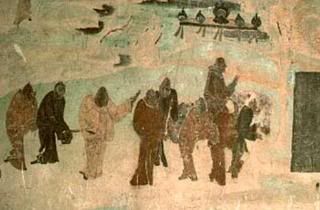
Zhang Qian in the 2nd century BCE, as potrayed by a 7th century CE mural

The Parthians fought along their northern borders, as well, eventually capturing several important cities along the Silk Road. This did two things in particular: it cut off from Western contact Greco-Bactria, the last remaining Hellenistic kingdom in Central Asia, and it brought Iran into almost exclusive contact with China. It seems the Chinese took a shine to Parthian horses - in the late 2nd century BCE, explorer/conquistador Zhang Qian first brought back word to the Han emperors that there were "Heavenly Horses" to be found on the Iranian Plateau; later he arranged for a trade pact between Parthia and China. By the first century CE, Han cavalry was composed largely of Parthian horses, and their battle tactics showed signs (like a modified Parthian shot) of Persian influence. Some Chinese took a shine to another import from Parthia, as well: around 148 CE, a Parthian nobleman/Bhuddhist missionary (the Bamiyan-Buddha-carving Kushan Empire was Parthia's next-door neighbor to the East) named An Shih Kao established temples around the Han capital of Luoyang, and went on to make the first translations of Buddhist scripture into Chinese.
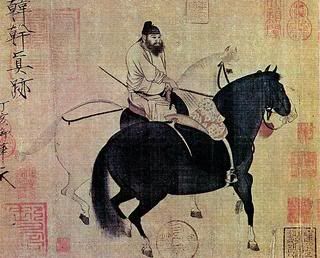
PhotobucketWeird Historical Sidenote: The Chinese thought very highly indeed of Parthian horses – I'm told another name for them, "Soulun," translates to "vegetarian dragon." There's also a rumor that the horses sweated blood, but stories like that (especially the 2000-year-old ones) are notoriously difficult to verify. Something that is a little easier to establish is that the Scythians dug Parthian horses, too – but usually just the chestnuts and bays. So it is that the Russian Don breed (est. 18th c. CE) preferred by the Cossacks often shows similar coloration even today.

Weird Historio-Political Parallel: The silk for which Rome was willing to pay dearly had to pass through the lands of a mortal enemy first, and the only reason that enemy didn't cut off trade entirely was that their own economy became increasingly dependent upon the commodity. For the life of me, I can't think of a single modern parallel to this situation – can you? ;-)

The Parthian governmental system was comprised of up to 18 vassal states and a Royal Council of 5 client kings with significant authority to check the power of their liege – the Suren clan, for example, had exclusive crowning rights. The decentralized nature of their government both helped and hurt the Parthians: they could (and did) survive multiple falls of their capital by simply relocating, but like all feudal systems, conflicts resulted when lords began to acquire power that rivaled that of the king. Such was the case in the early 3rd century CE, when the descendents of a priest named Sassan began dethroning and usurping other local lords in the region of Persis (a/k/a Pars; southern Iran).


An Empire of the Old School

Persia proper lay within the domain of the Parthians, but it was administered in the now-traditional satrap-based form of feudalism practiced in this region since Cyrus handed out his first political favor. Like all feudal systems, the Persian satraps had to constantly be wary of the local lords and chieftains who administered the various districts within their satrapy, as a feudal lord's strength is only as great as the sum of his loyal vassals. Turns out that this general rule applied to the Parthians, only they didn't realize it until it was too late.

In 224 CE, Papak (alternate spellings abound), a village leader and the son of Sassan, a priest of the Temple of Anahita, managed to dethrone Artabatus V, ruler of Persia. As Persia was a vassal state to Parthia, this might have caused little concern in Ctesiphon had the ongoing feudal obligations – the ass-kissing, the tax-paying – been met, but neither Papak nor the son who succeeded him, Ardashir, was the sort of guy to content himself with paying tribute to an overlord (actually, Ardashir had an older brother, named Shapur, who probably ascended the throne around 220 CE, but it seems a building collapsed upon him in 222 – u.m.)

For Parthia, the ensuing war was as short as its results were bad; Ctesiphon fell in 226 CE, and the Sassanids assumed the rulership of the empire. They saw themselves as a culture native to Persia, and like the Parthians before them, sought to legitimize their dynasty by claiming descent from the legendary Achaemenian line of Cyrus and Xerxes. From their own past they grabbed the title Shahanshah (“King of Kings)”, and they established their capital upon the site of ancient Gor (modern-day Firouzabad, in southern Iran), which had been destroyed by an Alexander the Great-engineered flood – Ardashir had a tunnel dug through a mountain to drain the lake that still remained.

Historiorant: As I mentioned above, I'm trying to compress those seven earlier diaries into four, so it really doesn't behoove me to be chasing after every shiny historical tidbit that appears along our route, but every once in while, your resident historiorantologist runs into one he can't help but share. Such is the case with Ardashir, founder of the Sassanid Empire – though I'm shortly going to blaze through four hundred years of their rule in just a few paragraphs, the story of their founder is simply too colorful to ignore. It's also quite a work of court history, and will no doubt serve as an invaluable resource after the Bush misadministration is gone and historiogrovelers (the sworn enemy of the historioranter) like Fances Fukuyama seek to tortuously justify the stupid assertions they made at the onset of the Era of Compassionate Conservatism.

The army of the Worm, which had been inside the fortress, completely marched out, and zealously and vehemently struggled and fought with Ardashir's troops, many being killed on both sides. When the army of the Worm came out (of the fortress), it took such a by-road that it became impossible for any of Ardashir's troops to go out (of the camp) or to bring in any food for himself or fodder for his horses, and, (consequently), the satiety of all men and animals was changed into want of food and helplessness.

When Mitrok, son of Anoshepat, an inhabitant of Zarham in Pars, heard that Ardashir was without provision near the capital of the Worm, and obtained no victory over its army; he accoutered his troops and heroes, marched towards the residence of Ardashir, and carried away all the wealth and riches of Ardashir's treasure.

Ardashir, hearing of such violation on the part of Mitrok and other men of Pars, reflected upon it for a while thus: "I ought to postpone the battle with the Worm, and [then] go to fight out a battle with Mitrok." He, (therefore), summoned all his forces back to his quarters, deliberated with their commanders, (first) sought the means of delivering himself and his army, and then sat himself down to eat breakfast.

That very moment a long arrow, dispatched from the fortress, came down and pierced, as far as its feathers, through the (roasted) lamb that was on the table.

On the arrow it was written as follows: "This arrow is darted by the troops of the lord of the glorious Worm; we ought not to kill a great man like you, so we have struck that (roasted) lamb," Ardashir, having observed the state of things, disencamped his army and withdrew from the place.

The army of the Worm hastened after Ardashir, and hemmed in his men again in such a manner that Ardashir's army could not proceed further. So Ardashir [himself] passed [lit. dashed] away singly by the sea-coast.

The Kârnâmag î Ardashîr î Babagân ('Book of the Deeds of Ardashir son of Babag'), Chapter 6

Weird Historical Sidenote: Great story about that "army of the Worm" thing. Seems that once upon time, a maiden found a kerm ("worm") in an apple, and made a pledge to feed and care for it. Since it just so happened to be a lucky worm, this turned out to be a really good decision: soon her father conquered the entire province, which became known as Kerman, or "Worm Province." The family's luck held until Ardashir realized that the worm was their Achilles' Heel, so to speak, and...well, I gotta let The Glory of the Shia World (pub. 1910) and its source, whom the authors describe as no less than the greatest epic poet ever, tell the rest of it:

Consequently he (Ardashir) resolved on a daring stratagem, and, disguising himself as a merchant prince, he presented himself before Haftan Bokht (the King of Kerman) and said, that as he owed all his success in trade to the good fortune of the Worm, he requested the honour of feeding it for three days. This petition was readily granted, and as Firdausi, the greatest epic poet of all the cycles of time, writes:

When their souls were deep steeped in the wine-cup;

Forth fared the Prince with his hosts of the hamlet,

Brought with him copper and brazen cauldron,

Kindled a flaming fire in the white daylight.

So to the Worm at its meal-time was measured

In place of milk and rice much molten metal.

Unto its trench he brought that liquid copper;

Soft from the trench its head the Worm upraised.

Then they beheld its tongue, like brazen cymbal,

Thrust forth to take its food as was its custom.

Into its open jaws that molten metal

Poured he, while, in the trench, helpless the Worm writhed;

Crashed from its throat the sound of fierce explosion,

Such that the trench and whole fort fell a-quaking.

Swift as the wind Ardeshir and his comrades

Hastened with drawn swords, arrows, and maces.

Of the Worm's warders, wrapped in their wine-sleep,

Not one escaped alive from their fierce onslaught.

Then from the Castle-keep raised he the smoke-wreaths

Which his success should tell to his captains.

Hasting to Shahr-gir swift came the sentry,

Crying, "King Ardeshir his task hath finished!"

Quickly the captain then came with his squadrons,

Leading his mail-clad men unto the King's aid.

And in the name of all that's holy, please, please: nobody tell President Bush that the key to conquering Iran lies in finding a gigantic, enchanted worm and pouring molten copper down its throat.

Despite the grandiosity of the title adopted by Sassanid rulers, "king of kings" accurately describes their government, which followed the same basically feudal format as the preceding three Iranian empires. Their aristocracy was an amalgamation of earlier history, too, with nobility comprised of a mix of the leaders of old Parthian clans, Persian aristocratic families, and nobles from subjected territories. The Sassanids imposed a 4-tiered caste system of Priests, Warriors, Secretaries, and Commoners, and sought actively to eradicate Greek influence in Iranian culture. Ardashir, especially, recognized the potent weapon that faith mixed with national pride can be, and he wasn't afraid to play favorites: Zoroastrianism was made the state religion, the Magi were given special privilege, and more than a few marble friezes show Ahuramazda, the supreme deity as spaken of by Zarathustra, conferring the authority to rule upon Ardashir.

The religious fervor of the Sassanids had, as religious fervors tend to, a darker side. . Run-of-the-pew Christians were periodically persecuted – a situation that became worse after Rome converted to Christianity and its practice in the Sassanid Empire became an act of treason. Still, for most of their 4-century reign, the Sassanids practiced religious toleration, bringing their Zoroastrian faith with them as they established trading colonies as far away as India, Vietnam, and Malaysia; other exports include the Cult of Mithras to Rome, where it competed for converts with the early Christians. A notable exception to the general rule of tolerance was made in the case of the prophet Mani,

...who claimed to be both Christ and the Buddha, and was crucified, (ca. 236 CE). Mani preached a Zoroastrian conflict between good and evil, but then (like the Gnostics) regarded matter as evil. Served by a celibate and vegetarian priesthood, Manicheanism spread both East and West. To the East, it was adopted by the Sogdians and Uighurs (under Bugug Khan, 759-780), until the advent of Islâm, and spread all the way to China. Marco Polo's description of a Christian community in China which had actually forgot it was Christian may actually refer to a group of Manicheans.

Media, Persia, Parthia, and Irân

Manicheanism headed West, too, where elements of it can be seen in the religion of the Cathars of southwestern France, whose unique culture and civilization were pretty much wiped out by a deliberate act of genocide emanating from Rome in the early 13th century.


The Crossroads of Classical Geopolitics
Photobucket

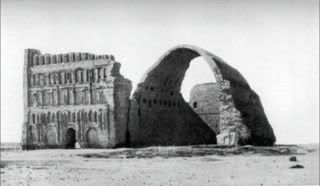
There's not much left of Ctesiphon, the largest city in the world in the 6th century. Located about 35 km south of Baghdad, people were still fighting one another on the site 14 centuries later: in 1915, the British and Ottomans engaged in a pitched battle amongst the ruins, destroying much of what little remained.

From their position astride the Silk Road, the Sassanids did a masterful job of allowing plenty of trade goods, but precious little knowledge, to pass between Rome and China. They also enriched themselves as middlemen, and availed themselves of all the scientific, cultural, and technological benefits that can accrue to a nexus of world trade. It was during the Sassanid period that close contact with India brought in stories that would eventually find their way into the Thousand Nights and One Night, and there is speculation that the 90-foot spiral Zoroastrian fire altar at Ardashir's new capital was the basis for the design of the Spiral Minaret at the Great Mosque of Samarra. Domestically, the Sassanids were aggressive builders who actively sought to reinvigorate traditional Persian art forms, and cities like Gundishapur, where a university was founded in the 4th century, were among the greatest centers of learning of their time. As for architecture, the great historiodeity Will Durrant says:

"Sasanian art exported its forms and motifs eastward into India, Turkestan, and China, westward into Syria, Asia Minor, Constantinople, the Balkans, Egypt, and Spain. Probably its influence helped to change the emphasis in Greek art from classic representation to Byzantine ornament, and in Latin Christian art from wooden ceilings to brick or stone vaults and domes and buttressed walls."
PhotobucketBeing a neighbor of the Roman Empire wasn't easy for anyone who had the pleasure, but the Sassanids began drawing lines in the sand in the earliest days of their power. Ardashir’s son Shapur antagonized the Romans even further than his father had, by demanding that they relinquish all their territories in Asia – presumably so that the title “King of all Iran and non-Iran” would better fit the new Sassanid ruler – then swiftly invading Mesopotamia. His initial victories were reversed in 243 CE, but the following year, the young emperor Gordian III opened the doors of the Temple of Janus – signifying that Rome was now at war; they'd been closed since 70 CE – for the last time in Roman history, and personally led a disastrous troop surge down the Euphrates. Since I don't want to be accused of mongering conspiracies, I'll defer to Wikipedia for some tidbits on the death of the emperor:

Persian sources claim that a battle was fought (Battle of Misiche) near modern Fallujah (Iraq) and resulted in a major Roman defeat and the death of Gordian III. Roman sources do not mention this battle and suggest that Gordian died far away, upstream of the Euphrates. Although ancient sources often described Philip, who succeeded Gordian as emperor, as having murdered Gordian at Zaitha (Qalat es Salihiyah), the cause of Gordian's death is unknown.

Philip the Arab (r. 244-249 CE), the Praetorian Prefect (recently ascended to his office following the mysterious death of his predecessor), quickly grabbed up the purple robes of the emperor's office, bought off Shapur to the tune of 500,000 denari (he also left behind bunch of legionaries, who were enslaved and compelled to build the city of Bishapur to commemorate the guy who had beaten them), and headed back to Rome to secure his claim in the Senate. Despite Philip's promise of future payments, Shapur soon resumed the war by looting Antioch – which provoked another Mesopotamian troop surge that would end with the first-ever capture of a Roman Emperor in battle.
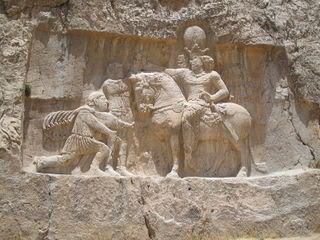
PhotobucketIn 253 CE, Valerian was named Emperor, and he spent the next seven years flitting about the imperial borders, putting out fires where he could. There were Marcomans in the Alps, Visigoths in Thrace, and Sassanids in Syria – and Valerian tried to deal with them all. So it was that in 260 CE, he found himself in Edessa as a Sassanid army surrounded the city. Though he had liberated Antioch (and captured Shapur's harem at one point), things did not turn out so well for Emperor Valerian: he was taken prisoner by Shapur in late 259 or 260 CE, and died without ever again tasting freedom or seeing Rome. Sources vary as to his treatment – some have Valerian being used as a footstool before getting the molten-gold-down-the-gullet treatment, while others say he and his men lived in passable conditions, considering that they'd been enslaved for hard labor, in Bishapur.

Shapur was also busy in the east. He expanded into the Kabul river valley, captured Peshawar, and carried a sacred relic – the Begging-Bowl of the Buddha – back to Istakhr. His son, Shapur II, expanded the empire to the borders of China, then invaded Arabia, prior to settling in for a nice long conflict with the Romans. As one of very few civilizations to whose ruler the Emperor addressed letters "My Brother," the Sassanids were a constant threat on Rome's eastern flank, and over time, their military made adjustments to its composition and tactics based on the Persian threat. The addition of heavily-armored cavalry, for example, was inspired by the cataphracts of Persia – and Roman heavy cavalry is part of what inspired the later development of the European mounted knight.


It Was (mostly) Fun While It Lasted
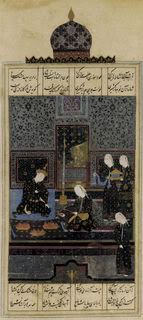
PhotobucketBahram Gur and the Indian princess in the black pavilion from a Khamsa (Quintet) by Nizami mid 16th century Safavid dynasty. (Wikipedia Commons)

For three centuries, the Sassanids and Rome parried, with the former enjoying no fewer than two golden ages while the latter succumbed to the inevitable forces of decline and fall. Notable leaders during this long span of time include Bahram V (421-438 CE), who was to go on to enjoy national epic hero status as the lover and hunter Bahram Gur, and Khorsow I (531-579 CE) a/k/a Khosrow Anushirvan (the Just). Treatment of the adherents of non-Zoroastrian faiths varied by ruler, as did the fortunes of war and trade, but the stability imposed the caste system generally helped the subjects of the empire ride out the reign of the occasional poor leader; when the end finally came, it did so during a precipitous quarter-century that saw virtually all of the empires of antiquity knocked back on their heels.

The final war between Rome – now reborn as Byzantium – and Persia started when the Sassanid king (and gargantuan dome-builder; see Ctesiphon pics above) Khosrow II (r. 591-628 CE) invaded Syria and sacked Jerusalem in 614 CE. It is said the Jews there welcomed the Persians, remembering the stories of the wise and merciful Cyrus, and because the Christians in the city were persecuting them. It is also said that the Sassanids carried back to Persia another sacred relic – the True Cross – as plunder from Jerusalem (they give it back in a generation or two). Khosrow went on to take over Egypt and the islands of Cyprus and Rhodes, and even besieged Constantinople for a time, but the slow-moving Byzantine army retaliated forcefully in 627 CE, cutting a broad juggernaut-type swath of destruction through Mesopotamia. Weary of being led by a megalomaniac and humiliated by the advance of Byzantine forces deep into Sassanid territory, the Persian army mutinied and murdered Khosrow in 628 CE.

Notice the dates? Now check them against your Hegira calendar.

After being decisively spanked by the Byzantines, not to mention having their ruler assassinated by his own army, the Sassanids fell into chaos and disunion. They ran through a dozen kings in the last twenty years of the empire, but this was just one of many symptoms of social and economic decline that were ultimately rooted in the vast power of the Zoroastrian state religion. Its rigid system of social stratification was beginning to strain under the weight of taxation – more favors to the priests and the powerful than could be paid for by the plebians – and the common folk were starting to resent the burden. Additionally, since persecution of non-Zoroastrians was sanctioned by the state, the empire could always be counted upon to produce a small-but-virulent undercurrent of seething resentment, just waiting for an opportunity to erupt into rebellion. And finally, that old Persian problem of freedom-minded satraps started cropping up again – the Lakhmids were only the first to assert their independence after the assassination of Khorsow II in 628 CE; other vassal states on the periphery soon followed.


Historiorant:
Photo Sharing and Video Hosting at PhotobucketThe original thought was to get all the way through the arrival of Islam in Persia, leaving off at the rise of the Abbasid Dynasty, but that version of the diary wound up at 15 single-spaced pages without pictures. That's a little long, even by my standards – but I gotta think a story like that of Ardashir and the Worm is worth delaying a discussion on the Battle of al-Qadissiyah by a week or so.

Next up, then, will be Islam and Medieval Persia; for this week, let's try'n think of some of the other non-Roman cultures of Classical Antiquity that our Dear Leader has spurned in his tortured interpretation of the historical record – what's the most critical thing he hasn't learned about Han China or Mauryan and Gupta India?, for example. If that seems a little esoteric, then how about this: Had he attended a university whose history professors had sufficient integrity to ensure that he actually earned his degree through study and effort, what lessons about the Parthians and the Sassanids might now be able to inform Bush's decision-making with regard to Iran?


Historically hip entrances to the Cave of the Moonbat can be found at Daily Kos, Never In Our Names, Bits of News, Progressive Historians, and DocuDharma.


Labels: , , , , , , , ,