by Joel Tscherne | 8/27/2009 07:00:00 AM

How much should historians pay attention to Hollywood and media coverage of historical events and figures? I bring this up after my first graduate class last night, a reading seminar on the American Revolution. When another student asked the professor about the HBO John Adams miniseries, the instructor responded, "I don't have cable", clearly showing no interest in even discussing the subject. But can historians afford to let screenwriters and producers make movies and TV shows that clearly plays fast and loose with history?


I bring this up as we approach the 70th anniversary of World War II (in a few days) and the 150th anniversary of the United States Civil War (in a few years). The media is always big on commemorating anniversaries and these will not be an exception. Steven Spielberg is in development on a biography of Abraham Lincoln, set for possible release in 2011, with Liam Neeson signed on to play the president. In addition, Robert Redford has just announced plans to make The Conspirator, a movie featuring the story of Mary Surratt, one of the Lincoln assassination plotters, the first woman executed by the Federal government.

Obviously there have been a large number of movies, documentaries, and TV shows that have used historians as consultants. Unfortunately, many of these works have been heavily criticized by historians for both the way they often play with facts and their misunderstanding of the events they mean to present. Of course, the problem is that more people are likely to see a movie or watch a show than read either university press books or even history best sellers.

So how can we juggle our desire to make sure that Hollywood gets it right with our belief that it isn't worth the time or trouble when it?s unlikely that anyone is going to listen to us anyway? And while you're thinking about it, consider this: Oliver Stone has signed with Showtime to create a 10-part miniseries on the secret history of America. No matter what you think about his films or his politics, doesn't that still give you pause for thought?

Labels: , ,

 
by Joel Tscherne | 8/17/2009 07:00:00 AM

Whenever I study a major historical event, I am struck by the amount of myths, legends, and misunderstandings crop up about the event. In August of 1969 a throng of young people descended on a farm near a small town in upstate New York to attend the Woodstock Music & Arts Fair. The event had been heavily publicized and the subject of a number of news stories, but nobody involved expected the huge attendance. Hailed by many as the culminating event of the 1960s, forty years later it is back in the news with new books, magazine articles, and recordings. Yet much of the new information has proven that like many major news events, it was a product of hard work and planning, but also a product of a great deal of luck. And like many other events, much of it is the stuff of myth.


The myth is largely built on the soundtrack and film released the following year. Both presented a festival that had problems (mostly because of the large crowds), but was successful due to the spirit of working and living together. The film opens up with lush and idyllic views of green grass and the building of the festival area. When the people begin to arrive, they’re shown as happy young people being welcomed by townspeople who, with few exceptions, talk about how nice the kids are. Looking below the surface though, it becomes very clear why something like it never happened again.

Michael Lang had very little experience as a concert promoter, but had a vision of a festival that would include art, recreation, as well as major rock acts, all together in a tranquil location. He was able to gather backers, as well as a crew built largely of experienced people in all the major facets needed to put it on. Barely a month before Woodstock was to happen, the promoters lost their planned location. Without the help of farmer Max Yasgur, the festival would likely have suffered a premature death with an ensuing financial disaster. Time and again, Lang and his organization had to deal with new potential roadblocks and come up with new ways to ensure success. However, it is also clear that they dodged a number of potential bullets that would have drastically changed Woodstock’s place in history.

The stage area was never finished and the crew constantly worried about the light towers and other parts of the structures, particularly because of the amount of rainfall during the weekend. The group of moonlighting New York City policemen who were hired to help work traffic control never came because they were forbidden at the last minute to be there by their superiors. The local National Guard had to get involved to help with transporting supplies and medical personnel. The festival area was inundated with a variety of recreational drugs that could have drastically affected the health of many of the attendees.

Yet both the film and soundtrack both tend to obscure just how much went wrong behind the scenes. For example, early on in the film, there is a scene of people “breaking into” the festival by climbing over damaged fences, followed soon after by the famous “It’s a free concert” announcement. However, days before Woodstock even started, people had already begun camping out on the festival site because no major barriers had been erected. Broken fences or not, it would have been impossible to stop the onslaught of attendees, so the decision to open the festival to all was largely a moot point. In the same way, as great as much of the music was, many acts were subject to logistical and technical problems often brought about by the fact that much of the site was never properly completed. As magical as the concert is considered, some of the bands still will not discuss their participation with any sense of good memories and at least two of the performances on the soundtrack weren’t even recorded at the actual festival (Arlo Guthrie's Coming into Los Angeles and CSNY's Sea of Madness).

Still, the careers of some artists were made because that weekend. Joe Cocker and Carlos Santana readily admit that much of their enduring fame was because of Woodstock. Yet two of the festival’s major headliners, Jimi Hendrix and Janis Joplin, as well as Alan Wilson of Canned Heat, would be dead a little more than a year later, victims of the hard and fast life almost reveled in at Woodstock.

As much as many want to remember Woodstock with nostalgic memories of a different time when things were better, forty years on maybe it might be better to accept it, not as any kind of turning point in American history, but as a part of the country’s cultural history, warts and all.

Labels: , ,

 
by mark | 4/20/2009 12:01:00 PM


" ...he was one of the most extraordinary individuals to have ever walked the earth. He above all others deserves to be called, "the Great'."

Alexander the Great by Paul Cartledge

Cambridge classicist Paul Cartledge has the rarest of talents among professional historians - the ability to write books that simultaneously appeal to academics and popular audiences alike. Alexander the Great has his trademark "concise depth" that Cartledge also brought to bear in The Spartans and later to Thermopylae: The Battle That Changed the World; there is enough historiographic "meat" for the scholar and the casual student of history or of war will enjoy Cartledge's depiction of Alexander as a "ruthless pragmatist", engaging in calculated gestures of epic magnaminity and brutal murder of his closest comrades in arms with equal certitude. One who, despite his mysticism and growing tyranny, had imperial ambitions that "....can symbolize peaceful, multi-ethnic coexistence".
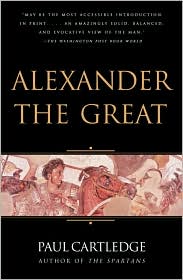


Cartledge, despite the above quotation, is not an Alexander-worshipper but a realist or a mild skeptic, rejecting hyperbole and hidden agendas in the ancient sources, which he discusses in detail, along with the more extreme portraits painted of Alexander by modern historians, such as "...the titantic and Fuhrer-like Alexander of Fritz Schachmeyer". Cartledge's Alexander is a military genius and an inspirational visionary to be sure, but his icy ruthlessness of calculated murder of potential opponents and superannuated followers like Callisthenes or Parmenion is never far away. Cartledge uses the term "purges" several times in the text and it is appropriate; Alexander, with his suspicions aroused, had the same irrevocable instinct for savage reprisal as did Joseph Stalin. Alexander running through Cleitus the Black with a spear in the midst of a banquet, a man who had saved Alexander's life, or who ordered the destruction of Thebes was the same Alexander who honored the religions and customs of his conquered subjects and tried to build his Overlordship of Asia on a fusion of Pan-Hellenism and ancient Persia:
"Alexander's importation and integration of oriental troops into the Macedonian army was a crucial and controversial issue. by the end of 328 he had units of Sogdian and bactrian cavalry, so presumably he was drawing also upon the excellent cavalry of western and central Iran. In 327 he recruited more than thirty thousand young Iranians. Since Greek was to be the lingua franca of the new Empire, replacing the use of the Achaemenids use of Aramaic, he arranged for them to be taught the Greek language as well as the demonstrably supeior Macedonian infantry tactics. when they arrived at Susa in 324, he hailed them as ' successors' - to the Macedonian soldiers understandable consternation" [ 204 ]

Cartledge discusses Alexander's generalship and his abilities as an adaptive military innovator, building on a his father Philip's original military reforms or improvising when faced with unexpected difficulties at river crossing or in siege warfare. He misses though an opportunity to explain the dreadful effectiveness in Alexander's hands of the Macedonian phalanx, a more heavily armed, lightly armored, mobile and deadly version of the original Greek Hoplite formation. While Alexander and his cavalry garnered most of the glory, the ordinary Macedonian phalanx cut through Persian ranks like an implacable meat grinder, mowing down enormous numbers of the enemy and trodding their dead and dying bodies underfoot. Understandably though, this is a biography of Alexander and not a history of his wars but the real scale of the slaughter Alexander inflicted is given far less attention than the skill with which he inflicted it, or his political and religious policies that came in their wake.

Alexander's religious sentiments and his mysticism, which spilled over in to his political vision for Asia and for himself as a semi-divine ruler are given much consideration by Cartledge, ranging from his at a distance dealings with subject state Athens, to his "contracting" a relationship with the Egyptian god Ammon, to his ideation with Achilles as a model for himself. There appears to have been something of a feedback loop between Alexander's military acheivments, which were truly superhuman, and his growing religious superstitions, both of which fed a kind of megalomania according to Cartledge, and led to Alexander's unsuccessful demand that his Greek and Macedonian soldiers adopt proskynesis in the Persian style. A more or less blasphemous act of hubris ( though not quite absolutely, as Cartledge explains, given the precedent of the deification of Lysander) that led to a break between Alexander and his most loyal followers. This craving for divinity later was expanded posthumously to fabulous extremes in the traditions of the Alexander Romance, where Alexander the Great becomes a symbolic and heavily mythologized figure for dozens of peoples and regimes. Alexander himself began cultivating the myths.

Cartledge has done an excellent job demystifying one of the archetypal figures of Western history, the man whom other would-be world conquerors had to measure themselves against - reportedly, Julius Caesar wept in despair because Alexander's glory was beyond his reach. He has also brought out the extent to which Alexander saw himself not as a Westerner, or a Hellene, but as a bridge to the East, a synthesizer of civilizations.

Labels: , , , , , ,

 
by mark | 6/22/2008 09:42:00 PM
Previously, Jeremy Young, our primus inter pares, called for a symposium on the question of what is a historian:


The argument we're (not quite) having here -- and to which Adam
Hochschild
in Historically Speaking makes another important
contribution -- concerns a series of rich and timeless questions: what exactly is a historian? Should the term be applied only to those who possess doctoral degrees and publishing histories, or are historians a more broad and multifaceted group? Is everyone a historian, as Carl Becker
famously argued? And assuming we can define the "wheat" and the "chaff," what separates the two? What does the "trained" historian have to offer that the "amateur" does not, or vice versa?

Good questions all. Let me start with what historians are not.

Historians are not theorists, though they may entertain certain theories in the course of interpreting an event they do not begin with answers as does a theorist but with questions. Questions they try to answer with research and evidence because history, while not a science, is an empirical discipline. Historians are not poets, they do not aim to create sweeping, romantic, myths, though like anyone else, historians admire mythic ideals but their task is to reveal where reality may have fallen short. Historians are not social scientists, though they sometimes borrow their tools; nor are they economists constructing abstract models hoping to predict events. A historian who tries to predict what will happen based upon the past is engaging in futurism, a very different and more difficult art.

None of this is meant to disparage political scientists, poets, economists, sociologists, anthropologists, authors of historical fiction or futurists. They all do worthy and interesting things, it's just that their work cannot properly be called "history". A historian is someone who tries to cogently explain what really happened, based upon the best evidence available; amateur or professional status matters less than skill, persistence and intellectual integrity in pursuing this task.


Historians have a varied set of skills. They are researchers, at times, detectives. They must consume and accurately recall vast amounts of historigraphical literature. Historians must think analytically foremost but also intuitively and sometimes, toward a synthesis. They must communicate clearly with the spoken and written word; and they must be teachers, literally in a classroom or in the larger sense of writing history to educate society. Few historians excel equally well at all of these different aspects but most good historians are strong or even exemplary in many of them.

In regard to the respective virtues of professional vs. "amateur" or "popular" historians ( many popular historians are or were also academics - Howard Zinn, Stephen Ambrose, Niall Ferguson and so on) it is important to recognize that they write for different audiences. Popular or amateur historians write for the intelligent reading public while academic historians write primarily for other academic historians. This is not a slam on profesional scholars but a recognition of differences in scope, scale and level of historical knowledge between the two groups of readers.

The public is not well prepared to handle or comment upon historical monographs of an esoteric or technical nature, only other specialists can do that. Nor are historians who have spent most of their career in a very rarefied subfield - say researching currency fluctuations in the Spanish Netherlands during the early modern period or Women's social status in the Caribbean during the late Colonial era - well positioned to write a panoramic history of Western civilization, of the history of technology or similarly big picture subjects desired by the layman who wants to "read some history". At least not without a major time investment.

The relationship between academic and popular/amateur historians is an interdependent one; the former are usually creating the monographic bricks with which the latter build their sweeping and entertaining literary edifices while popular historians "hook" readers into studying history more deeply - perhaps deeply enough to become a professional historian! One is not "better" than the other, simply different with distinct objectives.

The door of history is open to anyone - you simply need to walk through it.

Labels: , , , , ,