

by mark | 4/20/2009 12:01:00 PM


" ...he was one of the most extraordinary individuals to have ever walked the earth. He above all others deserves to be called, "the Great'."

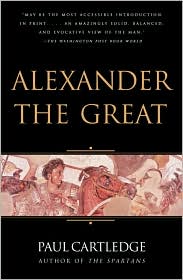
Alexander the Great by Paul Cartledge

Cambridge classicist Paul Cartledge has the rarest of talents among professional historians - the ability to write books that simultaneously appeal to academics and popular audiences alike. Alexander the Great has his trademark "concise depth" that Cartledge also brought to bear in The Spartans and later to Thermopylae: The Battle That Changed the World; there is enough historiographic "meat" for the scholar and the casual student of history or of war will enjoy Cartledge's depiction of Alexander as a "ruthless pragmatist", engaging in calculated gestures of epic magnaminity and brutal murder of his closest comrades in arms with equal certitude. One who, despite his mysticism and growing tyranny, had imperial ambitions that "....can symbolize peaceful, multi-ethnic coexistence".


Cartledge, despite the above quotation, is not an Alexander-worshipper but a realist or a mild skeptic, rejecting hyperbole and hidden agendas in the ancient sources, which he discusses in detail, along with the more extreme portraits painted of Alexander by modern historians, such as "...the titantic and Fuhrer-like Alexander of Fritz Schachmeyer". Cartledge's Alexander is a military genius and an inspirational visionary to be sure, but his icy ruthlessness of calculated murder of potential opponents and superannuated followers like Callisthenes or Parmenion is never far away. Cartledge uses the term "purges" several times in the text and it is appropriate; Alexander, with his suspicions aroused, had the same irrevocable instinct for savage reprisal as did Joseph Stalin. Alexander running through Cleitus the Black with a spear in the midst of a banquet, a man who had saved Alexander's life, or who ordered the destruction of Thebes was the same Alexander who honored the religions and customs of his conquered subjects and tried to build his Overlordship of Asia on a fusion of Pan-Hellenism and ancient Persia:
"Alexander's importation and integration of oriental troops into the Macedonian army was a crucial and controversial issue. by the end of 328 he had units of Sogdian and bactrian cavalry, so presumably he was drawing also upon the excellent cavalry of western and central Iran. In 327 he recruited more than thirty thousand young Iranians. Since Greek was to be the lingua franca of the new Empire, replacing the use of the Achaemenids use of Aramaic, he arranged for them to be taught the Greek language as well as the demonstrably supeior Macedonian infantry tactics. when they arrived at Susa in 324, he hailed them as ' successors' - to the Macedonian soldiers understandable consternation" [ 204 ]

Cartledge discusses Alexander's generalship and his abilities as an adaptive military innovator, building on a his father Philip's original military reforms or improvising when faced with unexpected difficulties at river crossing or in siege warfare. He misses though an opportunity to explain the dreadful effectiveness in Alexander's hands of the Macedonian phalanx, a more heavily armed, lightly armored, mobile and deadly version of the original Greek Hoplite formation. While Alexander and his cavalry garnered most of the glory, the ordinary Macedonian phalanx cut through Persian ranks like an implacable meat grinder, mowing down enormous numbers of the enemy and trodding their dead and dying bodies underfoot. Understandably though, this is a biography of Alexander and not a history of his wars but the real scale of the slaughter Alexander inflicted is given far less attention than the skill with which he inflicted it, or his political and religious policies that came in their wake.

Alexander's religious sentiments and his mysticism, which spilled over in to his political vision for Asia and for himself as a semi-divine ruler are given much consideration by Cartledge, ranging from his at a distance dealings with subject state Athens, to his "contracting" a relationship with the Egyptian god Ammon, to his ideation with Achilles as a model for himself. There appears to have been something of a feedback loop between Alexander's military acheivments, which were truly superhuman, and his growing religious superstitions, both of which fed a kind of megalomania according to Cartledge, and led to Alexander's unsuccessful demand that his Greek and Macedonian soldiers adopt proskynesis in the Persian style. A more or less blasphemous act of hubris ( though not quite absolutely, as Cartledge explains, given the precedent of the deification of Lysander) that led to a break between Alexander and his most loyal followers. This craving for divinity later was expanded posthumously to fabulous extremes in the traditions of the Alexander Romance, where Alexander the Great becomes a symbolic and heavily mythologized figure for dozens of peoples and regimes. Alexander himself began cultivating the myths.

Cartledge has done an excellent job demystifying one of the archetypal figures of Western history, the man whom other would-be world conquerors had to measure themselves against - reportedly, Julius Caesar wept in despair because Alexander's glory was beyond his reach. He has also brought out the extent to which Alexander saw himself not as a Westerner, or a Hellene, but as a bridge to the East, a synthesizer of civilizations.

Labels: , , , , , ,

 
by mark | 9/24/2008 09:47:00 PM

Jeremy was kind enough to invite me to engage in a brief burst of self-promotion at Progressive Historians, which I readily accepted. :)
Through the aegis of Nimble Books, I had the opportunity to work with a sizable group of professional military analysts, historians, bloggers and writers to produce The John Boyd Roundtable: Debating Science, Strategy, and War. The book was loosely based upon an online symposium at Chicago Boyz blog that discussed Science, Strategy and War: The Strategic Theory of John Boyd , a very impressive ( and at times quite technical) work of strategic studies history by Colonel Frans Osinga of the Netherlands Royal Air Force. What emerged from the conversion from blog to book is a concise primer on the ideas of the late military strategist and Pentagon dissident, Colonel John Boyd.
Briefly, who was Colonel Boyd ?

Colonel Boyd was virtually unknown to the general public until the publication of Robert Coram’s recent biography, which I read initially because the claims for Boyd’s importance seemed to border on the fantastic. Boyd, however, walked that talk. Formally a fighter pilot and an engineer, Boyd was a brilliant and abrasively eccentric autodidact. Known variously as “40 second Boyd”, ” the Mad Major” and ” Ghengis John” to his contemporaries, Colonel Boyd racked up a staggering list of professional accomplishments:

122 Combat sorties in the Korean War

Command of USAF base in Thailand during the Vietnam War

Original USAF “Top Gun”

Author of the official USAF Aerial Attack Study

Creator of the E-M Theory (which led to the design of the F-16 and F-18)

Creator of the OODA Loop

Cognitive theorist for a ” dialectical engine” of learning in his paper, Destruction and Creation

Inspiration for the development of USMC ” Maneuver Warfare” doctrine

A foremost authority on the lessons learned from 2400 years of military history, distilled in two mega-briefs entitled Patterns of Conflict and A Discourse on Winning and Losing

A major inspiration for the later development of Fourth Generation Warfare (4GW) theory and to a lesser extent, influenced concepts such as Network-centric Warfare (NCW) among others.

A leader of the "military reform movement" that challenged Pentagon spending priorities, excessive budget size, seedy relationships with defense contractors, dysfunctional weapons systems and rigged testing systems.

A key influence on the war plan of the first Gulf War in 1991. In the aftermath of the Gulf War, USMC General Charles C. Krulak wrote: "The Iraqi Army collapsed morally and intellectually under the onslaught of American and Coalition forces. John Boyd was an architect of that victory as surely as if he’d commanded a fighter wing or a manuever division in the desert”.

Ironically, Boyd died in 1997 not only in relative obscurity but as a virtual pariah to the U.S. Air Force he served for decades, where he remains persona non grata to the senior brass to this day. Defense Secretary Robert Gates recently invoked Boyd's memory in a high profile speech, in part, to drive home his deep dissatisfaction with the leadership of the Air Force ( juxtaposed with his firing of the Secretary of the Air Force and the Chief of Staff). A second irony, Boyd, at least judging by the public stance taken by all of his closest collaborators, would have been aghast at the second Iraq War - though he probably would have also admired how Petraeus managed to arrest the downward strategic spiral.

Colonel Boyd's reputation and ideas were introduced to the general public by Robert Coram and Grant Hammond but it fell to Frans Osinga to undertake a meticulous reconstruction of Boyd's evolution as a strategic thinker by systematically digesting Boyd's personal papers, copious briefing slides and voluminous collection of books, all of which were heavily marked up with furiously scrawled marginalia and dealt as with physics, mathematics, cybernetics and philosophy as much as they did military history. Dr. Osinga's prodigious tome, Science Strategy and War is a tour de force of 20th century intellectual history as well as an exposition of Boyd's strategic thought.

The online symposium on Science, Strategy and War included Colonel Osinga and attracted the attention of the publisher of Nimble Books, W.F. Zimmerman, who wanted to re-cast the discussion as a collection of essays. The authors included Dr. Chet Richards ( an associate and collaborator on the mathematical aspects of Boyd's theories), Daniel Abbott, Shane Deichman, Frank Hoffman, Adam Elkus, "Lexington Green", Thomas Wade and Dr. Frans Osinga, who contributed several essays. Dr. Thomas Barnett sets the intellectual tone in the foreword after which the authors brought a wide range of professional perspectives to bear - cognitive psychology, military history, physics, strategy, journalism and, of course, blogging - in a series of articles that tried to explain the essence and dimensions of John Boyd’s contribution to strategic thought. Hopefully, we made things clearer or easier to a reader approaching the subject for the first time.

A brief comment regarding Nimble Books: Progressive Historians has many academic and "popular" historians and writers in their readership and on the roster - I'd like to point out that Nimble is a wonderful publisher for first-time or experienced niche authors. The level of personal attention is high and the working relationship is very collegial, which might be the right venue for those with eminently publishable monographs banging their heads against the wall of the slower moving academic press. I give them my highest recommendation.


Labels: , , , , , , , , ,

 
by mark | 6/10/2008 11:23:00 PM
Jeremy's post on the political commentary of Princeton historian Sean Wilentz caught my attention with this argument:

There is nothing in this statement that prohibits historians from making mistakes in public. There is nothing that says they shouldn't be partisan, or even that they shouldn't lose their objectivity and engage in "sloppy political forecasting." And there is nothing that says they have to be right.What it does suggest is that historians' opinions on the questions of the day are more than just opinions. They are opinions backed up by knowledge, by information and analytical skills that are not available to the average person. And it suggests that historians have not only a right, but a duty to publish these historically-informed opinions in a public place, where they can enlighten and edify lay readers.

I will second Jeremy's call for historians to take a more active role as public intellectuals and shapers of policy and opinion. I will also offer a gentle caution because historians, even as we clearly see the analytical shortcomings of journalists, political scientists, economists and others, have blind spots of our own.


Historians have a great deal to offer as analysts because of their command of informational context and practiced experience evaluating the credibility of new evidence within their disciplinary subfields. Ideally, historians approach a question with skepticism and attempt to explain causation within an accurate context by working backwards toward the point of origin. “Primary source” documents are privileged as evidence by which historians mean certain kinds of documents, preferably government records and memoranda, alongside private papers, These are scrutinized with great care and are supplemented by authoritative secondary material that helps the historian understand the primary sources within the accurate context of the time rather than anachronistically.

Again, ideally, these discrete facts and clues are then reinterpreted by the historian in the form of a comprehensible narrative that does not deviate from the evidentiary trail and clearly separates fact from speculation. Historians not only attack the evidence analytically - breaking down and deconstructing specific events - they also synthesize and construct analogies to elucidate larger, general, patterns of human conduct and it is here that historians are most often helpful to policy makers or in educating the general public.

Ironically, this is also where we as historians are most apt to go astray.

As a profession, historians develop a methodological outlook that can make us prone to particular distortions of perception. The first is our obvious preference for the authority of the written word which means we tend to focus on an evidentiary trail that is a) far more incomplete than we tend to realize and b) less reliable than we would like to imagine.

Of the records we use, we give greater weight to official documents than did the bureaucrats, statesmen and various officials who wrote them at the time with different motivations, not least of which could be to say as little as possible or to advance the career of the author. Some bureaucracies are less than meticulous as institutional record keepers and some regimes lie with Orwellian abandon or attempt to bury records forever behind secrecy laws.

Then there is the problem of what risk theorist Nassim Nicholas Taleb calls the " silent evidence" of the larger picture that does not attract our attention. For example, for decades, historians discounted the veracity of oral tradition until recently discovering that this method of communication could often be more reliable than the official record. Artifacts other than written documents such as art, physical spaces, machinery and personal effects tell powerful stories of their own. Alternatives not taken were often avoided for important but unrecorded reasons that drove the choices that people and groups did make but these are not always readily discernable. Statesmen seldom - Richard Nixon excepted - record their most revealing thoughts. It is all too easy for historians, in other words, to mistake what we know for the general parameters of what is important to know.

By all means, historians should be robust participants in public debate and can be confident that their knowledge and analytical skills are a useful contribution. But some humility is also in order; our methodological tools have their limitations.


Labels: , , , , ,