by Winter Rabbit | 11/22/2009 06:51:00 PM


and out of that heightened violence came the massacre for which Thanksgiving is named.


Thanksgiving Day Celebrates A Massacre

William B. Newell, a Penobscot Indian and former chairman of the Anthropology department at the University of Connecticut, says that the first official Thanksgiving Day celebrated the massacre of 700 Indian men, women and children during one of their religious ceremonies. "Thanksgiving Day" was first proclaimed by the Governor of the then Massachusetts Bay Colony in 1637 to commemorate the massacre of 700 men, women and children who were celebrating their annual Green Corn Dance...Thanksgiving Day to the, "in their own house", Newell stated.

- small snip –

-----The very next day the governor declared a Thanksgiving Day.....For the next 100 years, every Thanksgiving Day ordained by a Governor was in honor of the bloody victory, thanking God that the battle had been won."


Without having the book or being able to see it online, the proclamation appears, according to Richard Drinnon, to have come from William Bradford. I'll be buying the book. "'Thanksgiving Day'" was first proclaimed by the Governor of the then Massachusetts Bay Colony in 1637," as from Newell, which was John Winthrop.

But "William Bradford became the governor of Plymouth after the first governor died in 1621."

And in "1631, John Winthrop (1588-1649) became the first elected official in America—governor of the Massachusetts Bay Colony."


They were both Puritans, they both probably said it.


Facing West: The Metaphysics of Indian Hating & Empire Building

The original Thanksgiving was marked by prayer and thanks for the untimely deaths of most of the Wampanoag Tribe due to smallpox contracted from earlier European visitors. Thus when the Pilgrims arrived they found the fields already cleared and planted, and they called them their own.

- snip -

He was inspired to issue a proclamation: “This day forth shall be a day of celebration and thanksgiving for subduing the Pequots.” The authentic Thanksgiving Day was born.


The following source cites Drinnon in the next paragraph, so I assume the following came from Drinnon as well.


Source

Jump 129 years to 1621, year of the supposed "first Thanksgiving." There is not much documentation of that event, but surviving Indians do not trust the myth. Natives were already dying like flies thanks to European-borne diseases. The Pequot tribe reportedly numbered 8,000 when the Pilgrims arrived, but disease had reduced their population to 1,500 by 1637, when the first, officially proclaimed, all-Pilgrim "Thanksgiving" took place. At that feast, the whites of New England celebrated their massacre of the Pequots. "This day forth shall be a day of celebration and thanksgiving for subduing the Pequots," read Massachusetts Bay Governor John Winthrop's proclamation. Few Pequots survived.


The first Official Thanksgiving was gratitude for genocide in 1637, and in 1676 – 1677 “a day was set apart for public thanksgiving,” because nearly all of them were exterminated by then.


http://www.dinsdoc.com/lauber-1-5.htm

3 See Sylvester, op. cit., ii, p. 457, for expedients adopted by Massachusetts to obtain money to defend the frontiers. Yet the number killed and sold, along with those who escaped, practically destroyed the warring Indians. According to the Massachusetts Records of 1676-1677 a day was set apart for public thanksgiving, because, among other things of moment, “there now scarce remains a name or family of them (the Indians) but are either slain, captivated or fled.”


http://rwor.org/a/firstvol/883/thank.htm

In their victory, the settlers launched an all-out genocide against the remaining Native people. The Massachusetts government offered 20 shillings bounty for every Indian scalp, and 40 shillings for every prisoner who could be sold into slavery. Soldiers were allowed to enslave any Indian woman or child under 14 they could capture. The "Praying Indians" who had converted to Christianity and fought on the side of the European troops were accused of shooting into the treetops during battles with "hostiles." They were enslaved or killed. Other "peaceful" Indians of Dartmouth and Dover were invited to negotiate or seek refuge at trading posts – and were sold onto slave ships.

- snip -

After King Philip's War, there were almost no Indians left free in the northern British colonies. A colonist wrote from Manhattan's New York colony: "There is now but few Indians upon the island and those few no ways hurtful. It is to be admired how strangely they have decreased by the hand of God, since the English first settled in these parts." In Massachusetts, the colonists declared a "day of public thanksgiving" in 1676, saying, "there now scarce remains a name or family of them [the Indians] but are either slain, captivated or fled."

Fifty-five years after the original Thanksgiving Day, the Puritans had destroyed the generous Wampanoag and all other neighboring tribes. The Wampanoag chief King Philip was beheaded. His head was stuck on a pole in Plymouth, where the skull still hung on display 24 years later.


Furthermore, the continuing historical context of the Massacre for which Thanksgiving is named was in the context of “slave-producing wars in New England.”


The war consisted of two battles: the Mistick Fight, and the Swamp Fight. In the first of these two events, but seven captives were taken.1 In the second, the Swamp Fight, about one hundred and eighty captives were taken.2 Two of the sachems taken in the Swamp Fight were spared, on promise that they guide the English to the retreat of Sassacus. The other men captives, some twenty or thirty in number, were put to death.3 The remaining captives, consisting of about eighty women and children, were divided. Some were given to the soldiers, whether gratis or for pay does not appear. Thirty were given to the Narraganset who were allies of the English, forty-eight were sent to Massachusetts and the remainder were assigned to Connecticut.4


During the years 1675 and 1676, one finds mention of the sale of Indians in Plymouth in groups of about a hundred,2 fifty-seven,3 three,4 one hundred and sixty,5 ten,6 and one.7 From June 25, 1675 to September 23, 1676, the records show the sale by the Plymouth colonial authorities of one hundred and eighty-eight Indians.8

In the Massachusetts Bay colony a similar disposal of captives was accomplished. On one occasion about two hundred were transported and sold.9 There is extant a paper written by Daniel Gookin in 1676, one item of which is as follows: “a list of the Indian children that came in with John of Packachooge.” The list shows twenty-one boys and eleven girls distributed throughout the colony.10


Hence, the continuing historical context of the Massacre for which Thanksgiving is named: "In Massachusetts, the colonists declared a 'day of public thanksgiving' in 1676, saying, "there now scarce remains a name or family of them [the Indians] but are either slain, captivated or fled."


A cold question arises about whether "the sale of Indians in Plymouth" was at least silently appreciated by the colony. Did they? Were they glad "the Indians" were almost exterminated? They never actually said they were far as I know.


Source

It all began when Philip (called Metacom by his own people), the leader of the Wampanoag Indians, led attacks against English towns in the colony of Plymouth. The war spread quickly, pitting a loose confederation of southeastern Algonquians against a coalition of English colonists. While it raged, colonial armies pursued enemy Indians through the swamps and woods of New England, and Indians attacked English farms and towns from Narragansett Bay to the Connecticut River Valley. Both sides, in fact, had pursued the war seemingly without restraint, killing women and children, torturing captives, and mutilating the dead. The fighting ended after Philip was shot, quartered, and beheaded in August 1676.


How many were glad Saddam Hussein was hung? How many would be glad if all the perpetrators of 9-11 were shot? One last question, how many realize that then and now, colonialism always brings more violence as "a colonizing European nation was asserting political jurisdiction."


Puritans, Indians, and Manifest Destiny. p.75 - 76


...But tribal rivalries and wars were relatively infrequent prior to Puritan settlement (compared to the number of wars in Europe)...Neither would have increased if it were not that a colonizing European nation was asserting political jurisdiction, in the name of God, over indigenous New England societies...When thus threatened with the usurpation of their own rights, as native tribes had been threatened years before by them, Puritans came to the defense of a system of government that was similar, in important ways, to the native governments that they had always defined as savage and uncivilized...


Some have lost careers over stating the obvious: the US brings it upon itself.


Howard Zinn. A People's History Of The United States. p. 682.

We are not hated because we practice democracy, value freedom, or uphold human rights. We are hated because our government denies these things to people in Third World countries whose resources are coveted by our multinational corporations. That hatred we have sown has come back to haunt us in the form of terrorism.


(Paraphrasing)
"And in secret places in our minds, in places we don't talk about, we can't handle the truth."


That is true now, and it was true then. Genocide and slavery "saved lives," just the lives the dominant culture wanted to live. And for that, the dominant culture (a mind set) is grateful.


http://www.republicoflakotah.com/2009/cooking-the-history-books-the-thanksgiving-massacre/

William Bradford, in his famous History of the Plymouth Plantation, celebrated the Pequot massacre:

“Those that scraped the fire were slaine with the sword; some hewed to peeces, others rune throw with their rapiers, so as they were quickly dispatchte, and very few escapted. It was conceived they thus destroyed about 400 at this time. It was a fearful sight to see them thus frying in the fyer, and the streams of blood quenching the same, and horrible was the stincke and sente there of, but the victory seemed a sweete sacrifice, and they gave the prayers thereof to God, who had wrought so wonderfully for them, thus to inclose their enemise in their hands, and give them so speedy a victory over so proud and insulting an enimie.”


"William Bradford, the author of Of Plymouth Plantation (c. 1630, c. 1646), has been hailed as the father of American history."- He sure as hell is.


Correction:


The timeline itself along with basic knowledge of the Pilgrim's Puritan's religious beliefs exposes the fact that historically speaking, Thanksgiving was literally about gratitude for genocide.

Labels: , , , , , ,

 
by AndrewMc | 11/22/2009 08:00:00 AM
Not much content here, but I thought that this video of the first Thanksgiving--as told by children--was pretty good. As they say, "out of the mouths of babes."


Enjoy!


Labels: , ,

 
by idiosynchronic | 11/28/2008 11:26:00 AM
The Panic of 1873 is considered by knowledgeable historians as the The Real Great Depression. The statistics of 1873-79 Long Depression make the 1931 Depression pale in comparison. An instructor of mine a couple of years ago whom was an economic historian, slumming and paying the bills teaching a 202 survey class, said to his class (me included), sic: "We simply don't have any way of comparing it or explaining it on par with the millions of pages written about the Great Depression - surveys and statistics hadn't been born or were in their infancy, and and only a very few people had thought about applying these maths to the social sciences as they existed. We have histories and numbers but our study of that time and it's documents are limited and no where near as comprehensive as the '30's. What do we know is terrifying - where we have quantifiable numbers that can be compared."

Scholar Scott Reynolds Nelson stated in the Chonicle of Higher Ed on October 17: " . . the current economic woes look a lot like what my 96-year-old grandmother still calls "the real Great Depression." She pinched pennies in the 1930s, but she says that times were not nearly so bad as the depression her grandparents went through. That crash came in 1873 and lasted more than four years. It looks much more like our current crisis."

(h/t to The Monkey Cage and BoingBoing)

Further quotes follow . .


As continental banks tumbled, British banks held back their capital, unsure of which institutions were most involved in the mortgage crisis. The cost to borrow money from another bank — the interbank lending rate — reached impossibly high rates. This banking crisis hit the United States in the fall of 1873. Railroad companies tumbled first. They had crafted complex financial instruments that promised a fixed return, though few understood the underlying object that was guaranteed to investors in case of default. (Answer: nothing). The bonds had sold well at first, but they had tumbled after 1871 as investors began to doubt their value, prices weakened, and many railroads took on short-term bank loans to continue laying track. Then, as short-term lending rates skyrocketed across the Atlantic in 1873, the railroads were in trouble. When the railroad financier Jay Cooke proved unable to pay off his debts, the stock market crashed in September, closing hundreds of banks over the next three years. The panic continued for more than four years in the United States and for nearly six years in Europe.

The long-term effects of the Panic of 1873 were perverse. For the largest manufacturing companies in the United States — those with guaranteed contracts and the ability to make rebate deals with the railroads — the Panic years were golden. Andrew Carnegie, Cyrus McCormick, and John D. Rockefeller had enough capital reserves to finance their own continuing growth. For smaller industrial firms that relied on seasonal demand and outside capital, the situation was dire. As capital reserves dried up, so did their industries. Carnegie and Rockefeller bought out their competitors at fire-sale prices. The Gilded Age in the United States, as far as industrial concentration was concerned, had begun.


The echoes of the past in the current problems with residential mortgages trouble me. Loans after about 2001 were issued to first-time homebuyers who signed up for adjustablerate mortgages they could likely never pay off, even in the best of times. Real-estate speculators, hoping to flip properties, overextended themselves, assuming that home prices would keep climbing. Those debts were wrapped in complex securities that mortgage companies and other entrepreneurial banks then sold to other banks; concerned about the stability of those securities, banks then bought a kind of insurance policy called a credit-derivative swap, which risk managers imagined would protect their investments. More than two million foreclosure filings — default notices, auction-sale notices, and bank repossessions — were reported in 2007. By then trillions of dollars were already invested in this credit-derivative market. Were those new financial instruments resilient enough to cover all the risk? (Answer: no.) As in 1873, a complex financial pyramid rested on a pinhead. Banks are hoarding cash. Banks that hoard cash do not make short-term loans. Businesses large and small now face a potential dearth of short-term credit to buy raw materials, ship their products, and keep goods on shelves.

If there are lessons from 1873, they are different from those of 1929. Most important, when banks fall on Wall Street, they stop all the traffic on Main Street — for a very long time. The protracted reconstruction of banks in the United States and Europe created widespread unemployment. Unions (previously illegal in much of the world) flourished but were then destroyed by corporate institutions that learned to operate on the edge of the law. In Europe, politicians found their scapegoats in Jews, on the fringes of the economy.


Give thanks, friends, for our blessings and fortunes this weekend.

Labels: ,

 
by idiosynchronic | 11/25/2008 11:00:00 AM
Amazon's reported Top Sellers this morning when I added something else to my Christmas list:


Here's the link to Team of Rivals. To my knowledge, a 2 year-old paperback rarely makes the Top Sellers list. I thought it was a static database query, but unless everyone online is buying this thing, Top Sellers must also be influenced by purchase and gift history.

What are you thankful for, and reflecting that dissatisfaction (*grin*), what are you asking for this Christmas?

Labels: ,

 
by midtowng | 11/22/2008 10:09:00 PM
39 years ago the first UnThanksgiving Day happened.
Oh, it wasn't called that then. Nor was it called that the following year. You see, it wasn't about Thanksgiving at all. It was about the Fort Laramie Treaty of 1868, and federal policy for native Americans.


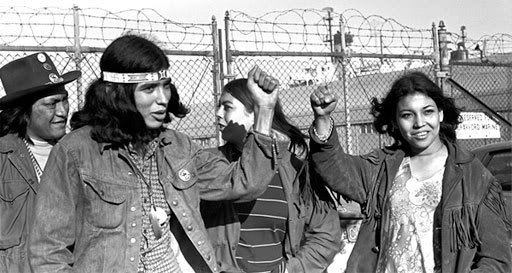
On November 20, 1969, 79 native Americans adults and six children symbolically claimed Alcatraz Island for United Indians of All Tribes, and so started the American Indian Movement (AIM).
This wasn't the first time indians had tried to take the island. In 1963 the federal government closed Alcatraz prison and declared the island "surplus federal property". Under the Fort Laramie Treaty, surplus property was supposed to be returned to native Americans. Richard McKenzie and five other Sioux Indians realized the significance of this action.

On March 9, 1964, McKenzie, Allen Cottier, Martin Martinez, Garfield Spotted Elk, and Walter Means, symbolically occupied Alcatraz Island for four hours. They wanted to use the island for a native American studies center and museum, but were ushered off the island by federal marshals after a few hours. Three weeks later the same group filed a claim in court. The U.S. Attorney's office ignored the claim and transferred custody of the island to the General Services Administration (GSA).

Meanwhile, the San Francisco Board of Supervisors was pitching the idea of Alcatraz Island being used as a park and recreational site. By 1968 the courts had dismissed all of McKenzie's complaints, and in October of 1969 the GSA got behind the idea of Alcatraz being a federal park. Bay Area indians decided to take action.

The Chief of Alcatraz


Richard Oakes was described as a handsome, charismatic, talented and natural leader. Already an indian activist, he was the one most responsible for Alcatraz being occupied. On November 9, 1969, Oakes, Jim Vaughn (Cherokee), Joe Bill (Eskimo), Ross Harden (Winnebago) and Jerry Hatch, convinced the owner of the sailing ship Monte Cristo to take them to circle the island. Before leaving Pier 39 they read a proclamation offering to buy the island for $24 and some beads. While doing so, the group jumped overboard and swam to the island. They claimed it by right of discovery. The following day the Coast Guard and GSA asked them to leave, and they did. No arrests were made. Oakes made certain that the press was involved at every step of the way.

It was during this time that Oakes realized that a more permanent occupation of the island was possible. Up until this point it was mostly Bay Area indians that were involved. Oakes went down to UCLA to recruit a larger group.

The average annual yearly income of a native American in 1969 was about $1,500 - one quarter of the national average. Their life expectancy was 44 years, as opposed to the average American of 65 years.
Even more importantly, the culture of the first Americans had been crushed. American Indian studies programs at universities were few and far between.
The U.S. government policy of Relocation and Termination encouraged indians to leave their reservations, and 200,000 took up the offer. But for most it was merely a one-way ticket to unemployment in a big city. In October 1969, the San Francisco Indian Center, a place of refuge for homeless indians, burnt down. Native Americans once again looked at the abandoned island of Alcatraz.

"We hold The Rock"


On the morning of November 20, 1969, 79 Native Americans landed on Alcatraz. The Coast Guard belatedly attempted to block the landing, but failed.
Glenn Dodson, the island's caretaker, advised them that they were trespassing. He then directed them to the old warden's residence, where they set up their headquarters and celebrated.
The Coast Guard set up a blockade of the island to prevent supplies getting in. That afternoon lawyers from the Department of the Interior arrived on the island and gave them 24 hours to leave. The group didn't budge.
"We invite the United States to acknowledge the justice of our claim. The choice now lies with the leaders of the American government - to use violence upon us as before to remove us from our Great Spirit's land, or to institute a real change in its dealing with the American Indian. We do not fear your threat to charge us with crimes on our land. We and all other oppressed peoples would welcome spectacle of proof before the world of your title by genocide. Nevertheless, we seek peace."
- Richard Oakes's message to the Department of the Interior
The new occupiers of the island made very simple demands. They wanted the land that the government deemed surplus to be returned to the Native Americans according to the Treaty of Fort Laramie. They also wanted enough funds to build and maintain an indian cultural complex and university. The government pretended to negotiate, but they rejected all demands.

A governing council was elected and everyone was given a job. Security, sanitation, day-care, cooking, laundry, etc. In the communal environment, all decisions were voted on by everyone. Within three weeks a school was set up.


The occupation quickly gained major media attention, and a certain amount of public sympathy. It was also a rallying point for Native American activists. One of those activists was John Trudell.
By 1972 John Trudell was chairman of AIM, and would later become a successful musician, author, and movie actor. But in 1969 he was just another Vietnam veteran and college drop-out. When Trudell heard about the occupation he packed a sleeping bag and headed for Alcatraz. Once there he became the voice of Radio Free Alcatraz, a pirate radio that was rebroadcast with the help of other stations.

The response was overwhelming.
Donated food and money poured in from everywhere. The Grateful Dead and Creedence Clearwater Revival played a concert on a boat anchored just off of Alcatraz, and then donated the boat to the cause.
Trudell and his wife Lou had the only baby born on Alcatraz, named Wovoka. By Christmas 1969 there were 200 living on the island.
Space was rented at Pier 40 by members of the longshoreman's union, where supplies were collected and ferried to the island.

During the occupation around 5,200 people came to Alcatraz to participate. Some just for the day. Some for months.

Indians of All Tribes

The downfall of the occupation started on January 3, 1970, when Oakes' 13-year old daughter, Yvonne, fell over a railing from the third-floor of their apartment building to her death.
Following her death, Oakes left the island, and with him the group was left without a clear leader.

Many of the original occupiers were students, and they left to go back to school. The new tenants were less idealistic and many of them had drug problems. Some non-indians from the hippie culture moved into the island.
Factions developed and two major groups fought for their own version of an indian utopia. The people who lived there described it as anarchy.

When negotiations with the government in April and May of 1970 failed to gain any traction, the government cut off all power and telephone service to the island, and also removed the water barge.
Just a few days later, a fire broke out on the island that destroyed the warden's quarters, doctor's quarters, and the inside of the lighthouse.


The federal government took a hands off approach, hoping to wait out the occupation rather than make martyrs.
Without electricity to the lighthouse there was no light or fog horn. Government workers went to the island to repair it, but were met by armed indians who demanded that they restore the water first.
Soon public opinion turned against the occupiers, and the press began publishing stories about beatings and assaults on the island.

Supplies began to run low. Residents began stripping the copper tubing of the buildings to sell to pay for food and supplies. Three were arrested and convicted. The living situation on the island began to get grim.
In mid-January two tankers collided and spilled 800,000 gallons of oil into the bay. Although Alcatraz was ruled to not be an issue, some blamed the lack of a lighthouse anyway.
On the negotiation front, the indians turned down an offer of part of nearby Fort Mason in exchange for giving up the occupation. The Nixon Administration began forming a plan to take back the island.

On July 11, 1971, a large force of federal marshals and FBI agents landed on the island to end the occupation. They found only six men, four women, and five children.


Afterwards

The occupation is universally considered to be a success, not because it achieved its goals, but because it started a vocal and militant indian rights movement.
President Nixon announced a new policy of "self-determination without termination" for Native Americans on July 8, 1970.

Robert Oakes died on September 20, 1972, when he tried to intervene in a dispute between a group of indian youths. A local security guard shot him when he suspected Oakes was reaching for a gun.

Labels: ,