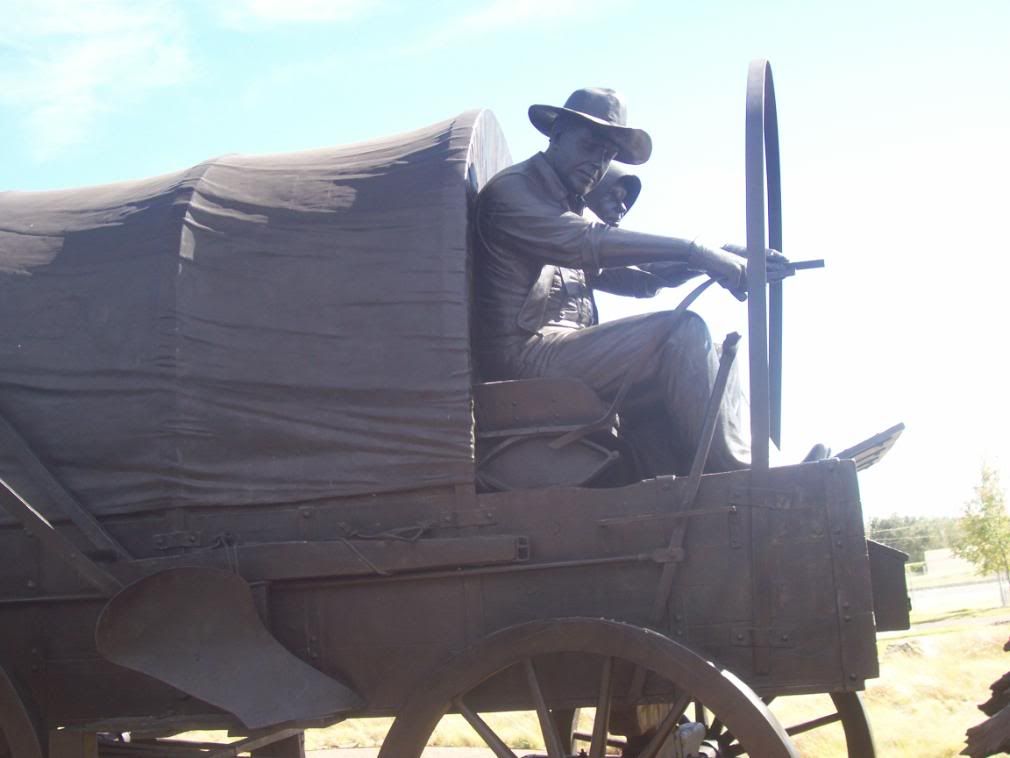
by Winter Rabbit | 12/20/2009 08:20:00 AM
Photobucket

The Sand Creek Massacre and the Washita Massacre both led to the Wounded Knee Massacre. The Sand Creek Massacre brought the realization that “the soldiers were destroying everything Cheyenne - the land, the buffalo, and the people themselves,” and the Washita Massacre added even more genocidal evidence to those facts. The Sand Creek Massacre caused the Cheyenne to put away their old grievances with the Sioux and join them in defending their lives against the U.S. extermination policy. The Washita Massacre did that even more so. After putting the Wounded Knee Massacre briefly into historical perspective, we’ll focus solely on the Wounded Knee Massacre itself for the 119th Anniversary of the Wounded Knee Massacre.


Black Kettle, his wife, and more than 150 Cheyenne and Arapaho had just been exterminated, and Custer’s 7th was burning the lodges and all their contents, thus stripping them of all survival means. Sheridan would wait until all their dogs had been eaten before “allowing” them into subjugation, then Custer would rape the women hostages in captivity.


Jerome A. Green. “Washita.” p. 126.


Far across the Washita Valley, warriors observed the killing of the animals, enraged by what they saw.


Photobucket

What did they see, feel, and think?


http://books.google.com/books?hl=en&lr=&id=_8_i4RoC-c4C&oi=fnd&pg=PP9&sig=PzXXLM0CyHIihEXH2rAS7cmyOIg&dq=Half+breed+-+the+remarkable+story+of+george+bent-+caught+between+the+worlds#PRA1-PA95,M1"

And so, when the Chiefs gathered to decide what the people should do, Black Kettle took his usual place among them. Everyone agreed Sand Creek must be avenged. But there were questions. Why had the soldiers attacked with such viciousness? Why had they killed and mutilated women and children?

It seemed that the conflict with the whites had somehow changed. No longer was it just a war over land and buffalo. Now, the soldiers were destroying everything Cheyenne - the land, the buffalo, and the people themselves.


See it? Feel it?

They witnessed and felt the Sand Creek Massacre happen, again.


Consequently, a number of Cheyenne who were present at Washita helped defeat Custer at Little Bighorn.

So, let us proceed from the Sand Creek Massacre,

Why does this say Battle Ground after there was a Congressional investigation?
Photobucket


and from the genocide at the Washita “Battlefield” –

No, it was a massacre.
Photobucket


Petition to Re-name
The Washita Battlefield National Historic Site toThe Washita National Historic
Site of Genocide


AND WHERE AS:

According to the 1948 Convention on the Prevention and Punishment of the Crime of Genocide, genocide means any of the following acts committed with intent to destroy, in whole or in part, a national, ethical, racial or religious group as such:

(a) Killing members of the group;

(b) Causing serious bodily or mental harm to members of the group;

(c) Deliberately inflicting on the group conditions of life
calculated to bring about its physical destruction in whole or in part;

WE, the undersigned members of the Native American community and the public at large, request that this site of the attack by the United States military against 8,500 Plains Indians camped as prisoners of war along the Washita River in 1868 be designated as the Washita National Historic Site of Genocide.


- to the Wounded Knee Massacre of 1890.

Photobucket


Harjo: Burying the history of Wounded Knee

But Wounded Knee was 14 years after Little Bighorn. Would the soldiers have held a grudge that long and why would they take it out on Big Foot? They blamed Custer's defeat on Sitting Bull, who was killed two weeks before Wounded Knee. The Survivors Association members had the answer: ''Because Big Foot was Sitting Bull's half-brother. That's why Sitting Bull's Hunkpapa people sought sanctuary in Big Foot's Minneconjou camp.''


The Wounded Knee Massacre of 1890


The first intention of the U.S. Army in part was to detain Chief Big Foot under the pretext that he was a "fomenter of disturbance," remembering that Native Americans did not have equal rights at that time in the Constitution.

In addition, the real intention was doing a "roundup" to a military prison camp, which would have become an internment and concentration camp in Omaha after they were prisoners. Colonel James W. Forsyth had orders to force them into going there.

Speculating, I bet at least part of the rationalization for the massacre was so the soldiers wouldn't have to transport them to the military prison in Omaha. Murdering them would have been easier. Then, they could've had another whiskey keg, like they did the evening right before this massacre, when they celebrated the detainment of Chief Big Foot. The soldiers may have even been hung over, depending on amount consumed and tolerance levels; moreover, if the soldiers were alcoholics, tolerance levels would have been high.


massacre:

n : the wanton killing of many people [syn: mass murder] v : kill a large number of people indiscriminately;

"The Hutus massacred the Tutsis in Rwanda" [syn: slaughter, mow down]


Source

White officials became alarmed at the religious fervor and activism and in December 1890 banned the Ghost Dance on Lakota reservations. When the rites continued, officials called in troops to Pine Ridge and Rosebud reservations in South Dakota. The military, led by veteran General Nelson Miles, geared itself for another campaign.


Source

Big Foot and the Lakota were among the most enthusiastic believers in the Ghost Dance ceremony when it arrived among them in the spring of 1890.


Chief Big Foot's arrest was ordered by the U.S. War Department for being a "fomenter of disturbance." Chief Big Foot was already on his way to Pine Ridge with his people, when the 7th U.S. Cavalry with Major Samuel Whitside leading them approached him on horses. Big Foot's lungs were bleeding from pneumonia.

Blood froze on his nose while he could barely speak. He had a white flag of surrender put up as soon as he caught glimpse of the U.S. Calvary coming towards them. At the urging of John Shangreau, Whitside's half-breed scout, Whitside "allowed" Big Foot to proceed to the camp at Wounded Knee. Whitside wanted to arrest Big Foot and disarm them all immediately. Ironically, the justification for letting Big Foot go to Wounded Knee was that it would prevent a gun fight, save the lives of the women and children, but let the men escape. The Warriors wouldn't have left their women and children to perish, but since the following was reported to Red Cloud:


Red Cloud


"...A white man said the soldiers meant to kill us. We did not believe it, but some were frightened and ran away to the Badlands.(1)


I believe Whitside didn't want the Warriors to have such an opportunity, under direct orders by General Nelson Miles.


(1): "Bury My Heart At Wounded Knee" by Dee Brown, pp. 441-442. (December, 1890).


"Later in the darkness of that December night (Dec. 28) the remainder of the Seventh Regiment marched in from the east and quietly bivouacked north of Major Whitside's troops. Colonel James W. Forsyth, commanding Custer's former regiment, now took charge of operations. He informed Whitside that he had received orders to take Big Foot's band to the Union Pacific Railroad for shipment to the military prison in Omaha.


Then, came the disarming.


..Colonel Forsyth informed the Indians that they were now to be disarmed. "They called for guns and arms," White Lance said, "so all of us gave the guns and they were stacked up in the center." The soldier chiefs were not satisfied with the number of weapons surrendered, so they sent details of troops to search the tepees. "They would go right into the tents and come out with bundles (sacred objects) and tear them open," Dog Chief said. "They brought our axes, knives, and tent stakes and piled them near the guns." Still not satisfied, the soldier chiefs ordered the warriors to remove their blankets and submit to searches for weapons...


Yellow Bird, the only medicine man there at the time danced some steps of the Ghost Dance, while singing one of it's songs as an act of dissent. Simultaneously, the people were furious at the "searches" when Yellow Bird reminded everyone of their bullet-proof shirts. To me, this was the void in time when the Ghost Dancers chose peace over war, and made it possible for the resurgence of their culture to occur in the future. A psychological justification for my saying so, is the Ghost Dancers would also have been Sundancers. Part of the well-known intent behind the Sundance is "that the people might live."

Continuing on; next, was false blame.


...Some years later Dewey Beard (Wasumaza) recalled that Black Coyote was deaf. "If they had left him alone he was going to put his gun down where he should. They grabbed him and spinned him in the east direction. He was still unconcerned even then. He hadn't pointed his gun at anyone. His intention was to put that gun down. They came and grabbed the gun that he was going to put down...(1) in proceeding paragraph, p.445.


Source

...The massacre allegedly began after an Indian, who was being disarmed, shot a U.S. officer.


Source

Hotchkiss guns shredded the camp on Wounded Knee Creek, killing, according to one estimate, 300 of 350 men, women, and children.


My Journey to Wounded Knee

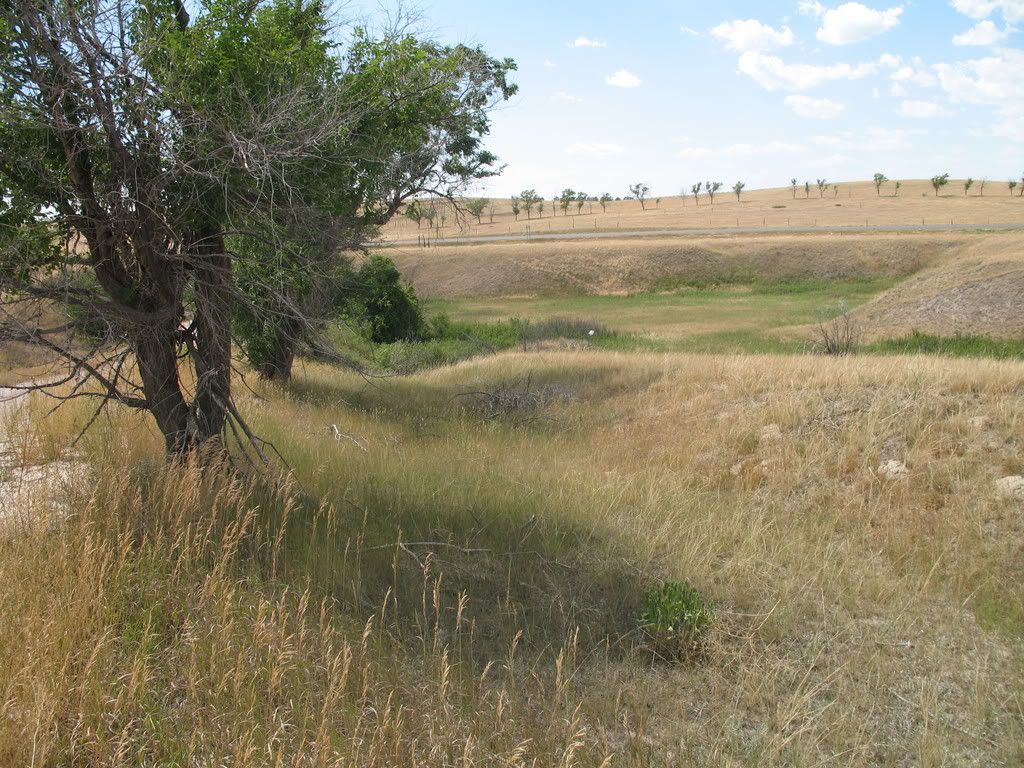
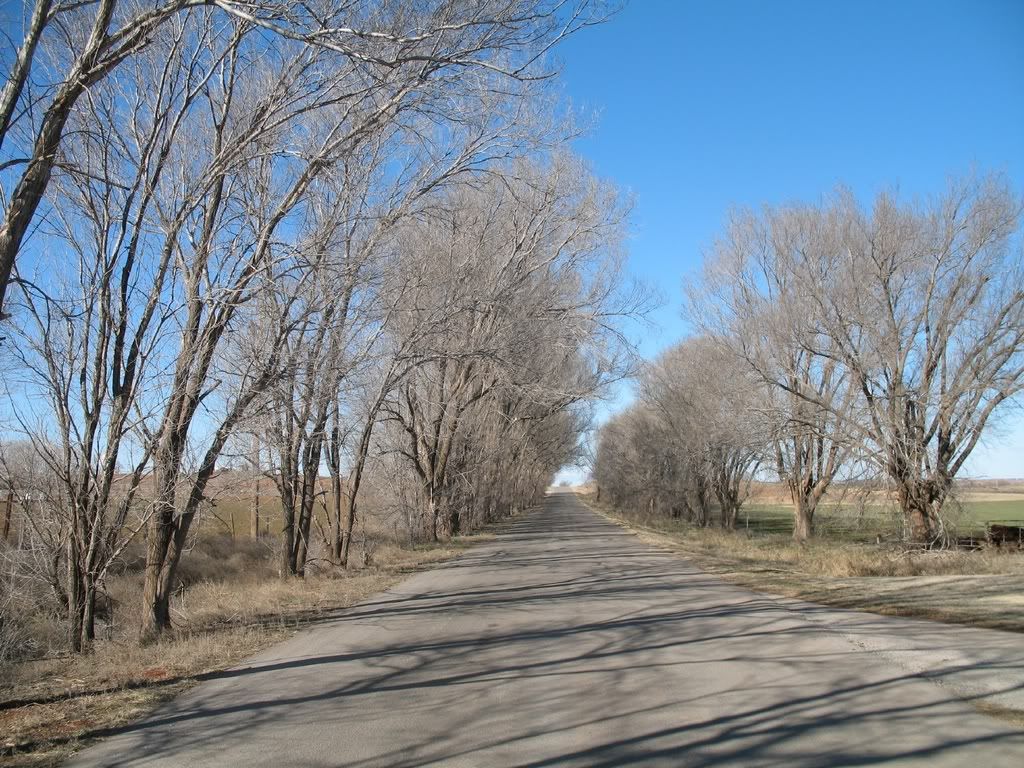
More people survived if they tried to escape through this tree row, because there was more tree cover.

Photo Sharing and Video Hosting at Photobucket

More were massacred if they tried to escape through this tree row, because there was much less tree cover.
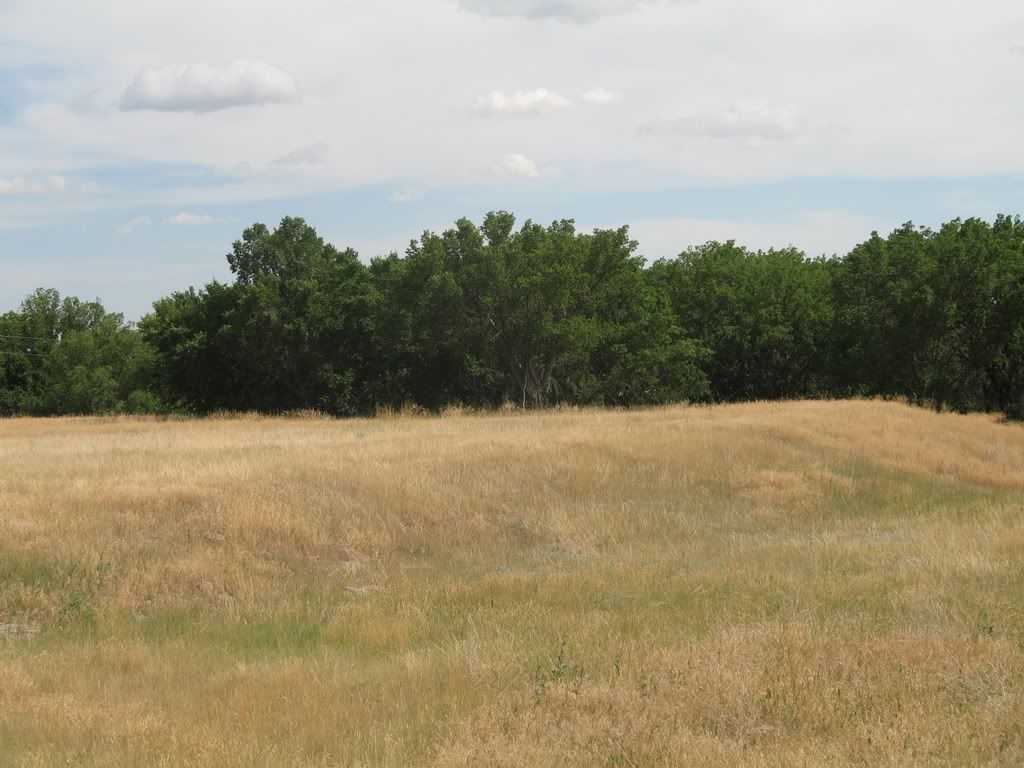
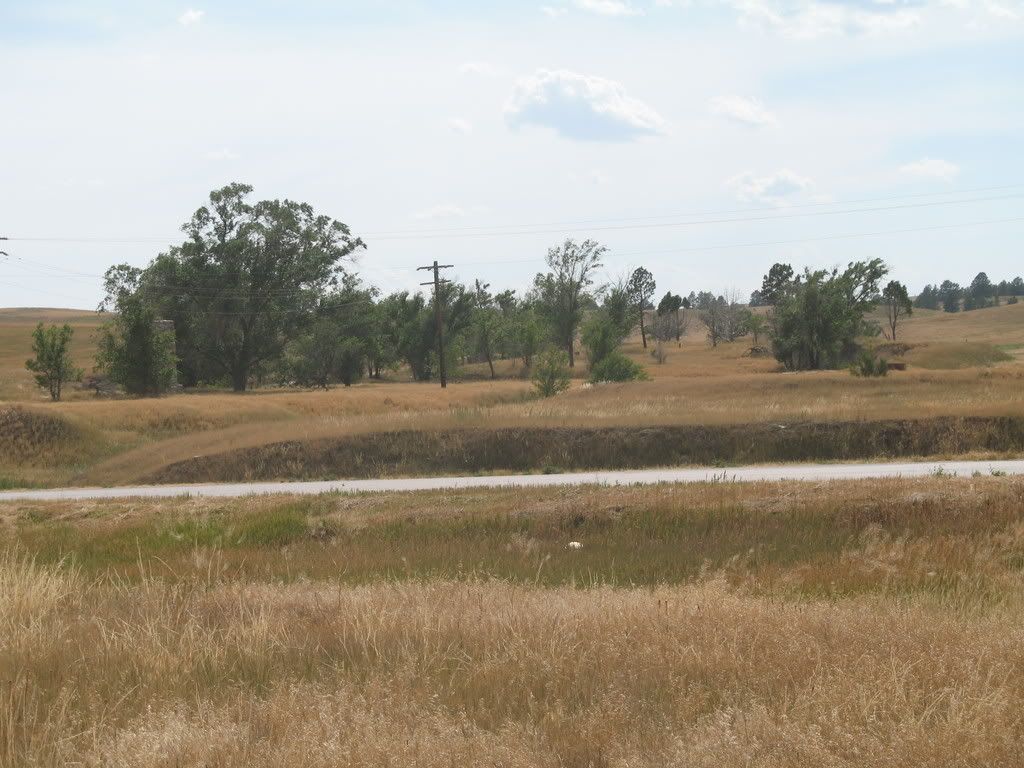
Photo Sharing and Video Hosting at Photobucket


Photo Sharing and Video Hosting at Photobucket

Photobucket


The truth has still been tried to be slanted and concealed, even after over one century ago, because the old sign said that there were 150 warriors. The truth is, there were only 40 warriors.


It was nothing less than false blame, deceptive actions, and blatant lies by the blood-thirsty troopers that started the Wounded Knee Massacre of 1890. In recognition of the governmental policy of using smallpox infected blankets as germ warfare against Native Americans since the first presidency, the Sioux Wars, and all the "successful" extermination by the U.S. government prior to this last "battle;" would they have had the atom bomb, they would have used it too.


For that would have been more convenient, than loading their remaining victims (4 men and 47 women and children) into open wagons and transporting them to Pine Ridge during the approaching blizzard for alleged shelter at the army barracks, then to the Episcopal mission "unplanned." They left the survivors out in that blizzard in open wagons for who knows how long, while "An (singular) inept Army officer searched for shelter."(1)

What that tells me is: they didn't plan on having any survivors. They planned on exterminating them. Of course, there wasn't any room at all in the army barracks for 51 people, so they had to take them to the mission. Well...if they'd been white, they would've found room for a measly 51 white people.


Source

"...A recurring dream in the mid-1980s directed a Lakota elder to begin the ride as a way to heal the wounds of the 1890 massacre. It continues today to honor the courage of the ancestors and to teach the young to become leaders...The Big Foot Ride began in 1987 at the urging of Birgil Kills Straight, a descendant of a Wounded Knee Massacre survivor. Each year, the riders have come together to sacrifice and pray for the 13-day trip from the Standing Rock Reservation beginning on the anniversary of the death of Sitting Bull and ending at Wounded Knee on Dec. 28, the day before the anniversary of the massacre..."


Source

"...The two-week Ride started in 1986 after a dream told one of its founders that it would "mend the sacred hoop" and heal the wounds of the famous massacre. For the first four years, the ride was led in intense cold by Arvol Looking Horse, keeper of the White Buffalo Calf Woman pipe bundle in Green Grass, S.D. It is now carried on by youths from the Lakota nation, starting in Grand River near Mobridge, S.D. on the Standing Rock Sioux reservation and continuing south 200 miles to Pine Ridge..."

Labels: , , ,

 
by Winter Rabbit | 11/22/2009 06:51:00 PM


and out of that heightened violence came the massacre for which Thanksgiving is named.


Thanksgiving Day Celebrates A Massacre

William B. Newell, a Penobscot Indian and former chairman of the Anthropology department at the University of Connecticut, says that the first official Thanksgiving Day celebrated the massacre of 700 Indian men, women and children during one of their religious ceremonies. "Thanksgiving Day" was first proclaimed by the Governor of the then Massachusetts Bay Colony in 1637 to commemorate the massacre of 700 men, women and children who were celebrating their annual Green Corn Dance...Thanksgiving Day to the, "in their own house", Newell stated.

- small snip –

-----The very next day the governor declared a Thanksgiving Day.....For the next 100 years, every Thanksgiving Day ordained by a Governor was in honor of the bloody victory, thanking God that the battle had been won."


Without having the book or being able to see it online, the proclamation appears, according to Richard Drinnon, to have come from William Bradford. I'll be buying the book. "'Thanksgiving Day'" was first proclaimed by the Governor of the then Massachusetts Bay Colony in 1637," as from Newell, which was John Winthrop.

But "William Bradford became the governor of Plymouth after the first governor died in 1621."

And in "1631, John Winthrop (1588-1649) became the first elected official in America—governor of the Massachusetts Bay Colony."


They were both Puritans, they both probably said it.


Facing West: The Metaphysics of Indian Hating & Empire Building

The original Thanksgiving was marked by prayer and thanks for the untimely deaths of most of the Wampanoag Tribe due to smallpox contracted from earlier European visitors. Thus when the Pilgrims arrived they found the fields already cleared and planted, and they called them their own.

- snip -

He was inspired to issue a proclamation: “This day forth shall be a day of celebration and thanksgiving for subduing the Pequots.” The authentic Thanksgiving Day was born.


The following source cites Drinnon in the next paragraph, so I assume the following came from Drinnon as well.


Source

Jump 129 years to 1621, year of the supposed "first Thanksgiving." There is not much documentation of that event, but surviving Indians do not trust the myth. Natives were already dying like flies thanks to European-borne diseases. The Pequot tribe reportedly numbered 8,000 when the Pilgrims arrived, but disease had reduced their population to 1,500 by 1637, when the first, officially proclaimed, all-Pilgrim "Thanksgiving" took place. At that feast, the whites of New England celebrated their massacre of the Pequots. "This day forth shall be a day of celebration and thanksgiving for subduing the Pequots," read Massachusetts Bay Governor John Winthrop's proclamation. Few Pequots survived.


The first Official Thanksgiving was gratitude for genocide in 1637, and in 1676 – 1677 “a day was set apart for public thanksgiving,” because nearly all of them were exterminated by then.


http://www.dinsdoc.com/lauber-1-5.htm

3 See Sylvester, op. cit., ii, p. 457, for expedients adopted by Massachusetts to obtain money to defend the frontiers. Yet the number killed and sold, along with those who escaped, practically destroyed the warring Indians. According to the Massachusetts Records of 1676-1677 a day was set apart for public thanksgiving, because, among other things of moment, “there now scarce remains a name or family of them (the Indians) but are either slain, captivated or fled.”


http://rwor.org/a/firstvol/883/thank.htm

In their victory, the settlers launched an all-out genocide against the remaining Native people. The Massachusetts government offered 20 shillings bounty for every Indian scalp, and 40 shillings for every prisoner who could be sold into slavery. Soldiers were allowed to enslave any Indian woman or child under 14 they could capture. The "Praying Indians" who had converted to Christianity and fought on the side of the European troops were accused of shooting into the treetops during battles with "hostiles." They were enslaved or killed. Other "peaceful" Indians of Dartmouth and Dover were invited to negotiate or seek refuge at trading posts – and were sold onto slave ships.

- snip -

After King Philip's War, there were almost no Indians left free in the northern British colonies. A colonist wrote from Manhattan's New York colony: "There is now but few Indians upon the island and those few no ways hurtful. It is to be admired how strangely they have decreased by the hand of God, since the English first settled in these parts." In Massachusetts, the colonists declared a "day of public thanksgiving" in 1676, saying, "there now scarce remains a name or family of them [the Indians] but are either slain, captivated or fled."

Fifty-five years after the original Thanksgiving Day, the Puritans had destroyed the generous Wampanoag and all other neighboring tribes. The Wampanoag chief King Philip was beheaded. His head was stuck on a pole in Plymouth, where the skull still hung on display 24 years later.


Furthermore, the continuing historical context of the Massacre for which Thanksgiving is named was in the context of “slave-producing wars in New England.”


The war consisted of two battles: the Mistick Fight, and the Swamp Fight. In the first of these two events, but seven captives were taken.1 In the second, the Swamp Fight, about one hundred and eighty captives were taken.2 Two of the sachems taken in the Swamp Fight were spared, on promise that they guide the English to the retreat of Sassacus. The other men captives, some twenty or thirty in number, were put to death.3 The remaining captives, consisting of about eighty women and children, were divided. Some were given to the soldiers, whether gratis or for pay does not appear. Thirty were given to the Narraganset who were allies of the English, forty-eight were sent to Massachusetts and the remainder were assigned to Connecticut.4


During the years 1675 and 1676, one finds mention of the sale of Indians in Plymouth in groups of about a hundred,2 fifty-seven,3 three,4 one hundred and sixty,5 ten,6 and one.7 From June 25, 1675 to September 23, 1676, the records show the sale by the Plymouth colonial authorities of one hundred and eighty-eight Indians.8

In the Massachusetts Bay colony a similar disposal of captives was accomplished. On one occasion about two hundred were transported and sold.9 There is extant a paper written by Daniel Gookin in 1676, one item of which is as follows: “a list of the Indian children that came in with John of Packachooge.” The list shows twenty-one boys and eleven girls distributed throughout the colony.10


Hence, the continuing historical context of the Massacre for which Thanksgiving is named: "In Massachusetts, the colonists declared a 'day of public thanksgiving' in 1676, saying, "there now scarce remains a name or family of them [the Indians] but are either slain, captivated or fled."


A cold question arises about whether "the sale of Indians in Plymouth" was at least silently appreciated by the colony. Did they? Were they glad "the Indians" were almost exterminated? They never actually said they were far as I know.


Source

It all began when Philip (called Metacom by his own people), the leader of the Wampanoag Indians, led attacks against English towns in the colony of Plymouth. The war spread quickly, pitting a loose confederation of southeastern Algonquians against a coalition of English colonists. While it raged, colonial armies pursued enemy Indians through the swamps and woods of New England, and Indians attacked English farms and towns from Narragansett Bay to the Connecticut River Valley. Both sides, in fact, had pursued the war seemingly without restraint, killing women and children, torturing captives, and mutilating the dead. The fighting ended after Philip was shot, quartered, and beheaded in August 1676.


How many were glad Saddam Hussein was hung? How many would be glad if all the perpetrators of 9-11 were shot? One last question, how many realize that then and now, colonialism always brings more violence as "a colonizing European nation was asserting political jurisdiction."


Puritans, Indians, and Manifest Destiny. p.75 - 76


...But tribal rivalries and wars were relatively infrequent prior to Puritan settlement (compared to the number of wars in Europe)...Neither would have increased if it were not that a colonizing European nation was asserting political jurisdiction, in the name of God, over indigenous New England societies...When thus threatened with the usurpation of their own rights, as native tribes had been threatened years before by them, Puritans came to the defense of a system of government that was similar, in important ways, to the native governments that they had always defined as savage and uncivilized...


Some have lost careers over stating the obvious: the US brings it upon itself.


Howard Zinn. A People's History Of The United States. p. 682.

We are not hated because we practice democracy, value freedom, or uphold human rights. We are hated because our government denies these things to people in Third World countries whose resources are coveted by our multinational corporations. That hatred we have sown has come back to haunt us in the form of terrorism.


(Paraphrasing)
"And in secret places in our minds, in places we don't talk about, we can't handle the truth."


That is true now, and it was true then. Genocide and slavery "saved lives," just the lives the dominant culture wanted to live. And for that, the dominant culture (a mind set) is grateful.


http://www.republicoflakotah.com/2009/cooking-the-history-books-the-thanksgiving-massacre/

William Bradford, in his famous History of the Plymouth Plantation, celebrated the Pequot massacre:

“Those that scraped the fire were slaine with the sword; some hewed to peeces, others rune throw with their rapiers, so as they were quickly dispatchte, and very few escapted. It was conceived they thus destroyed about 400 at this time. It was a fearful sight to see them thus frying in the fyer, and the streams of blood quenching the same, and horrible was the stincke and sente there of, but the victory seemed a sweete sacrifice, and they gave the prayers thereof to God, who had wrought so wonderfully for them, thus to inclose their enemise in their hands, and give them so speedy a victory over so proud and insulting an enimie.”


"William Bradford, the author of Of Plymouth Plantation (c. 1630, c. 1646), has been hailed as the father of American history."- He sure as hell is.


Correction:


The timeline itself along with basic knowledge of the Pilgrim's Puritan's religious beliefs exposes the fact that historically speaking, Thanksgiving was literally about gratitude for genocide.

Labels: , , , , , ,

 
by Winter Rabbit | 11/18/2009 04:14:00 PM
The clear origins of the Native American Flute date back several thousand millennia to flutes made of bone, to petroglyphs, and oral history. Unclear "origins" involve the Spanish Conquest insofar as the Spanish stealing the bamboo flute from Asia, and then introducing it to the Five Civilized Tribes. A Cheyenne Flute Maker relayed this to me. The idea goes, that the bamboo flute was made out of river cane by the Five Civilized Tribes after the Spanish "brought" the bamboo flute to the "New World." Subsequently, river cane flutes then proceeded to be constructed out of cedar wood by the Plains Tribes; hence, its origins within this idea being called Asian – Spanish. However, the Cheyenne Flute Maker said that the tribes already possessed the flute prior to the invasion, and the Spanish may have introduced it to a few. That raises some questions, but the ultimate answer we shall see is one of mystery.


What family of trees were flutes being constructed out of then? What are some woods that they are being made out of now? After answering those questions along with some general knowledge in that area, we will proceed to the clear and unclear origins of the flute. The only clear thing is that it's a mystery who specifically invented the first flutes world wide as old as approximately 82,000 years ago.


The juniper family of trees, including cedar, was used to make the earliest flutes. To illustrate, flutes were possibly constructed out of the Arizona cypress, the Utah juniper, or the Rocky Mountain juniper, but definitely out of the eastern red cedar. The length of the branch used was crucial in determining the overall pitch desired in the flute being made. To be more specific, the distance between the holes on the flute determined the musical scale that the flute would play, which was a process of trial and error to achieve the desired order of notes. Generally speaking, longer and larger flutes were lower in pitch, while shorter and smaller flutes were higher in pitch.

Photobucket

Currently, other woods that flutes are being made out of today besides cedar are the following: maple, cherry, apple, pear, teak, walnut, purpleheart, ash, and spruce. This includes making them out of tree branches as opposed to buying a block of the relevant wood at a hardware store. There were cultural uses of the flute.

According to the guide at the Cherokee National Museum, the flute was used in courting. Furthermore, when the man was successful with the flute in his courting purposes in the matriarchal society of the Cherokee Nation, the woman whom he had successfully courted broke the flute in half. She did so to prevent him from playing it for anyone else. For the Cheyenne, it is historically for courting and personal expression. While some tribes have used the flute in ceremony, it's crucial to state that some have not - all the tribes are different.

Photobucket


What does all this have to do with the fact that soldiers who became sleepy accused the Cheyenne of performing witchcraft when they heard Cheyenne flute music in the Cheyenne camps? According to the Cheyenne Flute Maker, when the soldiers were in the camps and heard the flute music being played, the soldiers got sleepy and fell asleep. The Doctrine of Discovery states, ”to find, discover and investigate whatsoever islands, countries, regions or provinces of heathens and infidels, in whatsoever part of the world placed, which before this time were unknown to all Christians;” and, Henry VII authorized Cabot to “conquer, occupy and possess” any discovered land whatsoever. Let's think of the question again. What does this have to do with the fact that the soldiers accused the Cheyenne of performing witchcraft? It wouldn't be the first time in history that fundamentalists associated music virtuosity, originality, and excellence with evil. For example, some thought Paganini played the violin so fast and furious that he was possessed by demons, and some believed Robert Johnson sold his soul to the Devil in order to play the blues. It's a very broad answer to answer why the soldiers accused the Cheyenne of witchcraft.

Regardless of the grain of truth that may exist in Spain introducing the Bamboo Flute to very few tribes, Spain wished to conquer the world. Ceremonies, languages, Indigenous musical styles, and ways of life were all affected by the invaders. Ceremonies? Hidden or now lost, yet survived in cases. Languages? Pronunciation or now lost, yet survived in cases. Indigenous musical styles? Musical influence from the "Church" modes. Ways of life? Gone as entire tribal entities when comparing past and present in the United States and in Canada; furthermore, try imagining what the above would now be if the invaders had never come. Indigenous population(s) who have been unmolested worldwide would be an exception, but the former and the latter previously mentioned affected cultural aspects and most likely unaffected cultures would require a dissertation. "Columbus was a disease" I heard it once said, as the speaker related how an entire uncommunicating network of different Indigenous tribes no longer do ceremonies to care for Mother Earth because of the genocide. But I digress even further as I add my thoughts in agreement with this (emphasis mine).


Source

Whether it’s pentatonic mode plus a note, or Dorian mode minus a note, or the six note Raga Mahohari mode, such labels are attempts to contemporize the Native American Flute.


The flute was used for courting within relevant tribal customs before and during the time of being actively hunted; it was used for personal expression; it was used for ceremonial purposes. Why is it that today some want to interpret the notes the earliest flutes may have played in terms of a sliver of music theory - the major scale of which at least 80% of Western music is based?


Source

...most Western music is played in a major key: 97 percent of popular American songs, and 73 percent of classical music is in a major key.


Tunnel vision is being applied to universal sound which is owed to the vibrations of the harmonic series and crosses cultural boundaries as a universal language, but little minds always like things much smaller, don't they? The scissor tail sings the Lydian dominant scale, except just prior to mating. Then he sings the blues scale. Witchcraft indeed.


Source

The brains behind Dreams Kaimin is Dr Takuro Endo, a neurologist who has made a science, and a lucrative CD business, out of selecting the right music to induce sleep. He divides it into three categories: melodies that fire the imagination; those that are calming and relaxing; and music that should, within ten minutes, slow the brain down to the point of unconsciousness.


But a fictitious flute spell is not what needs to be broken. How is it that all these different cultures worldwide developed the flute?


Source

Symbols of the American Indian come down to us in many forms. Some are beaded on elaborate wampum belts, others are found on strips of buffalo hide and more are seen chiseled on stone. Probably the most reliable, in terms of graphic interpretation, are those found in the Southwest commonly called 'rock art'. According to some estimates there are over 50,000 "known" stone petroglyphs and pictographs in the Southwest and West alone. Many more probably exist in remote areas or covered by modern civilization. Certainly, more existed prior to the European invasion.


Source

Flutes are the earliest known musical instruments. A number of flutes dating to about 40,000 to 35,000 years ago have been found in the Swabian Alb region of Germany. These flutes demonstrate that a developed musical tradition existed from the earliest period of modern human presence in Europe.[1]


Source

Kokopelli, ancient humpbacked flute player, is the Southwest's most popular icon. Presented here are more than 300 flute player images, including a great many that have never been published. Along with new information about the meaning and origin of Kokopelli, some of it challenges our current understanding of this unmistakable character. Explore the range of the flute player and see how it extends south into Mexico, north into Canada, west into Nevada, and east into the plains of Colorado, Texas, and Oklahoma.


Source

Flutes made of bamboo are found in many musical traditions.The Gamelan in Indonesia use them.

Some bamboo flutes include:


Source

The Indian flute, one of the oldest instruments of Indian classical music, appears to have developed independently of the western flute. The Hindu god Krishna is said to be a master of the instrument.


How is it that all those different cultures worldwide developed the flute without communicating? My best and only guess, is they "recognized their tune."


Source

Shortly after this research, Maman met French physicist Joel Sternheimer, who discovered the vibratory frequency of elementary particles. Long before the "string theory", Sternheimer was transposing certain molecular structures into musical patterns, creating "the music of the molecules."

Like Maman's cellular research, Sternheimer found that if there was a problem in an organic structure, the molecules of that structure did not vibrate, but if they heard the string of notes they recognized as their tune, they began to vibrate again.


There are no clear specific origins of the flute of any culture, except for the stories sacred to that culture and the obvious elements of the instrument's construction with its cultural usages. What is clear is that each is a unique stylistic interpretation of a universal language, but let the mystery remain of who created it first individually -

Photobucket

or collectively in its birth across the globe.

Photobucket

Some likely have made false claims, but let each unique song be sung and the spell of differentiation be broken - while maintaining the individual integrity of all.


Source

...The earliest possible evidence of Shamanic activity in the Americas comes from the recently excavated Jones-Miller site in Colorado (Stanford 1979). At this Plano kill site, dating to about 8,000 B.C., bison herds were slaughtered, apparently by driving them between ice-glazed snow banks. A post hole was discerned by the excavator, and near it were found an antler flute, a miniature point, and other objects that might have belonged to a Shaman...


Labels: , , , ,

 
by Winter Rabbit | 7/14/2009 07:48:00 AM
What happened inside the walls of theIndian Boarding School that used to be to the right here?

Photo Sharing and Video Hosting at Photobucket

Let’s look to history for some feasible answers.

(This video is over at Pretty Bird Woman House)


Updates (watch video “Older Than America”):


Updates Continued (two stories from NPR):


American Indian Boarding Schools Haunt Many

The late performer and Indian activist Floyd Red Crow Westerman was haunted by his memories of boarding school. As a child, he left his reservation in South Dakota for the Wahpeton Indian Boarding School in North Dakota. Sixty years later, he still remembers watching his mother through the window as he left.


American Indian School a Far Cry from the Past

These days, most American Indian children go to public schools. But remnants still exist of the boarding-school system the federal government set up for Indian children in the late 1800s.

Some people, such as U.S. officials at the Bureau of Indian Affairs, question whether the government should continue to be in the boarding-school business. Many students at these schools say they are a necessary escape from the poverty and addiction that plague many reservations.


(All bold mine)

Source

RICHARD PRATT -- "KILL THE INDIAN, SAVE THE MAN"


As we have taken into our national family seven millions of Negroes, and as we receive foreigners at the rate of more than five hundred thousand a year, and assimilate them, it would seem that the time may have arrived when we can very properly make at least the attempt to assimilate our two hundred and fifty thousand Indians, using this proven potent line, and see if that will not end this vexed question and remove them from public attention, where they occupy so much more space than they are entitled to either by numbers or worth.


Children are educated to become responsible and free thinking adults in the future; however, those were not Elazor Wheelock’s goals when he began Dartmouth College in 1769.
To the contrary of genuine education’s goals, Wheelock’s Indian College in Hanover, New Hampshire and the Indian Boarding Schools that followed had these things


Source

…cultural destruction, forced assimilation, and military regimen were popularized by Richard Henry Pratt, who started the Carlisle Indian School in 1879, and became cornerstones of most Indian boarding schools in the United States.


as the goals. So, just how did they come into reality?

Christian denominations were given power to build them on reservations as a result of Ulysses S. Grant’s “peace policy.”


Source

The policy pursued toward the Indians has resulted favorably, so far as can be judged from the limited time during which it has been in operation. Through the exertions of the various societies of Christians to whom has been entrusted the execution of the policy, and the board of commissioners authorized by the law of April 10, 1869, many tribes of Indians have been induced to settle upon reservations, to cultivate the soil, to perform productive labor of various kinds, and to partially accept civilization.They are being cared for in such a way, it is hoped, as to induce those still pursuing their old habits of life to embrace the only opportunity which is left them to avoid extermination.


I recommend liberal appropriations to carry out the Indian peace policy,
not only because it is humane, Christian like, and economical, but because it is right.


Those Christian denominations also had some measure of control with the B.I.A., yet only in terms of carrying out the “peace policy” on reservations. Now that the general historical context has been set with a few specifics; consequently, what were the means to the “cultural destruction and forced assimilation?” Clearly put, it’s at least categorized into the following: physical, mental, emotional, spiritual, sexual, and neglectful abuse with at least illness and poor sanitation which sometimes even resulted in death. Ironically, Friends of the American Indian and Thomas Morgan believed those were merely the lesser evils.


Source

The choices seemed simple and stark to the reformer movement — either kill all the Indians or assimilate them into white civilization through education.


Source

"We must either fight Indians, feed them, or else educate them. To fight them is cruel, to feed them is wasteful, while to educate them is humane, economic, and Christian."


Some examples of the extraordinary abuse and death in moreover extremely poor sanitation conditions of the Indian Boarding Schools are as follows:


Source


When they got to Carlisle, the students were extremely homesick. Their long hair was cut. One boarding school student, Lone Wolf of the Blackfoot tribe, remembered:

"[Long hair] was the pride of all Indians. The boys, one by one, would break down and cry when they saw their braids thrown on the floor. All of the buckskin clothes had to go and we had to put on the clothes of the White Man. If we thought the days were bad, the nights were much worse. This is when the loneliness set in, for it was when we knew that we were all alone. Many boys ran away from the school because the treatment was so bad, but most of them were caught and brought back by the police."


Source

They were forbidden to practice their religion and were forced to memorize Bible verses and the Lord’s Prayer.


Source

Rose was strapped for speaking her language. This is a common practice in schools all over the place at the time. Her open hands were hit with a large thick leather strap, many times.
I received the strap on several occasions, although not as harshly as Rose did in my story. I did see many native children whose hands were strapped so long and hard that they were blistered for days, as though they had been burned with fire.


Source

Indian Boarding School Abuse – Including Child Molestation
In the late 19th century, the Bureau of Indian Affairs (in conjunction with various churches) placed thousands of Native American children into Indian Boarding Schools. At the boarding schools, the children were forced to give up their Indian heritage and were forbidden from speaking their native languages. They were routinely beaten and sexually abused, and some even died.


Here is a letter that author and professor of American Studies at the University of Minnesota, Brenda J. Child posted,

Boarding School Seasons: American Indian Families, 1900-1940 (North American Indian Prose Award Series) (Paperback)
by Brenda J. Child,
that informs a parent of the death of its child from an Indian Boarding School.


(from photobucket)

(Italics mine)

Source
(letter is no longer up, this is the old address)

Dear Sir,

It is with a feeling of sorrow that I write you telling of the death of your daughter Lizzie. She was sick but a short time and we did not think her so near her end. Last Wednesday I was called away to Minneapolis and I was very much surprised upon my return Saturday evening to find she was dead, as they had given us no information except she might live for a number of months. Those that were with her say she did not suffer, but passed away as one asleep. I am very sorry that you could not have seen your daughter alive, for she had grown quite a little and improved very much since you let her come here with me. If we had known she was going to live but so short a time, we would have made a great effort to have gotten you here before she died.


So wrote the superintendent of Flandreau Indian School to the father of a student who died of tuberculosis in a government boarding school in 1907. …Hundreds of children like Lizzie died at boarding school, never to return to their families and communities.


Source

Meriam Report: GENERAL SUMMARY OF FINDINGS AND RECOMMENDATIONS


The survey staff finds itself obliged to say frankly and unequivocally that the provisions for the care of the Indian children in boarding schools are grossly inadequate.

The outstanding deficiency is in the diet furnished the Indian children, many of whom are below normal health.
The diet is deficient in quantity, quality, and variety. The effort has been made to feed the children on a per capita of eleven cents a day, plus what can be produced on the school farm, including the dairy. At a few, very few, schools, the farm and the dairy are sufficiently productive to be a highly important factor in raising the standard of the diet, but even at the best schools these sources do not fully meet the requirements for the health and development of the children. At the worst schools, the situation is serious in the extreme…
Next to dietary deficiencies comes overcrowding in dormitories. The boarding schools are crowded materially beyond their capacities. A device frequently resorted to in an effort to increase dormitory capacity without great expense is the addition of large sleeping porches. They are in themselves reasonably satisfactory, but they shut off light and air from the inside rooms, which are still filled with beds beyond their capacity.
The toilet facilities have in many cases not been increased proportionately to the increase in pupils, and they are fairly frequently not properly maintained or conveniently located. The supply of soap and towels has been inadequate…


What is a modern consequence of all this? Boarding School intergenerational trauma, which has been being addressed by those indigenous people who still suffer from its devastating effects.


Source

Working to heal the wounds of boarding school
United Nations panel hopes to undo the damage caused by U.S. government's Indian boarding school policies
By Karen Lynch


“People in Indian country are still becoming aware of the effects of boarding school trauma,” said Dr. Eulynda Toledo-Benalli, Dine’, currently performing boarding school healing project research with the Navajo people. “This is something about our history that is not being talked about in a way that encourages healing from its intergenerational trauma…”


As a panelist, Dr. Toledo-Benalli said the pain she suffered as a second-generation survivor affected not only herself but her children, as well. “Many times I have said to my children that I’m sorry for the way I treat them. This is so, because parents learn parenting skills from their parents. It is said that the oppressed become the oppressors.


As Dr. Toledo-Benalli talked about the painful memories as a survivor, the memory of her father who was “snatched and taken to Colorado, to a place that he did not know even existed. My mother who was herding sheep was also snatched.


The Wellbriety Movement helps with boarding school intergenerational trauma as well.


Source

The Healing Forest Model


The unhealed forest (community, left) transforms itself into a healed forest (right) by participating in and utilizing Wellbriety Movement activities, programs, and learning resources. The destructive roots of anger, guilt, shame and fear of the unhealed forest become the four gifts of the Sacred Hoop: Forgiving the Unforgivable, Healing, Unity and Hope. The wounded trees become healthy trees and the community participates in wellness involvements, such as, sober powwows, tradition, culture and spirituality. These are some of the gifts of the Wellbriety Movement.


(Medicine Bluffs)
Photo Sharing and Video Hosting at Photobucket
Having looked to history for some feasible answers as to what happened inside the walls of that Boarding School, as well as the definition of historical trauma and one helpful solution, I also suggest reading:

Tim Giago’s book “Children Left Behind: The Dark Legacy of Indian Mission Boarding Schools,”

and jenniestarrish’s diary Kill the Indian, save the man at Native American Netroots.


In my family's case, my dad was sent to a boarding school about 800 miles from home. This was in the early 1930's and that was an incredible distance to cover in those years.


I hope with all my heart that those relatives, known and unknown who still suffer from
boarding school intergenerational trauma are able to the find peace and resolution that they need for themselves and for their loved ones.

Labels: , , ,

 
by Winter Rabbit | 4/18/2009 03:18:00 PM
The sterilizations of indigenous women were covert means of the continuation of the extermination policy against the Indian Nations. At least three indigenous generations from 3,406 women are not in existence now as the result. The sterilizations were not unintentional or negligible. They were genocide. What would the indigenous culture and political landscape be now? One can only imagine, but the sterilizations like the relocations - were forced.


(This is a repost)

First, the forced sterilizations must be seen in historical and a more modern context.


Leonard Crow Dog and Richard Erdoes. “Crow Dog.” pp. 6-7.

Only when we saw them building roads through our land, wagons at first, and then the railroad, when we watched them building forts, killing off all the game, committing buffalo genocide, and we saw them ripping up our Black Hills for gold, our sacred Paha Sapa, the home of the wakinyan, the thunderbirds, only then did we realize what they wanted was our land. Then we began to fight. For our earth. For our children. That started what the whites call the Great Indian Wars of the West. I call it the Great Indian Holocaust.


Native American Women and Violence

Native American women experience the highest rate of violence of any group in the United States.
A report released by the Department of Justice, American Indians and Crime, found that Native American women suffer violent crime at a rate three and a half times greater than the national average. National researchers estimate that this number is actually much higher than has been captured by statistics; according to the Department of Justice over 70% of sexual assaults are never reported.


Here’s a historical example of violence against Native American women during this general time, to complete laying the foundation.


Anna Mae Aquash

On February 24, 1976, Aquash was found dead by the side of State Road 73 on the far northeast corner of the Pine Ridge Reservation, about 10 miles from Wanblee, South Dakota, close to Kadoka. Her body was found during an unusually warm spell in late February, 1976 by a rancher, Roger Amiotte.[2] The first autopsy (reports are now public information) states: "it appears she had been dead for about 10 days." The Bureau of Indian Affairs' medical practitioner, W. O. Brown, missing the bullet wound on her skull, stated that "she had died of exposure." [1]

Subsequently, her hands were cut off and sent to the Federal Bureau of Investigation headquarters in Washington, D.C. for fingerprinting. Although federal agents were present who knew Anna Mae, she was not identified, and her body was buried as a Jane Doe.

On March 10, 1976, eight days after Anna Mae's burial, her body was exhumed as the result of separate requests made by her family and AIM supporters, and the FBI. A second autopsy was conducted the following day by an independent pathologist from Minneapolis, Dr. Garry Peterson. This autopsy revealed that she had been shot by a .32 caliber bullet in the back of the head, execution style.[3]


The general historical foundation being laid, I ask what would the population of indigenous people be now, approximately three generations after the forced sterilizations?


Genocide or Family Planning?

According to the GAO report, 3406 Native American women between the ages of fifteen and forty-four were sterilized between 1973 and 1976.


The Scythe and the Scalpel:
Dissecting the Sterilizations of Native American Women in the 1970's


In the old days, genocide used to be so simple. Such things as biological warfare used to keep Indians warm with small pox infested blankets furnished by the United States government, and the only thing barren and infertile was the land set aside for reservations.In the 1970s, genocide became a little more complex.
Biological warfare invaded the reproductive rights of Native American women, making their wombs as barren and infertile as reservation land. The sterilization policies during this time perpetuated the genocidal tendencies that have made the eugenics movement a viable legacy of terror in the biological history of Native Americans.


Next, the specifics of who uncovered the forced sterilizations and why that conclusion was reached are vital. The dark moment of discovery came from a Choctaw- Cherokee physician named Connie Uri.


Kurt Kaltreider, PH.D. “American Indian Prophecies.” p. 71.

A Choctaw-Cherokee physician, Connie Uri, uncovered this program (large-scale sterilization) when she was asked by a young Indian woman for a womb transplant.


The Indian Health Service and the Sterilization of Native American Women

A young Indian woman entered Dr. Connie Pinkerton-Uri's Los Angeles office on a November day in 1972. The twenty-six-year-old woman asked Dr. Pinkerton-Uri for a "womb transplant" because she and her husband wished to start a family. An Indian Health Service (IHS) physician had given the woman a complete hysterectomy when she was having problems with alcoholism six years earlier. Dr. Pinkerton-Uri had to tell the young woman that there was no such thing as a "womb transplant" despite the IHS physician having told her that the surgery was reversible. The woman left Dr. Pinkerton-Uri's office in tears. 1


Kurt Kaltreider, PH.D. “American Indian Prophecies.” p. 71.

She (Connie Uri) scoured the records of the BIA-run Indian Health Service Hospital in Claremont, Oklahoma, and discovered that 75% of the sterilizations were nontherapeutic. Many of the women did not understand the true nature of the surgery, thought it was a kind of reversible birth control, or even signed the consent forms while groggy from sedation after childbirth.


A Look at the Indian Health Service
Policy of Sterilization, 1972-1976 by Charles R. England


The hospital records show that both tubal ligation and hysterectomies were used in sterilization. Dr. Uri commented: "In normal medical practice, hysterectomies are rare in women of child bearing age unless there is cancer or other medical problems" (Akwesasne Notes, 1974: 22). Besides the questionable surgery techniques being allowed to take place, there was also the charge of harassment in obtaining consent forms.


In addition, Montana also had instances of forced sterilizations.


The Indian Health Service and the Sterilization of Native American Women

Two young women entered an IHS hospital in Montana to undergo appendectomies and received tubal ligations, a form of sterilization, as an added benefit. Bertha Medicine Bull, a member of the Northern Cheyenne tribe, related how the "two girls had been sterilized at age fifteen before they had any children. Both were having appendectomies when the doctors sterilized them without their knowledge or consent." Their parents were not informed either. Two fifteen-year-old girls would never be able to have children of their own. 2


Kutr Kaltreider, PH.D. “American Indian Prophecies.” pp. 71-72.

Following Dr. Uri’s lead, Senator James Abourezk initiated a federal investigation of the General Accounting office. The resulting report gave the results of a survey from four out of twelve regions with Indian Health Services hospitals. In a three-tear period, over 3,400 sterilizations were performed; 3,000 of them on Indian women under the age of 44. In not one instance were the women offered consent forms that met the federal guidelines and requirements. About 5% of Indian women were being sterilized -


The Indian Health Service and the Sterilization of Native American Women

Native Americans accused the Indian Health Service of sterilizing at least 25 percent of Native American women who were between the ages of fifteen and forty-four during the 1970s.


Albuquerque, Aberdeen, and Phoenix also shared in “inconsistent and inadequate” medical forms. As was mentioned above, there was a federal investigation.


And Then There Were None by Kamet Larson

Most of the 3,400-plus cases involved women who have been sterilized by Indian Health Service doctors (by specially hired physicians in one-third of the cases) -- whether voluntarily or for reasons of medical necessity is unclear, since IHS records blur that critical distinction. Going through three years of files in four of the 52 IHS service areas, federal investigators could find no conclusive proof that the sterilized patients had given their fully informed consent as HEW (which operates the IHS) defines it. For “voluntary, knowing assent” HEW requires a description of what the surgical procedure or experiment is, its discomforts, risks and benefits; a disclosure of appropriate alternatives; an offer to answer questions; and an assurance that the patient is free to withdraw consent at any time without losing benefits. Forms on file in Albuquerque, Aberdeen, Oklahoma City and Phoenix were found to be incomplete on these basic points, inconsistent, inadequate, and “generally not in compliance with the Indian Health Service regulations.” Among the stacks of material looked at were physician complaints that preparing the required summaries of conversations with patients was “too time-consuming.” Had the IHS been as careless with its patients as with its own record-keeping?


What would the population of indigenous people be now? What would the indigenous culture and political landscape be now?

I don’t know, but one thing is clear to me: the sterilizations, like the relocations – were forced.


Source

"And...if ever we are constrained to lift the hatchet against any tribe, " he wrote, "we will never lay it down till that tribe is exterminated, or is driven beyond the Mississippi." Jefferson, the slave owner, continued, "in war, they will kill some of us; we shall destroy all of them". (Ibid)


sterilizations in the 70's

The following is a copy of an article by Joan Burnes which appeared in the Lakota Times last August 24th (1994).

- snip -

Emery A. Johnson, then-director of the IHS, told a congressional committee in 1975 that IHS "considered non-therapeutic sterilization a legitimate method of family planning... We are not aware of any instance in which such services have been abused."


To conclude, this is a video Sigrid shared with me. It says what I want to say in this conclusion.


We shall live again.


Labels: , ,

 
by Winter Rabbit | 3/25/2009 09:56:00 PM
Vine Deloria Jr. in God Is Red uses the self explanatory phrases, “spiritual owners of the land” and “political owners of the land.” Now, it is the “political owners of the land” who have taken tribal lands by conquest and yet distort the historical record.


Three members from the Hopi Tribe arrived to give their testimonies as show support for their neighbors, The Dine. Their presence dispelled the public relations myth that the traditional Hopi and the Dine are involved in a Range War."


Distorting the historical record is done by the executioners of history. Consequently, ”it is the job of thinking people… to not be on the side of the executioners.”


By Dan Katchongva, Sun Clan (Ca. 1865-1972) Translated by Danaqyumptewa

At the present time we face the danger that we might lose our land entirely. Through the influence of the United States Government, some people of Hopi ancestry have organized what they call the Hopi Tribal Council, patterned according to a plan devised by the Government, for the purpose of negotiating directly with the Government and with private businesses. They claim to act in the interests of the Hopi people, despite the fact that they ignore the existing traditional leaders, and represent only a small minority of the people of Hopi blood. Large areas of our land have been leased, and this group is now accepting compensation from the Indian Claims Commission for the use of 44,000,000 acres of Hopi land. This is in error, for we laid our aboriginal claim to all of this land long before the newcomers ever set foot upon it. We do not recognize man-made boundaries. We true Hopi are obligated to the Great Spirit never to cut up our land, nor to sell it. For this reason we have never signed any treaty or other document releasing this land. We have protested all these moves, but to no avail.

Now this Tribal Council was formed illegally, even according to whiteman's laws. We traditional leaders have disapproved and protested from the start. In spite of this they have been organized and recognized by the United States Government for the purpose of disguising its wrong-doings to the outside world. We do not have representatives in this organization, nor are we legally subject to their regulations and programs. We Hopi are an independent sovereign nation, by the law of the Great Spirit, but the United States Government does not want to recognize the aboriginal leaders of this land. Instead, he recognizes only what he himself has created out of today's children in order to carry out his scheme to claim all of our land.

Because of this, we now face the greatest threat of all, the actual loss of our cornfields and gardens, our animals and wild game, and our natural water supply, which would put an end to the Hopi way of life. At the urging of the Department of the Interior of the United States, the Tribal Council has signed several leases with an outside private enterprise, the Peabody Coal Company, allowing them to explore our land for coal deposits, and to strip-mine the sacred mesas, selling the coal to several large powerplants. This is part of a project intended to bring heavy industry into our area against our wishes. We know that this will pollute the fields and grazing lands and drive out the wildlife. Great quantities of water will be pumped from beneath our desert land and used to push coal through a pipe to a powerplant in another state (Nevada). The loss of this water will affect our farms as well as the grazing areas of the animals. It also threatens our sacred springs, our only natural source of water, which we have depended upon for centuries.


So, the “spiritual owners of the land,” or “the side of the executioners –“


American Activism too Privileged & Bogged: Europeans Maintain Efforts for Big Mountain


"The BIA Indian police are intensifying their daily presence and intimidations. They have graded the main dirt roads that allows them to be on constant patrol.."I think that they will be rounding up Dineh-owned cattle and horses. It is pretty likely that there will be livestock impoundments or confiscation… Indian police operating out of the Hopi reservation do not have any real commanding-authority..”


I know what side I'm on,

Photobucket


Obama: Stop the Peabody Mine Expansion on Black Mesa

Dear Mr. President Barrack Obama, and
Madame Secretary of State, Hillary Clinton,
Copies to:
Mrs. Katherine Smith & Mrs. Pauline Whitesinger, Big Mountain Sovereign Dineh,
Selected Kimongwis of the Independent Pueblo of Hotevilla,
Mr. William Means & Ms. Andrea Carmen, International Indian Treaty Council,
President Joe Shirley, Jr., The Navajo Nation,
Mr. Roman Bitsuie, The Navajo-Hopi Land Commission,
Office of the Hopi Tribe’s Office of Hopi Lands,
Department of the Interior, Bureau of Indian Affairs, Phoenix Area Agency
Department of the Interior, Office of Surface Mining

REPEAL “THE NAVAJO-HOPI LAND SETTLEMENT ACT OF 1974” (P.L. 93-531): IT ENFORCES THE METHODS OF GENOCIDE BY POPULATION REMOVAL AND COAL MINING EXPANSIONS


and what side I’m not.


Photobucket


John McCain in on the record as saying, “the reason why the office of Navajo and Hopi Indian Relocation was created originally, was because of the belief that the BIA couldn't handle it.” Interesting, because the beginning of this video shows the BIA impounding cattle.


What year was that? The "BIA couldn't handle" what McCain?

What’s more interesting, is this.


There is hereby established as an independent entity in the
executive branch the Office of Navajo and Hopi Indian Relocation which
shall be under the direction of the Commissioner on Navajo and Hopi
Relocation (hereinafter in this subchapter referred to as the
``Commissioner'').

- snip –

(1)(A) Except as otherwise provided by the Navajo and Hopi Indian
Relocation Amendments of 1988, the Commissioner shall have all the
powers and be responsible for all the duties that the Navajo and Hopi
Indian Relocation Commission had before November 16, 1988.


Oh look, "The Commissioner, no the Navajo and Hopi Indian Relocation office, no, the U.S. government with McCain at the helm in the relevant timeline, the U.S. Mining company security personnel, Peabody Coal's bulldozers, armed rangers, and the BIA shall have all the powers and be responsible for all the duties that the Navajo and Hopi Indian Relocation Commission ??????? had before November 16, 1988."

Confused yet? That’s what this “legislation” was supposed to do. It was supposed to hide McCain’s involvement to steal land, and the violations of human rights remains hidden as well to the overall public. “In 1996, Congress passed a law endorsing a 75-year lease arrangement that would allow a few of the families to remain as tenants on the land. The law sanctions the relocation of families not eligible for these leases and forces the families who sign the leases to live without benefit of civil and religious rights exercised by other Americans” the UN told us. Also, PL 104-301 tells us that "the number of homesites available for lease is 112," yet adds, "additional homesites may be made available subject to agreement between the Hopi Tribe and homesite applicant." Quite generous in light of the forced relocation of at least (edited in) 10,000 Navajos. One forced relocation is a tragedy, but apparently 10,000 or more is just a statistic. The UN also told us about the loss of voting rights, the physical harassment of elders, intimidation tactics, that armed rangers visited elders at their homes and stole their property, and that their sacred sites were bulldozed - including their graveyards.

Labels: , , , , ,

 
by Winter Rabbit | 2/04/2009 07:39:00 PM

Stop Land Run Re - Enactments in Oklahoma Public Schools


WHEREAS, S.P.I.R.I.T is working for the rights of Oklahoma Indians, all American Indians, Indigenous people and the peaceful solution to all differences; and

WHEREAS, the Oklahoma History and US History does not provide the whole and true history of Oklahoma Indians or American Indians (Native Americans), and

WHEREAS, re-enacting the Land Run in public schools and in communities in Oklahoma is demeaning and humiliating to Oklahoma Indians, and

- snip –

NOW THEREFORE BE IT RESOLVED, that the undersigned and S.P.I.R.I.T, the group formed to help American Indians with matters such as these, formally requests the Oklahoma School Boards, Department of Education, Legislators and public officials to abolish the Land Run re-enactments held annually in this state.

http://www.ipetitions.com/petition/nomorelandruns/


Source

At the time the US government believed that Americans would never need the land of the Great Plains, and adopted a Permanent Indian Frontier policy, declaring the land to the west of the Mississippi as Indian Territory ‘forever’.


Colonial Education is the reason “Oklahoma History and US History does not provide the whole and true history of Oklahoma Indians or American Indians (Native Americans).” Colonial Education is defined as the following: ”As a by-product of colonization, the colonizing nation implements its own form of schooling within their colonies.”


The concept of Colonial Education also involves the “idea of assimilation,” which


...is important when dealing with colonial education. Assimilation involves those who are colonized being forced to conform to the cultures and traditions of the colonizers. Gauri Viswanathan points out that "cultural assimilation (is)...the most effective form of political action" (Viswanthan 85). She continues with the argument that "cultural domination works by consent and often precedes conquest by force" (85). Colonizing governments realize that they gain strength not necessarily through physical control, but through mental control. This mental control is implemented through a central intellectual location, the school system.


Furthermore, Colonial Education very likely has been reinforced by the CIA.


Source

Source

The CIA also developed remarkably close ties to journalism and, during the period 1947 – 1977, some 400 American journalists “secretly carried out assignments” for the agency, according to a classic investigative study by Carl Berstein...CIA influence extended to book publication...


The article states that it’s not specifically pertaining to “American Indian politics,” but does explore what it calls “close connections” with the CIA’s influence over some journalism and book publications in academia with the fact that the “victors have been writing the history.”


What pertinent historical facts that are left out in Colonial Education pertaining to stopping the Land Run Re –Enactments? Let’s answer that with another question. Where are the American Indians?

Photobucket

Was there another forced location to “make room” for the settlers? One wonders what ”means other than a run” relates to. Back to our initial question, “Where are the American Indians?” Let’s start by citing the fact that there were actually five Land Runs, not just one; consequently, at least one was “chaotic” and at times violent.


Source

Land Runs, Lotteries and Auction 1889 -1906

What is popularly known as the "Land Run", was five land runs, a land lottery and finally a land auction. Prior to each Land Run the US government surveyed and platted 160 acres tracts for the first settler to reach to stake claim.

Below are the seven events
APR 22 1889
Oklahoma Territory's First Land Run.

SEP 22 1891
Iowa, Sac, Fox, Pottawatomie, and Shawnee Lands, opened by land run.

APR 19 1892
Cheyenne and Arapaho land opened by land run.

SEP 16 1893
Cherokee Outlet opened by land run.

MAY 3 1895
Kickapoo lands opened by land run.

AUG 1 1901
Wichita-Caddo and Comanche, Kiowa and Apache lands, opened by a "land lottery"

DEC 1906
Big Pasture lands opened by bids.


Source

The land run was chaotic, with people on foot, bicycles, horses, and wagons. Conflicts raged over who reached a plot of land first and were sometimes settled violently because of the lack of law and order in the West. Cheating also occurred - those who slipped through the US Army lines along the territory's border to find the best plots before the race began were nicknamed ‘Sooners’.


One still wonders if there was another forced location to “make room” for the settlers. Furthermore, what does “any violent resistance with the allotment process” mean? For there was military action at notable times.


Source

In 1887 the Dawes Severalty Act called for an end to reservations. The act established the Dawes Commission (not created until 1893), which broke up the communal reservations and distributed individual land allotments. The measure created considerable distress, as it destroyed traditional Indian life and invited land fraud.

Called upon to deal with any violent resistance with the allotment process, the army also found itself in another law enforcement role as it attempted to capture David Payne's capture these armed parties of squatters and escort them back to Kansas. But the would-be settlers' demand for free land finally succeeded. As a result, the army was in 1889 made responsible for regulating the Unassigned Lands land run in central Oklahoma. The army was again called upon to prevent fraud by "Sooners" and claim jumpers during the Cheyenne-Arapaho Reservation run of 1892 and the Cherokee Outlet land run of 1893. Overseeing the 1893 land run represented the last duty of the old frontier army.


1901:

In response to this appeal, a troop of United States Cavalry arrived from Ft. Reno in January, 1901, and the leaders of the movement were placed under arrest. Several of them including Crazy Snake were indicted in the United States court for seditious conspiracy, to which, pleas of guilty were made.


As per Colonial Education, the land theft resulting from the Boomer Movementis not generally taught, and neither is the fact that Indian Territory would have been a state all its own.

So, I still wonder...

Where are the American Indians in the Land Run Monument that cost approximately $5,000,000?

Land Run at the Bricktown Canal Pictures, Images and Photos

Hence, I’d really like you to sign this petition.


Stop Land Run Re - Enactments in Oklahoma Public Schools


WHEREAS, S.P.I.R.I.T is working for the rights of Oklahoma Indians, all American Indians, Indigenous people and the peaceful solution to all differences; and

WHEREAS, the Oklahoma History and US History does not provide the whole and true history of Oklahoma Indians or American Indians (Native Americans), and

WHEREAS, re-enacting the Land Run in public schools and in communities in Oklahoma is demeaning and humiliating to Oklahoma Indians, and

- snip –

NOW THEREFORE BE IT RESOLVED, that the undersigned and S.P.I.R.I.T, the group formed to help American Indians with matters such as these, formally requests the Oklahoma School Boards, Department of Education, Legislators and public officials to abolish the Land Run re-enactments held annually in this state.

http://www.ipetitions.com/petition/nomorelandruns/


Labels: , , ,