by AndrewMc | 1/18/2010 07:24:00 AM
Today is the day that the nation celebrates Martin Luther King Day. Expect to see a great number of "I Have A Dream" videos, remembrances, and musings.

The "I Have a Dream Speech" is a popular one for Americans. After all, it's safe. It expresses values with which we are comfortable--equality and fairness. [In fact, part of explaining "I Have a Dream" to schoolchildren today includes explaining the now-bizarre conditions under which it was given--segregation.]

In terms of "conservative themes," King's speech references the Declaration of Independence, the Constitution, and the Emancipation Proclamation. Its style follows, to some degree, a classic American genre--the jeremiad.

And so, people love it.

But . . .


. . . the "I Have a Dream" Speech is probably not the one for which I would memorialize MLK. In fact, "I Have a Dream" is pretty tame compared to where MLK had gone by the end of his life. When King was fighting against segregation, he was essentially fighting against something that the vast majority of non-Southern whites could see as weird. [I know, I know, I know that segregation was not just a "southern" thing--it was going on in other states. But the struggle was being played out in the south. And the south was seen by non-southerners as a backward, strange place.]

So, the fight against segregation, while incredibly difficult, was a fight against a regional problem--southern extremism.

But by 1968 MLK had begun what he called his "Poor People's Campaign," in which he was highlighting the multiracial nature of poverty in the Untied States. He began to travel across the United States, giving speeches on the nature of poverty in the United States, and on the fundamental unfairness of the American economy.

By this point, King had become quite radicalized. And here he wasn't challenging a problem confined to one part of the country.

Consider his words from the speech "A New Sense of Direction," in which he spoke to the SCLC about the next phase of the struggle, in order to prepare them for the "Poor People's Campaign." Here he talks about the causes of recent riots across the nation:

I find five basic causes of riots—the white backlash; pervasive discriminatory practices; unemployment; the war in Vietnam; and the urban problems of crime and extensive migration.


He goes on from there to explain these problems, but it should be noted that these aren't problems that can be written off as "regional" in nature. He's getting at system, national issues that struck at the heart of the American system in all forms--social, economic, racial.

To redress these issues he planned to call for massive action and change that bordered on the revolutionary:


Now this leads me to say that we must formulate a program and we must fashion the new tactics which do not count on government goodwill but instead serve to compel unwilling authorities to yield to the mandates of justice. We must demand, for instance, an emergency program to provide employment for everyone in need of a job, or, if a work program is impractical, a guaranteed annual income at levels that sustain life in decent circumstances. A second feature of our program must be the demolition of slums and rebuilding by the population that lives in them. Third, we must make a massive move toward self-determination and the shaping of our own destiny. In other words, we must get rid of the domestic colony which is the ghetto. Fourth, we must delve deeply into the political arena. Wherever possible we must elect well-qualified and committed Negro candidates, as we have in Cleveland, Gary, and in states all across the South. In Mississippi, Louisiana and Georgia we have, for the first time, Negroes in state legislatures. We've got to escalate this kind of program, and it is high time that we retire all the white racists who are in Congress. They can be retired if we vote in larger numbers.


How to do this? Mobilize willing groups of people. Who?


The largest group of young people is struggling to adapt itself to the prevailing values of our society. Without much enthusiasm they accept the system of government, the economic relationships of the property system, and the social stratifications our system engenders.

[...]

There is a second group of young people, presently small in number but dynamic and growing. They are the radicals. They range from moderate to extreme in the degree to which they want to alter the social system.

[...]

The young people in the third group are sometimes called hippies. They are struggling to disengage from society and to give expression to their rejection of it. They disavow responsibility to organize society.


In other words, MLK proposed to unite a large cross-current of American society in a struggle to essentially overturn the American system in order to redress fundamental issues of economic and social injustice. This was radical stuff.


Go to youtube, and try to find any speech by King that isn't "I Have a Dream," or his final speech. Nearly impossible. The King we want to remember is the King that secures our own conservative values.

The King I want to remember is the one who tries to move us forward to address more difficult concerns.


Labels: , ,

 
by Robert Ellman | 1/18/2009 04:30:00 PM
The topic below was originally posted in my blog, the Intrepid Liberal Journal.

Tomorrow, America honors the birthday of heroic civil rights activist Martin Luther King. Americans revere King across the political and ethnic spectrum for his wisdom, idealism, courage and practice of non-violent civil disobedience against the forces of racial oppression. Thanks in large part to the trailblazing efforts of King and his followers; America inaugurates its first black president the very next day when Barack Obama takes the oath of office on January 20th. Yet even as Americans celebrate the historical arc from Martin Luther King to Barack Obama, the scars of racial injustice remain woven into our country’s fabric.

Understandably, historians have overlooked the immediate aftermath of King’s assassination in a Memphis, Tennessee hotel on April 4th, 1968. The meaning of King’s life as well as the tragedy his loss represented has received considerable attention from historians and the body politic. Yet the immediate aftermath of King’s death was dwarfed by his iconic life as well as the assassination of Robert Kennedy and the violence that took place during the Democratic National Convention later that year.

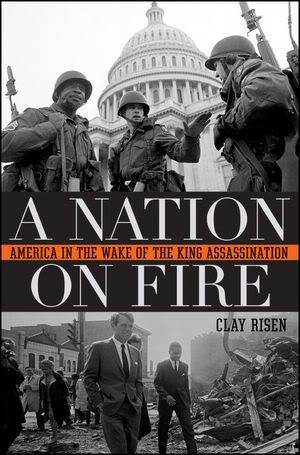
Clay Risen, author of A Nation On Fire: America In the Wake of the King Assassination (John Wiley & Sons) argues that what transpired immediately after April 4th impacted America as intensely as King’s death itself. Within hours, there was rioting in Washington D.C. and before the violence subsided, the U.S. Army occupied three major American cities while National Guard units patrolled a dozen more. Overall, there were disturbances in nearly 120 cities. Ultimately, the riots helped facilitate forty years of conservative hegemony as urban America reaped the whirlwind of white resentment and indifference.

Risen specifically chronicles the period covering President Lyndon Johnson’s withdrawal from the 1968 campaign on March 31st, to King’s assassination on April 4th and culminates with Johnson’s signing of the 1968 Civil Rights Act on April 11th. The author relies on dozens of interviews as well as newly declassified documents to provide a dramatic day-by-day, city-by-city narrative of the riots, from the looting in Washington to violence in Chicago, Baltimore and other cities following King's death in Memphis.


Indeed, Risen skillfully takes the reader on a historical tour with larger than life personalities like the militant Stokely Carmichael to white racist vigilantes in Baltimore and political figures such as New York City Mayor John Lindsey, Chicago Mayor Richard Daley, New York Senator Robert Kennedy and Maryland Governor Spiro Agnew. Perhaps the book’s most dramatic anecdote was when a young Deputy Attorney General named Warren Christopher, joined General Ralph Haines, and Public Safety Commissioner Patrick Murphy at a Washington DC gas station pay-phone to recommend to President Johnson that he deploy federal troops in the nation’s capitol.

George Pelecanos, author of The Turnaround and The Night Gardner issued the following praise for Risen’s book:
“Clay Risen’s A Nation on Fire is the long-awaited definitive account of one of the most important, underreported events of the 1960s. As important for its historical aspect as it is for understanding where we are today, it is an exciting, important document, excitingly told.”
Risen, was formerly an editor at The New Republic and is the founding Managing Editor of Democracy: A Journal of Ideas. He has also contributed to Smithsonian, Slate, the Atlantic, and the New York Times Sunday Magazine. Risen agreed to a telephone interview with me in a podcast format about his book as well as the fateful days following King’s death. Our conversation was just over forty-seven minutes. Please refer to the flash media player below.


Either searching for the Intrepid Liberal Journal or Robert Ellman can also access this interview at no cost via the Itunes Store.

Labels: , , ,

 
by Valtin | 4/04/2008 12:01:00 PM
On this 40th anniversary of the assassination of Martin Luther King, Jr., there's been a lot of speechifying and article-writing. But I have seen precious little that recounts the campaign of the United States government to discredit and vilify Dr. King. The activities of the FBI's Cointelpro program were documented by the United States Senate in its Church Committee Report. The "likelihood" that King was shot by James Earl Ray "as a result of a conspiracy" was the conclusion of the House Select Committee on Assassinations in 1975. Unlike the JFK case, the HSCA documents on the MLK assassination remain classified to this day.

Yet we will hear nothing about these facts in today's mainstream news. It's unlikely that much will even be said at the liberal blogs. Yet, outside of the work of Dr. King himself, it's the most salient fact about this day of dark remembrance.

I am charging the U.S. government, and most specifically the FBI, with culpability in the assassination of Martin Luther King. What does "culpability" mean?


Culpability generally implies that an act performed is wrong but does not involve any evil intent by the wrongdoer. The connotation of the term is fault rather than malice or a guilty purpose. It has limited significance in Criminal Law except in cases of reckless Homicide in which a person acts negligently or demonstrates a reckless disregard for life, which results in another person's death. In general, however, culpability has milder connotations. It is used to mean reprehensible rather than wantonly or grossly negligent behavior. Culpable conduct may be wrong but it is not necessarily criminal.
I personally believe the guilt of the U.S. government is greater, but I don't have the evidence to prove it. Such a charge of complicity requires much more evidence than the circumstantial but damaging facts I will quote from the Church Committee report below. However, the activities of the FBI in the King case clearly helped create an atmosphere of hatred and distrust around the person of Dr. King. Rather than seeking to protect American leaders from harm, the FBI clearly sought to cripple the life and reputation of the U.S. civil rights leader.

Let's look at the Church Report itself. All bolded material is my emphasis. All footnotes must be referenced in the original document via link:
SUPPLEMENTARY DETAILED STAFF REPORTS
ON INTELLIGENCE ACTIVITIES AND THE
RIGHTS OF AMERICANS

_____

BOOK III
_____

FINAL REPORT

OF THE

SELECT COMMITTEE
TO STUDY GOVERNMENTAL OPERATIONS

WITH RESPECT TO

INTELLIGENCE ACTIVITIES
UNITED STATES SENATE

APRIL 23 (under authority of the order of April 14), 1976

DR. MARTIN LUTHER KING, JR., CASE STUDY

I. INTRODUCTION

From December 1963 until his death in 1968, Martin Luther King, Jr. was the target of an intensive campaign by the Federal Bureau of Investigation to "neutralize" him as an effective civil rights leader. In the words of the man in charge of the FBI's "war" against Dr. King:
No holds were barred. We have used [similar] techniques against Soviet agents. [The same methods were] brought home against any organization against which we were targeted. We did not differentiate. This is a rough, tough business. 1
The FBI collected information about Dr. King's plans and activities through an extensive surveillance program, employing nearly every intelligence-gathering technique at the Bureau's disposal. Wiretaps, which were initially approved by Attorney General Robert F. Kennedy, were maintained on Dr. King's home telephone from October 1963 until mid-1965; the SCLC headquarter's telephones were covered by wiretaps for an even longer period. Phones in the homes and offices of some of Dr. King's close advisers were also wiretapped. The FBI has acknowledged 16 occasions on which microphones were hidden in Dr. King's hotel and motel rooms in an "attempt" to obtain information about the "private activities of King and his advisers" for use to "completely discredit" them. 2

FBI informants in the civil rights movement and reports from field offices kept the Bureau's headquarters informed of developments in the civil rights field. The FBI's presence was so intrusive that one major figure in the civil rights movement testified that his colleagues referred to themselves as members of "the FBI's golden record club." 3

The FBI's formal program to discredit Dr. King with Government officials began with the distribution of a "monograph" which the FBI realized could "be regarded as a personal attack on Martin Luther King," 4 and which was subsequently described by a Justice Department official as "a personal diatribe ... a personal attack without evidentiary support."5

Congressional leaders were warned "off the record" about alleged dangers posed by Reverend King....

The FBI's program to destroy Dr. King as the leader of the civil rights movement entailed attempts to discredit him with churches, universities, and the press. Steps were taken to attempt to convince the National Council of Churches, the Baptist World Alliance, and leading Protestant ministers to halt financial support of the Southern Christian Leadership Conference (SCLC), and to persuade them that "Negro leaders should completely isolate King and remove him from the role he is now occupying in civil rights activities." 6 When the FBI learned that Dr. King intended to visit the Pope, an agent was dispatched to persuade Francis Cardinal Spellman to warn the Pope about "the likely embarrassment that may result to the Pope should he grant King an audience." 7 The FBI sought to influence universities to withhold honorary degrees from Dr. King. Attempts were made to prevent the publication of articles favorable to Dr. King and to find "friendly" news sources that would print unfavorable articles. The FBI offered to play for reporters tape recordings allegedly made from microphone surveillance of Dr. King's hotel rooms.

The FBI mailed Dr. King a tape recording made from its microphone coverage. According to the Chief of the FBI's Domestic Intelligence Division, the tape was intended to precipitate a separation between Dr. King and his wife in the belief that the separation would reduce Dr. King's stature. 7a The tape recording was accompanied by a note which Dr. King and his advisers interpreted as a threat to release the tape recording unless Dr. King committed suicide. The FBI also made preparations to promote someone "to assume the role of leadership of the Negro people when King has been completely discredited." 8

The campaign against Dr. King included attempts to destroy the Southern Christian Leadership Conference by cutting off its sources of funds. The FBI considered, and on some occasions executed, plans to cut off the support of some of the SCLC's major contributors, including religious organizations, a labor union, and donors of grants such as the Ford Foundation. One FBI field office recommended that the FBI send letters to the SCLC's donors over Dr. King's forged signature warning them that the SCLC was under investigation by the Internal Revenue Service. The IRS files on Dr. King and the SCLC were carefully scrutinized for financial irregularities. For over a year, the FBI unsuccessfully attempted to establish that Dr. King had a secret foreign bank account in which he was sequestering funds.

The FBI campaign to discredit and destroy Dr. King was marked by extreme personal vindictiveness. As early as 1962, Director Hoover penned on an FBI memorandum, "King is no good." 9 At the August 1963 March on Washington, Dr. King told the country of his dream that "all of God's children, black men and white men, Jews and Gentiles, Protestants and Catholics, will be able to join hands and sing in the words of the old Negro spiritual, 'Free at last, free at last. Thank God almighty, I'm free at last."' 10 The FBI's Domestic Intelligence Division described this "demagogic speech" as yet more evidence that Dr. King was "the most dangerous and effective Negro leader in the country".... The depth of Director Hoover's bitterness toward Dr. King, a bitterness which he had effectively communicated to his subordinates in the FBI, was apparent from the FBI's attempts to sully Dr. King's reputation long after his death. Plans were made to "brief" congressional leaders in 1969 to prevent the passage of a "Martin Luther King Day." In 1970, Director Hoover told reporters that Dr. King was the "last one in the world who should ever have received" the Nobel Peace Prize. 13

The extent to which Government officials outside of the FBI must bear responsibility for the FBI's campaign to discredit Dr. King is not clear. Government officials outside of the FBI were not aware of most of the specific FBI actions to discredit Dr. King. Officials in the Justice Department and White House were aware, however, that the FBI was conducting an intelligence investigation, not a criminal investigation, of Dr. King; that the FBI had written authorization from the Attorney General to wiretap Dr. King and the SCLC offices in New York and Washington; and that the FBI reports on Dr. King contained considerable information of a political and personal nature which was "irrelevant and spurious" to the stated reasons for the investigation. 14 Those high executive branch officials were also aware that the FBI was disseminating vicious characterizations of Dr. King within the Government; that the FBI had tape recordings embarrassing to Dr. King which it had offered to play to a White House official and to reporters; and that the FBI had offered to "leak" to reporters highly damaging accusations that some of Dr. King's advisers were communists. Although some of those officials did ask top FBI officials about these charges, they did not inquire further after receiving false denials. In light of what those officials did know about the FBI's conduct toward Dr. King, they were remiss in falling to take appropriate steps to curb the Bureau's behavior. To the extent that their neglect permitted the Bureau's activities to go on unchecked, those officials must share responsibility for what occurred. The FBI now agrees that its efforts to discredit Dr. King were unjustified.
"The FBI now agrees... its efforts to discredit Dr. King were unjustified" -- ya think? In Taylor Branch's well-regarded biography of MLK, we find the following (NYT link & Google cache link):
The systematic character of the F.B.I. vendetta astonishes to this day. After the bureau learned of assassination threats against a number of prominent Americans, each was notified -- except King.
Forty years after Dr. King was assassinated, we must demand that the government declassify its files on the case. This is the proper way to remember the civil rights leader. Re the suppression of the MLK files, I also found this at Wikipedia:
In January 31, 1977, in the cases of Bernard S. Lee v. Clarence M. Kelley, et al. and Southern Christian Leadership Conference v. Clarence M. Kelley, et al. United States District Judge John Lewis Smith, Jr., ordered all known copies of the recorded audiotapes and written transcripts resulting from the FBI's electronic surveillance of King between 1963 and 1968 to be held in the National Archives and sealed from public access until 2027.
I don't care if Obama, or Hillary, or McCain (who voted against a Martin Luther King Day holiday when it was first proposed), or anyone attended any memorial service. It's all pious posturing. Let us seek justice for the murdered leader, and know the full truth about U.S. culpability (or worse) in King's murder.

Labels: , , , , , ,