
by pico | 12/11/2008 12:14:00 AM
How well do you know LGBT history in the United States?

I put together a short 15 question quiz addressing different facts, figures, and facets of this long and diverse history. See how many you know, keep track of your answers along the way, then join me for a discussion in the comments section below.


Here we go! To find out the answers, highlight the black boxes underneath each of the questions. No cheating!

++++

1. The first same-sex couple to apply for a state marriage license, and to fight for that right in court, did so in...

a. California
b. Minnesota
c. Hawai'i
d. Massachusetts


b) That honor belongs to Richard John Baker and James Michael McConnell of Minnesota. Baker v. Nelson was heard in 1971, and the U.S. Supreme Court rejected their appeal "for want of a substantial federal question."

But if you guessed California, you're not far off: in the same year Reverend Elder Troy Perry of the Metropolitan Community Church filed suit in Los Angeles for recognition of same-sex marriages performed in his church.


2. The first riot against police brutality towards the LGBT community took place in...

a. San Francisco
b. New York City
c. New Orleans
d. Los Angeles


a) Though the 1969 riot at the Stonewall Inn captured national attention and helped galvanize the movement, it was the transgender victims in San Francisco's Tenderloin district who launched the first ever LGBT riot against the police, at Compton's Cafeteria in 1966.

As a direct result, the San Francisco Police Department established a liaison to improve its relationship with the queer community.


3. Who was the first openly gay person to be elected to public office in the United States?

a. José Sarria
b. Kathy Kozachenko
c. Harvey Milk
d. Elaine Noble

b) Kathy Kozachenko won her race for Ann Arbor city council in 1971, followed by Elaine Noble in 1975 (Massachusetts legislature) and Harvey Milk in 1977 (San Francisco Board of Supervisors).

José Sarria was the first openly gay political candidate, making a failed bid for public office way back in 1961 (San Francisco Board of Supervisors).


4. What was the "Twinkie defense"?

a. A polemic on the dietary habits of lesbians
b. A pamphlet supporting the role of young gay men in the community
c. The legal strategy for lessening the sentence against murderer Dan White
d. None of the above

c) When Dan White assassinated Harvey Milk and San Fransisco mayor Moscone, the defense lawyers argued that White - a former football player, police offer, and fireman - had recently taken to gorging on junk food. They argued this was evidence that his mental health had deteriorated, convincing jurors to convict him of mere misdemeanor, and sparking the White Night riots of 1979.

Contrary to popular belief, the lawyers did not argue that the junk food itself was responsible.


5. Which President's life was saved by a gay man?

a. Gerald Ford
b. Ronald Reagan
c. Richard Nixon
d. George W. Bush

a) Disabled Marine vet Bill Sipple just happened to be on the scene when Sarah Jane Moore pulled a gun on Gerald Ford in 1975, diving at her to deflect the bullet. In the intense media coverage that followed, Sipple was outed as a gay man. Harvey Milk later said that Sipple's homosexuality was the only reason he'd been sent a Thank You note from Ford rather than an outright invitation to visit the White House.


6. What Supreme Court case invalidated sodomy laws across the country?

a. Bowers v. Hardwick
b. Lawrence v. Texas
c. Loving v. Virginia
d. Griswold v. Connecticut

b) After being arrested in Houston for consensual sex, John Geddes Lawrence took his legal challenge all the way to the Supreme Court, and sodomy laws around the country were finally invalidated.

Griswold was the case defining a right to privacy; Bowers was the first unsuccessful attempt to get the SCOTUS to strike down sodomy laws; and Loving was the case that ended laws against interracial marriage.


7. Who was Bayard Rustin?

a. Gay rights activist and organizer of MLK, Jr.'s 1963 rally in Washington, D.C.
b. Author, poet, and painter famous for discussing the queer side of the Harlem Renaissance
c. Octogenarian activist famous for being out since the beginning of the 20th century
d. First NBA player to come out gay, after retirement

a) Rustin is famous for being a friend of Martin Luther King, Jr. and a fellow Civil Rights activist. Rustin was the principle organizer of the march that culminated in King's "I have a dream" speech.

But all of the choices were real figures in queer African American history. b) is Richard Bruce Nugent, author of "Smoke, Lilies, and Jade"; c) is lesbian activist Mabel Hampton, who lived out and proud for over 80 years, and d) is John Ameichi, formerly of the Orlando Magic and Utah Jazz, who came out in 2007.


8. The first transgender mayor in the United States was elected in...

a. 1978
b. 1996
c. 2004
d. 2008

d) Just last month, the state of Oregon saw the election of the country's first transgender mayor, Stu Rasmussen. Rasmussen had already served as mayor of Silverton, OR back in the 90s, but came out as transgender before the 2008 election.


9. The first Academy Award given to someone for playing an openly queer character went to...

a. Peter Finch
b. William Hurt
c. John Lithgow
d. Tom Hanks

b) And the Oscar goes to... William Hurt, for 1985's Kiss of the Spider Woman. Finch had been nominated in 1971 for Sunday, Bloody Sunday, as was Lithgow in 1982 for The World According to Garp. Hanks' Philadelphia win came in 1993.


10. By what name is the proposed "Local Law Enforcement Hate Crimes Prevention Act" more commonly known?

a. the Frank-Baldwin Act
b. the Harvey Milk Act
c. the Matthew Shepard Act
d. ENDA

c) Democrats in Congress have been trying to expand existing Hate Crimes legislation to the unprotected categories of sex and gender since 1999, when national outrage at the Matthew Shepard murder. It passed both the House and Senate this year as part of a Defense Appropriations bill, but pressure from the President, Congressional Republicans and unsympathetic Democrats led to its being dropped from the final bill.


11. How many openly gay politicians elected to federal office are currently serving?

a. None
b. 3
c. 5
d. 7

b) With the recent election of Jared Polis as freshman Representative from Colorado, the tally now stands at a whopping three: Polis, Barney Frank (D-MA), and Tammy Baldwin (D-WI). They were preceded by Gerry Studds (D-MA), who served until 2003 and passed away in '06.

There are not and never have been any openly gay Senators.


12. What activist group got its start in 1987 with an act of civil disobedience at Wall Street that led to 17 arrests?

a. GLAAD
b. OutRage!
c. the Gay Liberation Front
d. ACT UP

d) ACT UP, the AIDS Coalition to Unleash Power, was formed to call attention to the conspiracy of silence and stigma surrounding what Jerry Falwell called "the gay plague". They received their greatest notoriety for a mass protest targeting St. Patrick's Cathedral in 1989, due to the Catholic diocese's opposition to AIDS education.


13. Which U.S. president received a visit from We'wha, a Zuni two-spirit widely mistaken for "an Indian princess"?

a. Grover Cleveland
b. William Taft
c. Harry Truman
d. Ronald Reagan

a) Grover Cleveland. A member of the Zuni tribe of present-day New Mexico, We'wha was a sensation in the capitol in the late 19th century. Photographs taken of We'wha give us rare insight into a nearly forgotten history of indigenous attitudes toward gender fluidity.


14. How many countries have legalized same-sex marriage (not civil unions, but the full deal)?

a. 2
b. 4
c. 6
d. 8

c) In order of legalization: the Netherlands, Belgium, Spain, Canada, South Africa, and Norway.

Due to a recent high court decision, Nepal will be introducing same-sex marriage rights in the near future.


15. Gay performers (often in drag), who attracted a spike in popularity in New York of the 1920s and 30s, were known as...

a. pansies
b. travesties
c. illusionists
d. wildeans

a) From Broadway to Harlem, the popularity of pansy performers in the late 20s and early 30s led to a veritable "Pansy Craze" in New York city.

A turn towards increasingly conservative views of public mores effectively shut these down, but by the 40s the term "pansy" had gained widespread currency as a euphemism for queerness.


Difficult, wasn't it?

My intention in writing this quiz wasn't to dig up the most obscure facts possible, but to show the relatively sparseness of widespread information about LGBT history.

Knowing the exact office of the first openly gay elected official may or may not strike us as vital, but it's important to know that gender fluidity was an accepted part of some Indigenous traditions as far back as recorded evidence goes, or that gay black activists were an integral part of the Civil Rights movement, or that queers have been involved and subsequently erased from some of the most major events of our shared American history.

One of the challenges we face is the lack of an inherited history. Many groups pass shared history on from generation to generation, parent to child, but queer children typically grow up without parents who share that history - forcing us to reinvent the wheel with each new generation.

I hope that this quiz encourages us all to research more about some of the people and events I discuss here. Putting it together was an eye-opener for me, as well.

Labels: , ,

 
by pico | 12/18/2007 06:47:00 PM
Greetings, literature-loving historians! Last time we discussed gay Harlem Renaissance author Richard Bruce Nugent, who tapped into the experimental cadences of black modernist literature to spin fantasies on queer life long before it became acceptable to do so. This week we're going to talk about another American experimental writer, albeit one who achieved enormous popularity both at home and abroad.
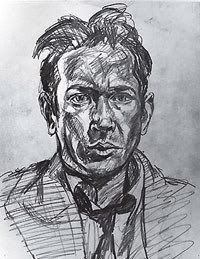
With torture and extraordinary rendition so much in the news, it may come as something as a surprise that today's subject experienced the agony of unjust political imprisonment first hand. But in 1917, this recent Harvard graduate and volunteer in a World War I ambulance corps found himself thrown in prison for "espionage" without recourse to any legal defense. Fortunately for history (and for us) the experience did nothing to crush his puckish personality, and he went on to become one of America's most warmly loved artists.

Follow me below for a jaunt with this 20th century master, and don't forget your capital letters and punctuation:


Poet, novelist, painter, and all-around shit-stirrer Edward Estlin Cummings was born in 1894 in Cambridge, Massachusetts. After graduating magna cum laude from Harvard, he skipped to France with his old college buddy John Dos Passos and quickly fell in love with the vibrant art scene (especially American) in Paris. That artistic growth was cut short - or, if you will, significantly advanced - when he was arrested on suspicion of espionage and interred in the village of La Ferté-Macé. While his father fought for his removal by contacting anyone he could, Cummings himself was discovering the joys of political prisonerhood, an experience he'd memorably capture in his novel The Enormous Room.
Throughout his life Cummings sought experience in the world: he lived in Paris and New York, traveled to the Soviet Union, North Africa, and Mexico, and incorporated the breadth and depth of life into his enormous poetic output. In the meantime he developed an idiosyncratic style of poetry that managed to be disorienting and surprising without putting off readers: as far as avant garde poets go, Cummings is easily the most popular this country has produced (although it's equally fair to argue that his poetry is usually only avant garde on the surface, while the often otherwise conventional poem underneath in some way accounts for his approachability. I'm not sure I agree 100%, but that's a not uncommon view.)

Today I want to talk a bit about what makes Cummings so popular, but also - and especially - to encourage people to pick up his first novel, which has a great deal to say about culture of indefinite and indiscriminate imprisonment and the way it is used to stifle dissent in countries that nonetheless need it. So first, The Enormous Room:

A quick note on the spelling of the author's name: Norman Friedman has made a compelling argument that caps are called for, and the correct presentation is E.E.Cummings. Friedman cites a letter from Cummings to his publisher, specifically rejecting the lowercase, punctuation-less form of his name: "E.E.Cummings, unless your printer prefers E. E. Cummings/ titlepage up to you;but may it not be tricksy svp[.]" Now, does anyone want to place bets on whether over-eager readers skip this to leave me a comment correcting my usage? :)

The Enormous Room

Everyone is here for something.


The Enormous Room (full text!) is Cummings' prose masterpiece, a fast-paced comic brawl with a warm moral heart, a portrait gallery of eccentricity and lunacy and humanity surviving under the shadow of authoritarian cruelty, an exuberant middle finger to authority and a passionate plea for humanity. And it all takes place in a cramped camp where dubiously labeled 'political prisoners' are being held with no chance of legal consul or defense.

In other words, it's the perfect book for our time.

Cummings transformed his experience as a 'political prisoner' into a vibrant testament to the human experience, but not in the way you might expect. Rather than a litany of suffering appealing to the reader's moral sense (although there is plenty of both in the book), the main technique of Cummings' work is humor: the absurdity of the situation cannot be ignored, and might as well be enjoyed. The jovial narrator spins tales of friendships, gambling, defiance, bureaucracy, and freedom, all the while wearing a giant smile. That humor - that inability to be crushed by a cold and fearful political machine - is itself the ultimate statement of his defiance.

The absurdity begins in the first chapter: according to Cummings' version of the events, he did not need to go to prison at all. His acquisition was one part solidarity with his unfairly sentenced friend, and one part puckish defiance: when the interrogator Noyon decided to throw out one last, loathsome question ("Do you hate the Krauts?"), Cummings refused to give the "correct" answer, even in front of a sympathetic military tribunal (referred to by their most exaggerated physical qualities: "the rosette", "the moustache"):

'Est-ce que vous détestez les boches?'
I had won my own case. The question was purely perfunctory. To walk out of the room a free man I had merely to say yes. My examiners were sure of my answer. The rosette was leaning forward and smiling encouragingly. The moustache was making little oui's in the air with his pen. And Noyon had given up all hope of making me out a criminal. I might be rash, but I was innocent; the dupe of a superior and malign intelligence. I would probably be admonished to choose my friends more carefully next time, and that would be all....
Deliberately, I framed the answer:
'Non. J'aime beaucoup les français.'
Agile as a weasel, Monsieur le Ministre was on top of me: 'It is impossible to love Frenchmen and not to hate Germans.' (15)


The Enormous Room is less a narrative than a portrait gallery, and this contributes a great deal to the book's warm humanism. After all, before gaining notoriety as a poet, Cummings worked as a painter - his sense of portraiture is exact and revealing. Each inmate of La Ferté is sketched from a lovingly comic angle, as if the artist Cummings can hardly conceal his joy at being imprisoned with such delightful company. Take for example Jean le Nègre:

[Jean's] mind was like a child's. His use of language was sometimes exalted fibbing, sometimes the purely picturesque. He courted above all the sounds of words, more or less disdaining their meaning. He told us immediately (in pidgin-French) that he was born without a mother because his mother died when he was born, that his father was (first) sixteen (then) sixty years old, that his father gagnait cinq cent francs par jour (later, par année), that he was born in London but not in England, that he was in the French army and had never been in any army.
He did not, however, contradict himself in one statement: 'Les français sont de cochons' - to which we heartily agreed, and which won him the approval of the Hollanders. (206)


Cummings and his friends rename everyone in the room, and soon the reader becomes acquainted with the strangest collection of "criminals" imaginable: the Machine-Fixer, the Silent Man, Emile the Bum, the Schoolmaster, Bathhouse John, the little man in the Orange cap, the Holland Skipper, Garibaldi, and my personal favorite: So-and-so, being a Turk.

The exaggerated nicknames initially feel like caricatures, but Cummings' instincts are right on: by the book's end, you'll remember nearly every character and a bit of their back stories. The nomenclature shorthand makes everyone 'stick' in a way that dry lists of names would not.

Four of the prisoners receive their own chapters: the Delectable Mountains. As a framing device, Cummings loosely outlines his book according to John Bunyan's Pilgrim's Paradise, in which the Delectable Mountains were four peaks so high that one could see the Heavenly Kingdom. In The Enormous Room, the Delectable Mountains are four prisoners so pure of heart that their inclusion among the already eclectic band of misfits at La Ferté was the greatest crime of all: the Wanderer, Zulu (sometimes Zoo-loo) Surplice, and Jean le Nègre. Any system, Cummings argues, that is capable of putting men like these behind bars as "dangerous criminals" is a system rotten to the core; Cummings expresses great admiration for his fellow prisoners to endure (especially the women, who have it even worse).

In the nickname game, the French guards fare much worse: Cummings labels the head of La Ferté "Apollyon", a nickname he certainly deserves for his casually brutal treatment of the prisoners. However, Apollyon is just one of many toadies in the machine that crushes the rights and freedoms of other human beings under the guise of necessity during wartime:

Who was eligible for La Ferté? Anyone whom the police could find in the lovely country of France (a) who was not guilty of treason, (b) who could not prove that he was not guilty of treason. By treason I refer to any little annoying habits of independent thought or action which en temps de guerre are put in a hole and covered over, with the somewhat naive idea that from their cadavers violets will grow whereof the perfume will delight all good men and true and make such worthy citizens forget their sorrows. (88)


Despite the book's strong critical success (including such advocates as T.E. Lawrence and F. Scott Fitzgerald), The Enormous Room has faded in popularity. I have no idea why: I've read it half a dozen times and never failed to enjoy every single page. It's a miracle of language, humor, and heart, and one of the best American books of the first half of the 20th century.

It may be that Cummings the poet was simply so overwhelming that he overshadowed everything else:

The Poetry

E.E. Cummings was not only one of America's most successful poets, but also one of best-loved avant garde poets in any language. The reasons are relatively easy to discern: Cummings' experimentation can be radical but never inaccessible, and it never fails to be entertaining. This is largely because Cummings' experimentation is usually visual rather than poetical: as a painter he understood the power of visual presentation, leading to his often jarring arrangement of words and punctuation.

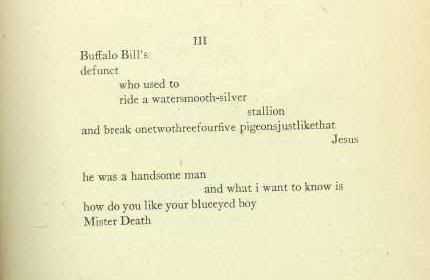
Among the most famous and earliest was "Buffalo Bill's / defunct" (see image). Note that contrary to popular belief Cummings uses both capitalization and punctuation: the important thing is how he uses it and when he chooses not to.


Cummings was not the first to recognize the importance of visual presentation in literature, but his experiments are among the best known, from the extended sex-as-driving metaphor of "she being Brand" to the initially unreadable "r-p-o-p-h-e-s-s-a-g-r" (it makes sense after you work with it a while). The disorientation caused by radically unexpected alignments also allows Cummings to slip in some sneaky bits of information for the careful reader, as in the popular "in Just- / spring" (Chansons Innocents), which creates a dizzying joyful portrait of children playing "when the world is puddle-wonderful", but subtly undercuts it in its epithets for the Balloonman. If you catch the references, the last line suddenly feels sinister.

Cummings' concerns expressed in The Enormous Room also figure prominently in his poetry, which mocks superficial moralism and facile patriotism, especially when they are used to crush people underfoot:

why talk of beauty what could be more beaut-
iful than those heroic happy dead
who rushed like lions to the roaring slaughter

(link)


Again and again, in poems like "i sing of Olaf glad and big", "the Cambridge ladies who live in furnished souls", and "pity this busy monster,manunkind" Cummings shows little tolerance for the idiocies that lead to oppression, war, and hopelessness. "Humanity" he writes, "i hate you".

All this would make him a curmudgeonly old misanthrope, except that the single most common topic in his poetry is the reverse: love. Cummings is first and foremost a poet of love, whether of a significant other, of family, or of this stupid race of idiots we're so wonderfully trapped with:

love is a deeper season
than reason;
my dear one
(in april's where we're)

(link)


In fact a great deal of his poetry concerns the disorientation of being in love, with the confused syntax and unorthodox spellings allowing the sheer giddiness of love to burst through the prisons of language and grammar. Cummings was sensitive to the relationship between form and theme, and his twisting explorations of grammar and punctuation and alignment are often tied indelibly to the topic at hand.

Along these lines, my personal favorite of all Cummings' poems is "anyone lived in a pretty how town", a brief storybook-like lyric about a lifelong love that's nonetheless heavy with nostalgia and loss. Check out these opening lines:

anyone lived in a pretty how town
(with up so floating many bells down)


This is radical even for Cummings: the second line involves a complete dissociation of grammar from meaning. But it's one of the most beautiful lines Cummings ever wrote, and powerfully sad when it returns unexpectedly later in the poem.

Though I earlier described Cummings as a visual poet, poems like these demand to be read out loud. His singsong, nursery rhyme cadences deepen the portrait of childhood, memory, forgetting, and the inevitable cycles of life. And this very life-ness of life at the center of his artistic work is the reason that Cummings can tackle so many of the concerns that keep the rest of us awake at night, but do so with humor, heart, and humanity.

Further Reading:


Excerpts taken from The Enormous Room as published by Penguin Classics. Image of Cummings taken from Wikimedia commons (source)

Thank you for reading.

Labels:

 
by pico | 12/04/2007 07:27:00 PM
Greetings, literature-loving historians! I haven't posted in a while, and I apologize for that: a mix of real-life duties and sporadic internet activity. At any rate, I'm happy to be back, especially with this topic: a rebel author from an unusually rich period of American creative history. Let's go back to the first decades of the 20th century, to where a cultural revolution is fomenting...

After World War I, black soldiers returning from the front were disgusted by the treatment they received from countrymen they'd fought and died defending. At the same time, black intellectuals like W.E.B DuBois and Alain Locke began to envision a cultural project that would elevate the African American experience in the eyes of its otherwise cultural oppressors, while political activists like Marcus Garvey brought pan-Africanism to the streets of New York. Throw in a sudden burst of artistic imagination and some seriously talented writers, and you've got all the ingredients for the Harlem Renaissance.

Today we're going to talk about one of its most fascinating personalities.


First some background.

DuBois, the first African American to receive a Ph.D. from Harvard, felt that the biggest stumbling block to achieving civil rights (apart from white racism, naturally) was the lack of a stable, intellectual middle class among the black population. He believed in a concerted project to tap into the potential of the best and brightest, dubbing them "the Talented Tenth", who could capture the essence of the black experience in a way that even white America could understand and empathize with.

Education and work are the levers to uplift a people. Work alone will not do it unless inspired by the right ideals and guided by intelligence. Education must not simply teach work — it must teach Life. The Talented Tenth of the Negro race must be made leaders of thought and missionaries of culture among their people.


DuBois' project was successful, but not in the way he'd hoped: the stunningly talented crop of writers, poets, and artists who gathered in Harlem a generation later were iconoclasts with little interest in middle class respectability. DuBois had hoped for novels and opera, businessmen and professors: meanwhile they embraced sexual fluidity and Marxism, wrote about prostitution and gambling, loved jazz and cabaret.

And it wasn't just the artists: Harlem itself became a hotbed of 'vice' that welcomed performers, pleasure-seekers, and queers into its turbulent fold. The latter especially. Despite the stereotypes about black culture and alternative sexuality, there was never a pre-civil rights community in this country more actively queer than Harlem in the 1920s and 30s:

Drag balls offered the most public form of gay and lesbian spectacle; the 1929 Hamilton Lodge Ball drew three thousand spectators to watch two thousand “fairies” strut their stuff. By this point, everyone in Harlem knew the Hamilton Lodge Ball simply as the “Faggots Ball.” According to one observer, the ball brought together “effeminate men, sissies, ’wolves,’ ’ferries’ [sic],’faggots,’ the third sex, ’ladies of the night,’ and male prostitutes...for a grand jamboree of dancing, love making, display, rivalry, drinking and advertisement.”

In short, Harlem in the twenties was a kind of queer amusement park, both for its inhabitants and for white bohemians from downtown.


Gender and sexual 'deviance' was still mocked and ridiculed in many circles, but it was also tolerated - especially since the more damning and pervasive sin of racism overshadowed concerns like who was sleeping with whom. Despite the minor outrage surrounding the publication of Fire!! (see below), more writers began to write about their own sexuality or incorporate themes of queerness into their texts. DuBois was deeply disappointed.

Though he wasn't the only gay writer of the Renaissance, one writer in particular attracted the lion's share of negative attention...

I've been asked how I was able to write so openly about homosexuality in 1926. . . . People did what they wanted to do with whom they wanted to do it. You didn't get on the rooftops and shout, 'I fucked my wife last night.' So why would you get on the roof and say, 'I loved prick.' You didn't. You just did what you wanted to do.


Richard Bruce Nugent was the most colorful, eccentric, flamboyant member of the Harlem Renaissance. He also outlived most of them, dying in the late 1980s.

Painter, poet, prosaist, and essayist, Nugent burst into Harlem after a childhood spent in Washington, DC. Content with living the Bohemian artist lifestyle, he was typically shiftless and rarely comfortably moneyed. He struck easy friendships with the stars of the Renaissance, and in the mid 20s began developing ideas for a literary journal with fellow author (and sexually ambiguous) Langston Hughes.

Nugent and Hughes mingled with Zoara Neale Hurston and Wallace Thurman in a salon they affectionately dubbed "Niggerati Manor". Thurman would eventually satirize them all mercilessly for what he considered their affectations - his thinly fictionalized novel Infants of the Spring depicts Nugent ("Paul") as the queeniest of queens, not far removed from Nugent's real-life reputation:

"Have you ever been seduced?" Paul asked. "Don't blush. You just looked so pure and undefiled that I had to ask that."
Stephen looked inquiringly at Raymond.
"Don't mind Paul. He's harmless."
"I like your drawings," Stephen said.
"You should," Paul replied. "Everybody should. They're works of genius."
"You're as disgusting as ever, Paul."
"I know it, Sam, but therein lies my charm. By the way, how did you ever get to know such a gorgeous man as this. . . . You know, Steve," he added abruptly, "you should take that part out of your hair and have it windblown. The hair, not the part. Plastering it down like that destroys the golden glint."


In fact Thurman's barbs are aimed less at Nugent (and others, and himself) than at issues surrounding the Renaissance - the value of art, the politics of change, popularity with the white community, etc.

Because of his longevity, Nugent also became an important historian of the Renaissance, outliving Thurman and Hughes, Hurston and Locke and DuBois and all the rest. He even married in 1952 - to a woman - though he assured her that he was homosexual. They were together 17 years until her death in 1969.

Despite his long life, Nugent was not a prolific artist. Of his scant production, one piece in particular deserves a close reading both because of its historical importance (it was the first open depiction of gay love in African American literature) and its aesthetic merits:

"Smoke, Lilies and Jade"

None of the Negro intellectuals would have anything to do with Fire. Dr. Du Bois in the Crisis roasted it. The Negro press called it all sorts of bad names, largely because of a green and purple story by Bruce Nugent, in the Oscar Wilde tradition, which we had included.

-- Langston Hughes, from The Big Sea


Nugent's free-form story "Smoke" was the most controversial piece in the already controversial collection Fire!!, which appeared in 1926 with contributions by Wallace Thurman (who also edited), Zora Neale Hurston, Langston Hughes, and a host of others. Fire!! was a slap in the face to the middlebrow expectations of the Harlem Renaissance's first wave, emphasized by the journal's subtitle: "Devoted to Younger Negro Artists". In The Big Sea Hughes goes on to note that the white press ignored it completely.

Copies were, fittingly, burned.

"Smoke" unrolls as a series of disconnected thoughts linked by ellipses. The loose, semi-autobiographical narrative concerns a hopeful young artist (Alex) who moves to Harlem and finds himself mingling with the Greats, people he'd only ever read about. In the meantime he becomes involved with two lovers: Adrian, a Spanish-speaking man who hits him up for a cigarette light one night and whom Alex nicknames "Beauty"; and Melva, the woman to whom Alex is already attached. In the afterglow of an intense and (for 1926) surprisingly explicit sexual encounter with Beauty, Alex thinks,

he would like Beauty to know Melva...they were both so perfect...such compliments...yes he would like Beauty to know Melva because he loved them both...there...he had thought it...actually dared to think it...but Beauty must never know...Beauty couldn’t understand...indeed Alex couldn’t understand...and it pained him...almost physically...and tired his mind...Beauty...Beauty was in the air...the smoke...Beauty...Melva...Beauty...Melva...Alex slept...and dreamed......


Meanwhile Alex loses himself in a tobacco haze of artists, parties, fiction, and dreams. The narrative fragments begin to loop on themselves like disjointed leitmotifs, mixing people and themes together in a foggy soup of perceptions.

The ending is almost frustratingly ambiguous, but Nugent's diving deep into the hazy uncertainty of love and attraction. When Alex repeats at the end, "one can love" (emphasis his), is he confidently asserting a worldview or trying to ward away his own considerable doubts? I'll leave that for you to decide.

Two important formal qualities help advance the story's concerns. The first is its striking use of color - though commenters usually point to the text's rhythms as somehow emulating jazz (?), Nugent is primarily a visual artist. The text is electric with striking imagery, and he paints with bold primary colors:

.Alex thought of a sketch he would make...a personality sketch of Fania...straight classic features tinted proud purple...sensuous fine lips...gilded for truth...eyes...half opened and lids colored mysterious green...hair black and straight...drawn sternly mocking back from the false puritanical forehead...maybe he would make Edith too...skin a blue...infinite like night...and eyes...slant and gray...very complacent like a cat’s...Mona Lisa lips...red and seductive as...as pomegranate juice...in truth it was fine to be young and hungry and an artist...to blow blue smoke from an ivory holder........


The second major formal concern is binary opposition, if not dialectical by nature. Whether this comes from Nugent's artistic worldview or from the Marxist tenor of late Renaissance thought, I don't know: but it suggests two possible readings of the story, one in which the oppositions frustrate our attempts at happiness, and another in which they can be resolved into some kind of happy synthesis.

Black/White, Prose/Poetry, Male/Female, Gay/Straight, Fictional/Non-Fictional, Dream/Reality... Sometimes the push-pull resolves, as the narrative concerns a bisexual writer expressing himself in poetic prose. Sometimes they don't, as when his fantasies about introducing fictional characters to real people remain only in his dreams, or that Melva and Beauty never meet in the narrative.

Only one binary is not in opposition: Beauty and Sweetness, which are also the terms of endearment between Alex and Adrian.

Alex stretched and opened his eyes...Beauty was looking at him...propped on one elbow...cheek in his palm...Beauty spoke...scratch my head please Dulce...Alex was breathing normally now...propped against the bed head...Beauty’s head in his lap...Beauty spoke...I wonder why I like to look at some things Dulce...things like smoke and cats...and you...Alex’s pulse no longer hammered from...wrist to finger tip...wrist to finger tip...the rose dusk had become blue night...and soon...soon they would go out into the blue........


Most readings I've found of "Smoke" are fairly superficial, and you'd be surprised how many (yes, many) incorrectly note that the male lover is unnamed in the story (*slaps forehead* - yes, it's a difficult text, but you'd hope a scholar would bother reading more carefully). Meanwhile the otherwise useful Harlem Renaissance Reader notes without challenge the perception that "Smoke" marked a decline into decadence. Fortunately the resurgence of interest in Nugent has led to more sophisticated readings of the story and a rediscovery of his other, less frequently anthologized texts:


Other Works

Even stranger and more difficult than "Smoke" (although superficially easier to read) is Nugent's 1937 story (?) "Pope Pius the Only", a surreal trip through history and literature via drug-induced free association. The narrator Algy stumbles through New York City, his brain flitting from Broadway to Mongolia, Pushkin to Crispus Atticus.

He went on down Seventh Avenue. Nineteen thirty five, summer and fall. E.R.A., N.R.A., P.W.A., W.P.A. Almost like Russia for initials. Huey P. Long and General Hugh Johnson, only Long was dead and so was Pushkin. Long live Pushkin.


Beneath the dense allusions and indirect narrative is a desire to situate oneself in the scattered strands of African history: the narrator feels both the stare of white Russia and the searing of slave irons around his wrists. The incoherency helps create a deeper understanding of the totality of the vision, which is neither neat nor easy to separate into threads: Algy feels in himself bits of all black experience, mingling with the aid of marijuana.

During his lifetime, Nugent's other major success was "Sahdji", famous less for his words than for the musical ballet composed around them. "Sahdji", in which Nugent wraps the elliptical poetic-prose style of "Smoke" around African folk culture, premiered in 1931 with music by William Grant Still. The text itself, which concerns a Sati-like act of marriage devotion by a tribal widow, was published a few years earlier:

They laid the body in the funeral hut... Goa shoa motho go sale motho—(when a man dies a man remains)—Sahdji danced slowly... sadly... looked at Mrabo and smiled... slowly triumphantly... and to the wails of the wives... boom-boom of the drums... gave herself again to Konombju... the grass-strewn couch of Konombju....


Nugent's nonfiction piece "On Harlem" is a personal favorite for the way he laces an otherwise deadpan, descriptive essay about life during the Renaissance with a sly, subtle humor. The essay appeared in 1939, after the Renaissance had effectively ended, giving it an extra layer of nostalgia for the passing of a golden era. Nugent's terse descriptions are all the more evocative for their economy, as he runs through racial, social, and sexual politics of the day through theatre, violence, alcohol, economics, and art:

Harlem continued its hectic, money-spending, impossible way, creating colorful character after colorful character. ...[It] continued to eat at Craig’s and to discuss music and art at Eddie’s while giving its pennies to Sewing-Machine Bertha, who could buy and sell most of her benefactors. It continued to produce Chappie Gardiners to hoax a willing world masquerading as Ethiopian princesses when they were in reality houseworkers from the Bronx. Or Catarina Jarbera, who traveled the path of song from the blues to opera. The cabaret and the church continued to be the points between which the Negro was held taut, through which he grew and in which he forgot for the moment his great economic problems.


Equally good, although heartbreaking in its final paragraph, is Nugent's essay on one of Harlem's most celebrated drag queens: "On Gloria Swanson". Gloria Swanson was the stage name of a certain Mr. Winston, a performer so effective that Nugent notes some of his clients never realized that he wasn't born a woman. Again the portrait is affectionate but not without Nugent's subtle humor:

He had the free, loud camaraderie that distinguished the famous Texas Guinan. Gangsters and hoodlums, pimps and gamblers, whores and entertainers showered him with feminine gee-gaws, spoke of him as “her,” and quite enthusiastically relegated him to the female’s function of supplying good times and entertainment. He could also cook.


As a portrait of transvestitism stretching back into the late 1920s, "On Gloria Swanson" is valuable enough as a historical document. But the article is doubly valuable for the relaxed prose of its author, who wrote too little and has disappeared too easily from our usual literary canons.

Fortunately two signs point to a resurgence of interest in Nugent: the first was the issue of Thomas H. Wirth's book-length collection of Nugent's life and work, Gay Rebel of the Harlem Renaissance: Selections from the Work of Richard Bruce Nugent (available from Duke University Press).

The second was the 2004 indie film Brother to Brother, which uses a fictional meeting between a contemporary young gay black man and the elderly Nugent as a way of exploring racial and sexual identity across the 20th century. Brother starred Anthony Mackie and opened to generally strong reviews, the Sundance Special Jury Prize, and modest box office (not surprising, given its subject matter). If you're interested in Nugent but hesitant to add more reading to your already growing list, the film is a good place to start.

Links:

  • the outstanding Richard Bruce Nugent website, which includes complete texts, paintings, and photographs;

  • Fire!! - Fire Press' reissue of the Harlem Renaissance classic;

  • PBS has a host of links related to Brother to Brother, including a section on the history and real-life figures covered in the film;

  • Bio and info about Nugent at the African American Registry;

  • online article: "Biblical gender bending in Harlem: the queer performance of Nugent's 'Salome.' - poet and artist Richard Bruce Nugent"


All images in the text from Wikimedia Commons, linked back to their original sources. Cross-posted at DocuDharma.

This series will continue to be a little sporadic, for reasons I can't avoid. In the meantime, I hope you've enjoyed getting to know this author as much as I have.

Thank you for reading.


Labels:

 
by pico | 11/06/2007 07:37:00 PM

Greetings, literature-loving Historians! I apologize for my hiatus from the series, but the demands of real life took me away from the computer longer than I expected. And what better way to celebrate a re-start than by picking up with a writer whose work is so recent, the ink is practically still drying on the page...

How do we form our identities? Do we rely on our parents, our neighborhoods, or our religion? What happens when those sources are compounded by immigration, or by mixed families, or by social circumstances that don't align in ways that suggest convenient ways of defining ourselves?

At least one author is diving headlong into this mess... And she's doing it with style. Join me below for a conversation with one of England's most talked-about young authors.


Zadie Smith, who just turned 31 this past week, is likely to be the youngest person I profile in this series. She was 25 when her first novel hit the shelves, and in less than a decade she has amassed an impressive collection of awards for her her three novels, short stories, and stream of essays.

Smith is a London native: her father was working class Brit and her mother a Jamaican immigrant - this is a familial pattern we'll see in her work below. Her literature is especially concerned with the implications of multiculturalism in modern culture, and the identity issues that face the younger generation who have to negotiate a much more complex set of values than their parents.

On the publication of White Teeth, a novel so highly anticipated that it led to a bidding war between publishing companies, the critic James Wood used it as a prime example of what he termed "hysterical realism", or the type of novel that is immensely cerebral without providing any insight about human beings as such (in his mind). Other examples included DeLillo, Pynchon, and Foster Wallace. Smith's full response appeared in the Guardian, and I highly, highly recommend it (especially for those of you participating in NaNoWriMo). In this brief essay, she discusses the fiction of the last quarter century, the ability to write in a post 9/11 world, and the nature of the novel as artifice:

It's all laughter in the dark - the title of a Nabokov novel and still the best term for the kind of writing I aspire to: not a division of head and heart, but the useful employment of both.


Let's discuss two of her novels:

White Teeth

If religion is the opium of the people, tradition is an even more sinister analgesic, simply because it rarely appears sinister. If religion is a tight band, a throbbing vein and needle, tradition is a far homelier concoction: poppy seeds ground into tea; a sweet cocoa drink laced with cocaine; the kind of thing your grandmother might have made. (193)


Smith's first novel debuted in 2000, appropriately channeling the fears of a new century which had not yet dealt with the mistakes of the previous one. With an intricate plot that moves from back and forth from 1857 to 2000 (and many points in between), Smith tackles the lovely confusion of modern London, a boiling stew of race, class, gender, sexuality, and age that threatens to boil over at any point.

For the older generation, the barriers of interaction are too great and too tied to weight of history. Smith's immigrants find themselves lost in behavioral loops, clinging to aspects of culture that they may not even sincerely believe - but the experience of refashioning an existence in a foreign country has trapped them in these cultural repetitions:

There's no proper term for it - original sin seems too harsh; maybe original trauma would be better. (161)


The younger generation has a shot at escaping this, but they're faced with their own unique challenge: what does it mean to be young and multi-ethnic in the modern world? From what stray pieces do modern youth forge their identities? The older generations have created a heritage of tradition, religion, and ideology that the younger generation no longer finds appropriate for their context, and in the confusion they cling to cultural detritus to create a new identity. Writing about one group of teenagers of (at least partial) mid-Asian decent, Smith writes:

[They] spoke a strange mix of Jamaican patios, Bengali, Gujarati and English. Their ethos, their manifesto, was equally a hybrid thing: Allah featured, but more as a collective big brother than a supreme being, a hard-as-fuck geezer who would fight in their corner if necessary; Kung Fu and the works of Bruce Lee were also central to the philosophy; added to this was a smattering of Black Power (as embodied by the album Fear of a Black Planet, Public Enemy); but mainly their mission was to put the Invincible back in Indian, the Bad-aaass back in Bengali, the P-Funk back in Pakistani. (231-2)


The winding plot concerns three families:

1. The Joneses, an interracial family with a white father, a Jamaican (mixed white and black) mother, and their awkward daughter Irie.
2. The Iqbals, a Benglali family whose two sons are being sucked into opposite poles of middle-class respectability and Muslim fundamentalism (though as always, this isn't so clear-cut as it seems)
3. The Chalfens, a Jewish family that prides itself on being hip, socially progressive, and smarter than the average familial unit.

In the third we have one of the strongest threads in Smith's work: the skewering of pseudo-progressive values that manifest themselves in petty hypocrisies and half-baked ideologies - this thread will reach its most direct form in her third novel, On Beauty.

In the meantime, the parents of the three families interact, the children discover their sexuality, and the mish-mash of London culture zooms by in hilarious set-pieces. This isn't to say that there isn't considerable racial tension, but that the tension is muted by powerlessness:

'Liberal? Hosh-kosh nonsense!' No one was more liberal than anyone else anywhere anyway. It was only that here, in Willesden, there was just not enough of any one thing to gang up against any other thing and send it running to the cellars while the windows were smashed. (63)


Those thoughts belong to Alsani Iqbar, the Bengali mother who expresses her own petty prejudices in the way she treats her niece (actually calling her "Niece-of-Shame"), who is in a relationship with another woman. But like most characters in the novel, Alsani is not a cold ball of prejudices: beneath the harsh words, she loves her niece deeply and sincerely. Ideology is often blurred by family.

The quote is also a good example of Smith's style: an indirect prose that leaves the reader unsure if the author is merely reporting a character's thoughts or giving us her own (we discussed this as a marker of Carson McCullers' style, too: third-person limited omniscient). Because the novel is so character-oriented, there are no comments we can definitively call "the author's" alone, leaving us on unstable ideological ground. As far as ideology is concerned, the world of Smith's novels is subjective.

If only the world of action were the same. On the history of one character's radicalization after the many beatings he'd received:

The culprits ranged from secondary school children coming in the cornership side to buy sweets... decrepit drunks, teenage thugs, the parents of teenage thugs, general fascists, specific neo-Nazis, the local snooker team, the darts team, the football team and huge posses of mouthy, white skirted secretaries in deadly heels. These various people had various objections to him... But they all had one thing in common, these people. They were all white. And this simple fact had done more to politicize Mo over the years than all the party broadcasts, rallies, and petitions the world could offer. (472-3)


The many different plot threads come together neatly - maybe a bit too neatly - in a climax that is comic, violent, and practically fore-ordained. If it feels a little too schematic, it's no worry: the strength of White Teeth is not plot but character, and the gorgeous complexity of her characters carry the story over its (very minor) rough spots.

On Beauty

The unexamined life is not worth living. That had been Howard's callow teenage dictum. Nobody tells you, at seventeen, that examining it will be half the trouble. (297)


On Beauty is a slower and more difficult novel, but equally as rich and more direct in its complexity. Although London again features in this novel, now the action is moved to Ivy League America, where the politics surrounding a small college's faculty and their families become ugly (and often comically so).

Again the family unit is at the center of the novel. On Beauty is dominated by the Belseys: a white English father, a black mother raised in Florida, and their three very different children. The oldest is sensitive and may be adopting religion (to the horror of his parents), the middle is a precocious young woman with high academic aspirations, and the youngest wishes his street was the street - instead of a predominantly white neighborhood

Trouble arrives with the Kipps family. Paterfamilias Monty Kipps is Howard Belsey's academic rival and an unsettling phenomenon at the west-coast liberal arts college: a very conservative black professor. When Kipps challenges the college's affirmative action policy, the pieties of progressive ideology turn the administration into a pretzel of conflicting beliefs.

Ah, let's go back to that word "beliefs":

'Look, of course I know you and your family have "beliefs",' began Howard uneasily, as if 'beliefs' were a kind of condition, like oral herpes. 'You know...and I completely and utterly respect and tolerate that." (38)


Skewering academics for being out of touch is like shooting fish in a barrel. But Smith succeeds where others often fail, for two reasons: she's accurate in the specifics of her criticisms, and she's sympathetic to her targets even while pillorying them from all fronts.

But education level is a major factor in how we forge our identities, and Smith integrates education into the way the younger generation of On Beauty attempt to create unique identities for themselves. As in White Teeth, the young people of this novel find themselves pulled between the expectations of their parents and the modern world. What does it mean when the strong attractions of identity don't match up along socially expected lines? What does it mean to be a person of color raised in a predominantly white culture? The two youngest Belsey children take opposite tacks in defining themselves:

'No, no, but that don't make no difference. Any black lady who be white enough to live in Redwood thinks 'zackly the same way as any old white lady.'
'Who is white enough,' corrected Zora. 'It's the worst kind of pretention, you know, to fake the way you speak - to steal somebody else's grammar. People less fortunate than you. It's grotesque. You can decline a Latin noun, but apparently you can't even - ' (86)


As in White Teeth, sexuality also plays a major role: not as much sexuality as orientation (although it occasionally figures) as a simple fact of human biology. We are sensual beings, even if our "higher" nature rebels against it. When you place sexuality against the expectations of age and race, the issue becomes even more confused. A middle aged black woman living in white America, Kiki Belsey feels the sting of sexual expectations on multiple levels:

When you are no longer in the sexual universe - when you are supposedly too old, or too big, or simply no longer thought of in that way - apparently a whole new range of male reactions to you come into play. One of them is humour. They find you funny. But then, thought Kiki, they were brought up that way, these white American boys: I'm the Aunt Jemima on the cookie boxes of their childhoods, the pair of thick ankles Tom and Jerry played around. Of course they find me funny. And yet I could cross the river to Boston and barely be left alone for five minutes at a time. (51)


Though the universe of Smith's novels are more comfortably aligned with the expectations of liberal America - diversity is good, all people are worthy of compassion and understanding, truth is often a slippery subjective notion - she saves her most brutal barbs for the hypocrisy of a liberal culture that pays lip service to equality while engaging in petty discrimination: consciously or not.

This is an important lesson for us all. The danger of progressivism - of an ideology that claims moral law as its backbone - is a heightened sense of moral superiority where none is warranted. Smith's novels are like a correcting lens that show the complex interaction of race, generation, sexuality, and ideology as they are, not as we'd like them to be.

The slippery subjectivism of her novels is a constant reminder that human beings are never reducible to types, that we cannot make universal claims that deny the individual, and that we shouldn't be afraid of being wrong.

Citations from both novels are from the Penguin Books editions. Cross-posted at DocuDharma.

Labels: